 All Case Studies











Web Design and Development
Website Design and Development for Brands That Want to Sell
Dcrayon builds every kind of website a business needs to grow: custom marketing sites, lead-generation sites, D2C and e-commerce storefronts, SaaS product apps, listing and real-estate or property portals, booking platforms, B2B sites, web apps and portals, and content and CMS sites. We have been AI-first since 2024, so every build also ships share-of-answer work across ChatGPT, Gemini, Perplexity, and Google AI Overviews alongside the traditional web and e-commerce build. We read the search and analytics signals before we write a line of code, and we check every build decision against the numbers. Founded in 2016, with 485 active clients and 500-plus campaigns across India, the US, the UK, and the UAE, and offices in Delhi and Wyoming.
< 1sInitial response
WCAG AAAccessibility min.
CWV GreenGoogle criteria
Mobile-firstEvery build



Web Design and Development
Website Design and Development for Brands That Want to Sell

Dcrayon builds every kind of website a business needs to grow: custom marketing sites, lead-generation sites, D2C and e-commerce storefronts, SaaS product apps, listing and real-estate or property portals, booking platforms, B2B sites, web apps and portals, and content and CMS sites. We have been AI-first since 2024, so every build also ships share-of-answer work across ChatGPT, Gemini, Perplexity, and Google AI Overviews alongside the traditional web and e-commerce build. We read the search and analytics signals before we write a line of code, and we check every build decision against the numbers. Founded in 2016, with 485 active clients and 500-plus campaigns across India, the US, the UK, and the UAE, and offices in Delhi and Wyoming.
Start your web development project
Tell us where you are and what you want to achieve. We reply within one business day with a clear plan and a quote.

Why Dcrayon
What makes our work different
Design and engineering in one team
The people who design the work and the people who build it sit together, so nothing breaks in the handover.
Built for outcomes
We measure success in orders, leads, and finished tasks, not just how a page looks.
You own everything
Code, design files, and accounts are yours. Nothing is locked to us.
Senior people on your work
Experienced designers and engineers run your project, not juniors learning on it.
Filters
31 articles
Furry Fits
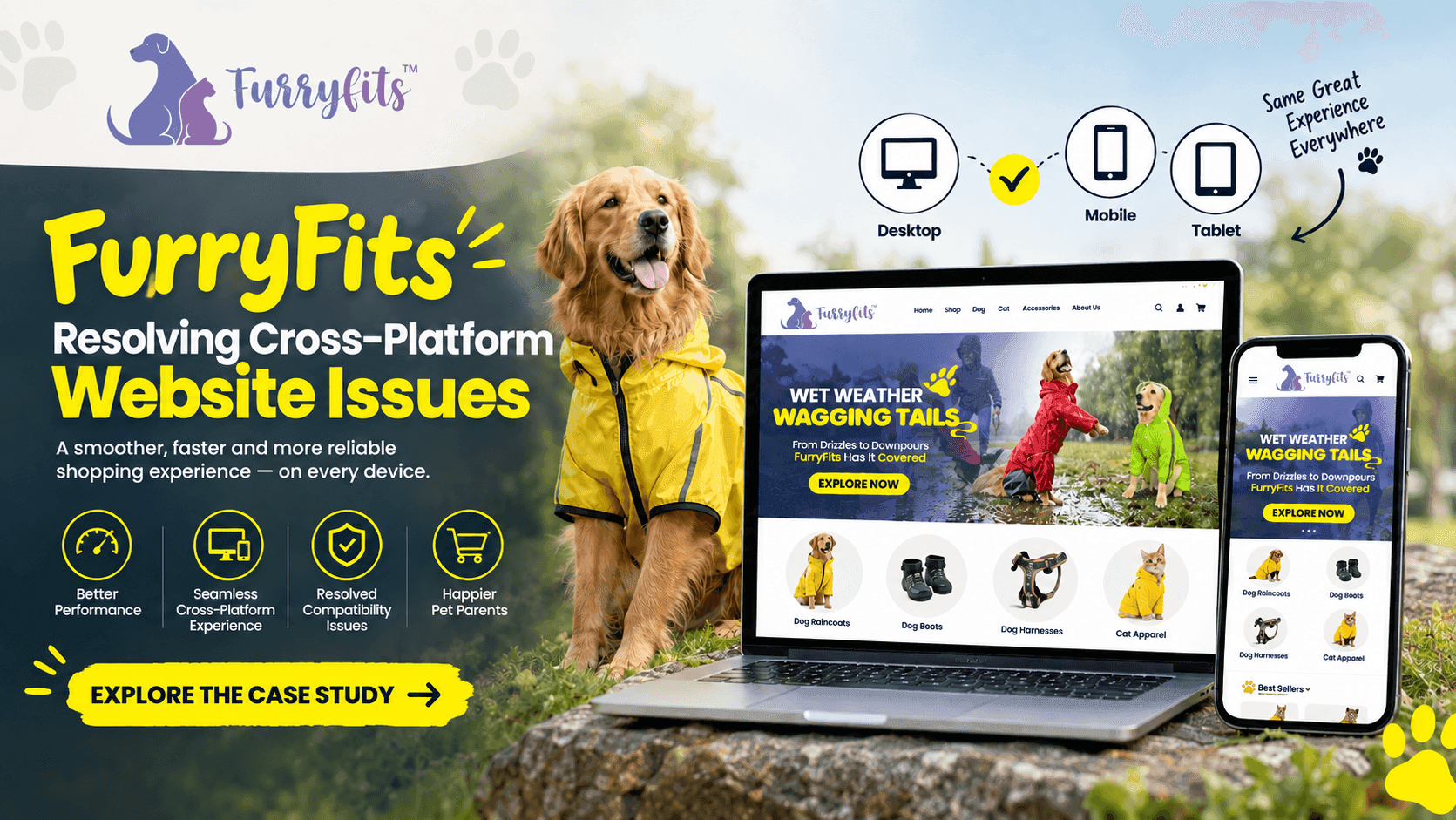
Furry Fits runs a Shopify store for pet clothing, grooming products and pet beds. Shoppers on phones, especially those tapping through from Instagram, could not open it reliably.Dcrayon looks after the store under a website maintenance and social media retainer, and built the theme it runs on, as described in the Furry Fits store build case study. The brand's social media is handled under the same retainer, and its Instagram posts send shoppers to its festive kurtas, raincoats and winter wear. A shopper who sees a product on the brand's Instagram and taps the link does not open Chrome or Safari: the store opens inside Instagram itself. A link that fails there fails at the moment the shopper is most interested.The catalogue behind those links is large for a single brand. On 13 October 2026 the catalogue counted 113 products and 939 variants, because almost every clothing piece comes in a run of sizes, and the home page shows products from six tabbed collection sections. When the store stopped opening properly on both Android and iOS, the first task was to find out what was actually breaking.How the Furry Fits failures showed up on phonesThe store failed on phones, and it failed differently on Android and on iOS.Users could not open the website properly on their phones, and the failure was not consistent. The same page could behave one way on an Android phone and another way on an iPhone. That ruled out a single broken page and pointed to something in how different devices and browsers were handling the store as a whole.Chrome did not reproduce the fault, but Instagram's in-app browser did.Testing the store in Chrome did not reliably trigger the problem. The failures appeared mainly when the store was opened through Instagram's in-app browser. An in-app browser is a stripped-down browser built into an app, so that a link opens without the user leaving the app. It uses the phone's browser engine but is controlled by Instagram, with its own settings and limits, so it does not behave exactly like Safari or Chrome. A check in Chrome alone would have reported the store as working while Instagram shoppers watched it fail.iPhones showed compatibility errors that stopped pages loading.On iOS the store displayed compatibility-related errors, and the page did not finish loading. Browsers on an iPhone in India, including Instagram's in-app browser, run on Apple's WebKit engine. A problem that WebKit handles badly therefore shows up in Safari, in Chrome for iOS and inside Instagram at the same time.The size of the catalogue added to the load on every page.The team found that the sheer number of products added to the work each page asked of the browser. Every product card brings images, prices and script work, and a clothing catalogue with hundreds of size variants adds to the data behind each card. On a phone, and especially inside another app, that load contributed to the rendering and compatibility failures.
Natually
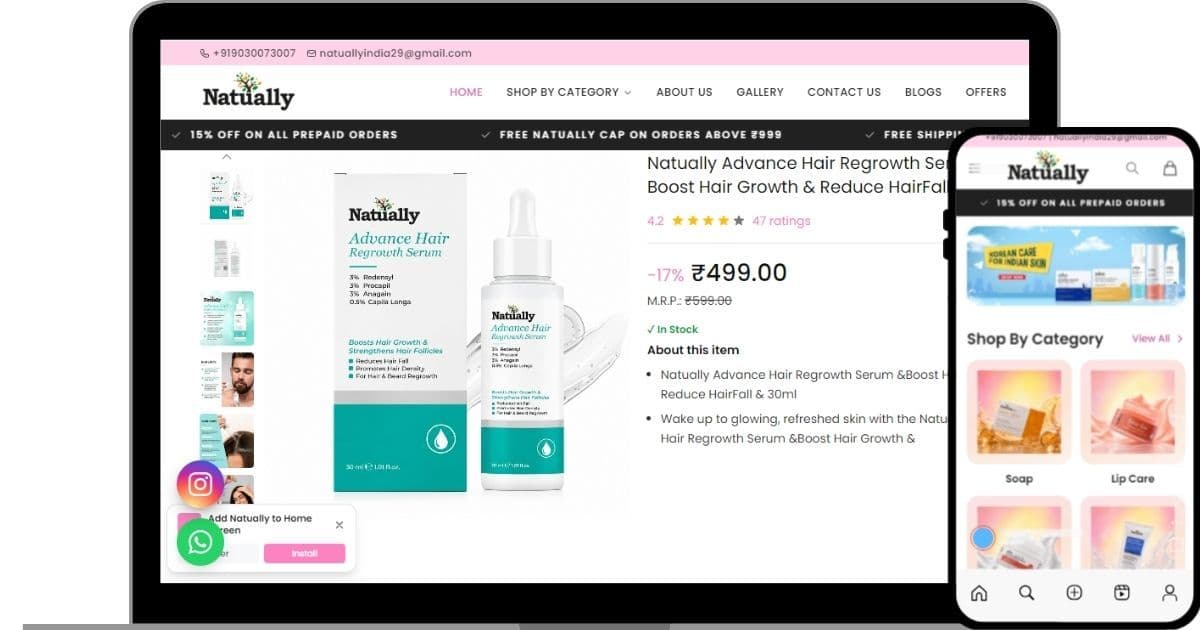
Natually sells natural skincare and haircare products online in India. In 2026 Dcrayon moved its store from Shopify to a Laravel platform that Dcrayon builds and maintains.Natually's range runs from face serums, day and night creams, cleansers and kojic soaps to hair colour, hair removal wax, lip care and facial kits, most of them priced for everyday buying. The store ran on Shopify, and Dcrayon had customised its Shopify theme since 2025 (see Natually's Shopify storefront work). In March 2026 the catalogue was imported into Dcrayon's own e-commerce platform, built on Laravel 12, and by May 2026 the store was running on its own server under the brand's domain.What Natually's store had to keep doing after leaving ShopifyShopping features were spread across separate Shopify apps.The archived storefront from 6 March 2026 loads a third-party one-page checkout and a shoppable-video app, and a capture from February 2025 shows further apps for free gifts, volume discounts and an Instagram feed. Each app brought its own scripts, its own settings screen and its own subscription, and none of them shared rules with the others. On the new platform, offers, cart rules and the connections to payment and shipping providers had to be managed from one codebase.About 170 products and their old links had to survive the move.A platform change can break every product link that search engines, ads and saved bookmarks point to. Natually's old store used Shopify's /products/ and /collections/ addresses, and the domain had been live since at least 2022. Some products had been renamed over the years and some had been discontinued. The new store had to keep each address working, redirect it deliberately, or retire it in a way search engines understand.Checkout had to match how Indian shoppers pay.The store needed UPI, cards, net banking and wallets, a form of cash on delivery, and a way for customers to follow their parcel after dispatch. It also had to keep selling when an outside checkout window failed to load.Offers change often and must show everywhere at once.Natually runs standing offers: a discount on prepaid orders, free shipping, and free gifts above set order values (on 13 October 2026, a free cap above Rs 999 and a free facial kit above Rs 1,699). Shoppers need to see these in the announcement bar, on product pages and in the cart, along with how far they are from the next gift.One codebase serving several brands must keep each brand's details apart.Dcrayon's platform runs more than one brand from the same code. The team's own notes record the risk plainly: a default value written for one brand, such as a phone number, could surface in another brand's footer. Natually needed its own theme, settings, payment keys and data without inheriting anyone else's.
Cartense
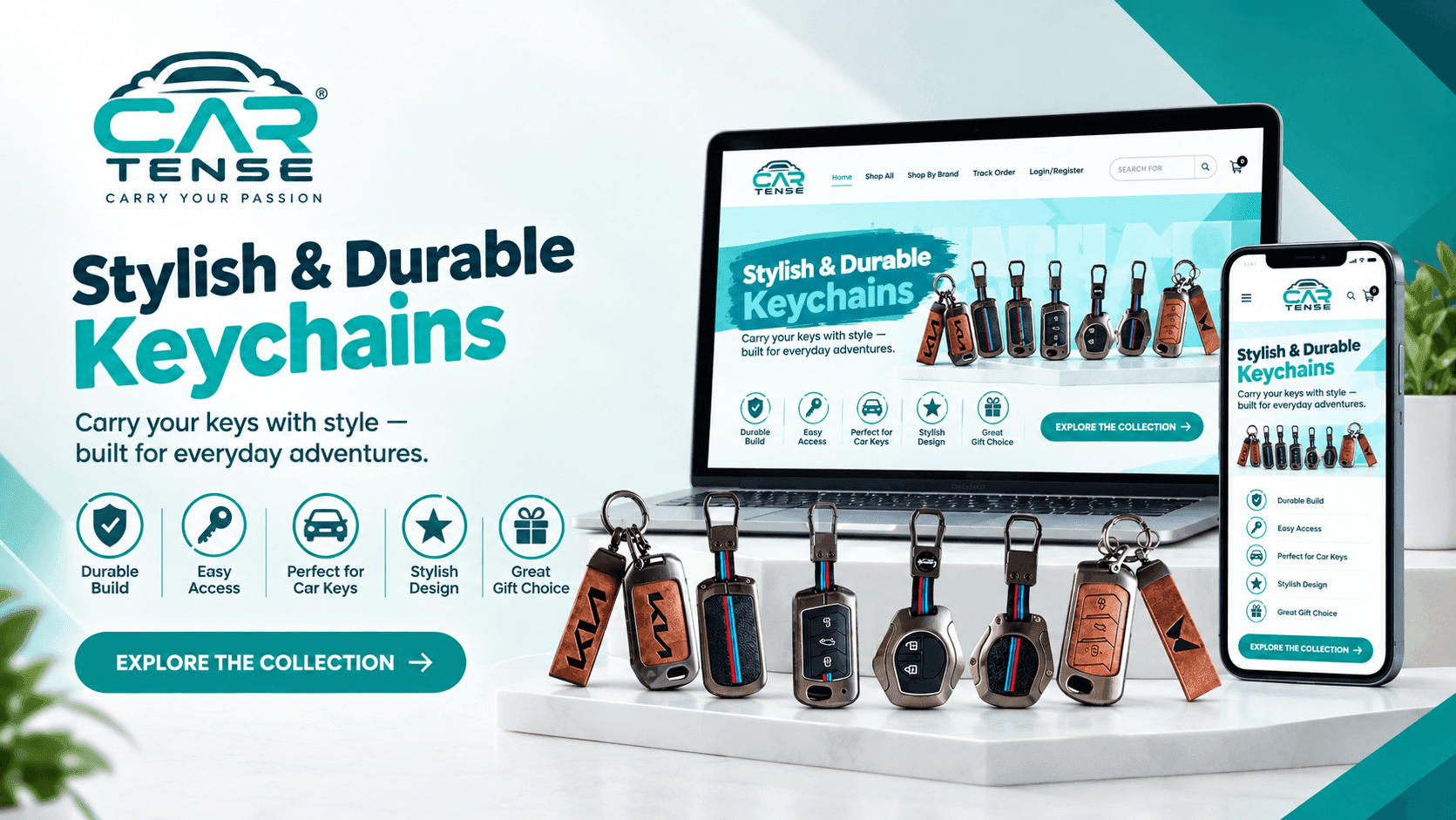
Cartense sells metal, leather and silicone covers for car keys across Indian and imported car brands. Dcrayon reviewed its Shopify store's shopping journey and simplified the path from browsing to checkout.Cartense runs its store on Shopify. On 13 October 2026 its product feed listed 217 products: metal-leather, metal-silicone, leather, TPU and zinc alloy key covers, plus keychains and cleaning cloths, for 18 car brands from Suzuki and Hyundai to BMW and Land Rover. Each cover is made for one key shape, and product titles name it precisely, for example a two-button push-start smart key for a Toyota Fortuner, Hilux or Innova Crysta. A cover that looks right in a photo can still be the wrong size in the hand, so the route from "my car" to "the cover that fits my key" is the journey that decides whether a visit becomes an order.Cartense asked Dcrayon to make the store easier to shop and the purchase easier to complete. The work covered the whole journey: navigation, categories, product pages, calls to action, the add-to-cart and checkout steps, and the phone layout.Where Cartense shoppers were getting stuckShoppers struggled to move between product categories.A Cartense product can be described three ways at once: by car brand, by key type and by material. A store organised along all three needs one obvious place to start and a clear path from there, or shoppers are left unsure where their key belongs. The review found that customers had difficulty moving between categories, and every wrong turn on a fitment catalogue sends the shopper back to the start.Finding the right cover took unnecessary steps.Product discovery needed more taps than the task deserved. For a fit-critical product, each extra step is another chance to give up or, worse, to pick a cover for the wrong key and return it.The route from product page to checkout was longer than expected.There were extra clicks between choosing a cover and paying for it, product information that was hard to take in at a glance, and an add-to-cart step that needed simplifying. When fit, price and offer are scattered across a page, hesitation sets in at the moment of decision.The phone experience needed work.Shoppers who find a key cover through a phone search or a short video arrive on a small screen, and for them the phone layout is the store. The review found the mobile experience needed improvement, from layout to touch interaction.
Prompt Dairy Mart
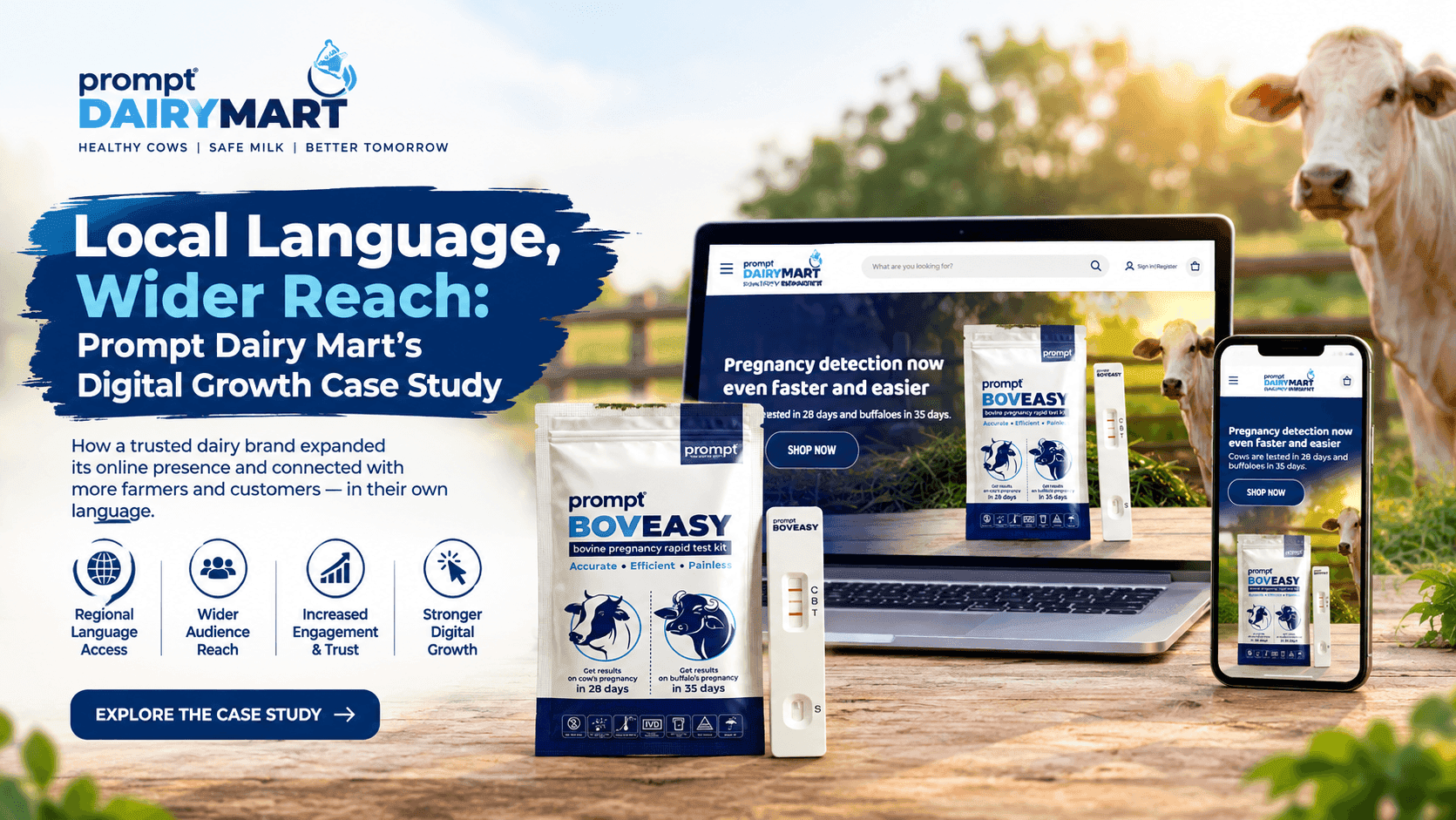
Prompt Dairy Mart sells breeding, testing and milking equipment to dairy farmers across India. Dcrayon set up its online store so that farmers could browse and buy in Hindi.Prompt Dairy Mart is the online store of Prompt, an Ahmedabad dairy-technology company. Its range includes BovEasy rapid pregnancy test kits for cows and buffaloes, the ThawEasy digital semen thawing machine, the BreedEasy digital AI gun used in artificial insemination, and MilkEasy milking machines in trolley and fixed versions. The store's own copy describes its buyers as dairy farmers, artificial insemination technicians and veterinarians, many of them in rural areas, and the project team found that a large share of them prefer to browse in Hindi.Dcrayon's scope covered multilingual website development, the SEO strategy, Hindi content and URL structure planning. The catalogue structure itself, from pack sizes to machine configurations, is described in the companion Prompt Dairy Mart storefront case study.Why an English-only dairy store did not work for Prompt's buyersFarmers were being asked to read about technical equipment in English.The starting point was an English-only website. A milking machine or a pregnancy test kit is a considered purchase, and the buyer needs to understand configurations, usage and care before paying. When that explanation is in a language the buyer does not read easily, the product page does not do its job, and for a first-time online buyer it may be the only explanation they get.Translating the URLs into Hindi would have created a new problem.The obvious way to localise a site is to translate everything, including the URL slug, the part of the address after the domain. A Hindi slug written in Devanagari for "milking machine" looks short on screen, but when it is copied into WhatsApp, an email or an analytics report it often appears in percent-encoded form, a 101-character string that begins %E0%A4%A6%E0%A5%82. Links like that are hard to read, can break when shared, are hard to scan in reports, and are easy to get wrong when the team builds internal links by hand.Hindi search behaviour had to be researched, not assumed.The team could not assume that a Hindi-speaking farmer searches in Hindi script. The words buyers use for each product type had to be checked before the pages were written, or the Hindi content would be readable but hard to find.

Shaadihub
Shaadihub is a wedding marketplace for couples planning weddings in India and abroad. Dcrayon designed and built the platform on Laravel, from vendor listings and quote requests to the planning tools couples use.The project began with a Dcrayon proposal in May 2026 for a marketplace that connects couples with verified wedding vendors, for local weddings and for destinations from Dubai and Bali to Tuscany. The scope covered a public website, a vendor area, a customer dashboard with planning tools, and an admin panel. Online payment collection was left out of the first release on purpose, so the platform had to record bookings, invoices and vendor payouts without a payment gateway attached.Three groups share the platform: couples and their families, who browse, compare and plan; wedding businesses, from banquet halls and photographers to mehndi artists and pandits, who list services and answer enquiries; and the admin team, who approve vendors and decide what goes public. Each needed its own view of the same records.Why a wedding marketplace is harder than a vendor directoryOne enquiry has to live on three screens at once.When a couple asks a Jaipur venue for a quote, the request has to reach the vendor's lead inbox, stay visible in the couple's dashboard and appear in the admin team's enquiry list, with every reply, quote and eventual booking attached. A contact form that sends an email loses that thread the moment someone answers by phone.A banquet hall, a photographer and a pandit cannot share one form.A venue sells halls, lawns and guest capacity. A photographer sells packages with hours and deliverables. A caterer prices per plate, and a pandit offers ceremonies by tradition. One generic vendor form would either hide the details couples compare or bury vendors in fields that make no sense for their trade.Pages for every category and city could flood search engines with empty listings.Couples look for pages such as bridal makeup in Lucknow or destination venues in Bali, so the site needed a landing page for each useful combination of trade and place. Most of those combinations start with no vendors at all, and hundreds of empty pages would tell search engines that the site is thin.Destination weddings bring other currencies and a right-to-left script.A family planning a Dubai wedding thinks in dirhams, and the platform was to offer Arabic, which runs right to left, alongside English. Vendors, meanwhile, are billed in Indian rupees, so the price a visitor sees and the price an invoice records had to be kept strictly apart.
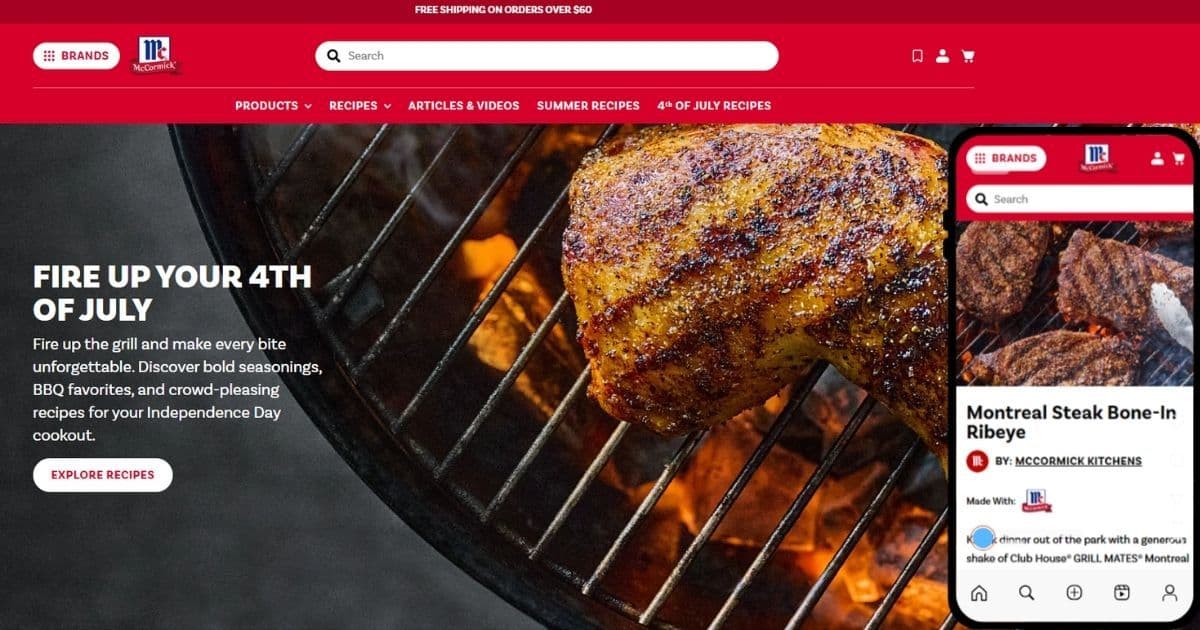
McCormick & Company
McCormick & Company is a global spice and flavour business. Dcrayon managed the front end of a Sitecore JSS website for McCormick and worked on how quickly its pages loaded.A headless Sitecore site with a Shopify checkoutSitecore JSS (JavaScript Services) is Sitecore's framework for building a website's front end in a JavaScript framework while editors keep working in the Sitecore content management system. It suits component-based, headless sites, where the content system and the pages that display it are separate, but it moves more of the page-loading work into the visitor's browser, so the order in which scripts and files load matters a great deal. The site we worked on carried recipe and product pages, and its checkout ran on Shopify. Our scope was ongoing front-end management of the JSS application and a focused piece of performance work.Pages loaded slowly, particularly on mobileDcrayon's audit found the site scoring poorly in Google PageSpeed Insights on both desktop and mobile. On recipe and product pages, slow loading delays the content a visitor came for and weighs on how search engines assess the page.Third-party scripts competed with the site's own codeAnalytics, marketing pixels and product recommendation widgets loaded early and held up the browser's main thread while the JSS components were starting, and many files loaded one after another rather than in parallel.Two sets of assets had to share one experienceThe Shopify checkout brought its own scripts and files into the Sitecore experience, and there was no performance governance in place to stop each release adding weight.
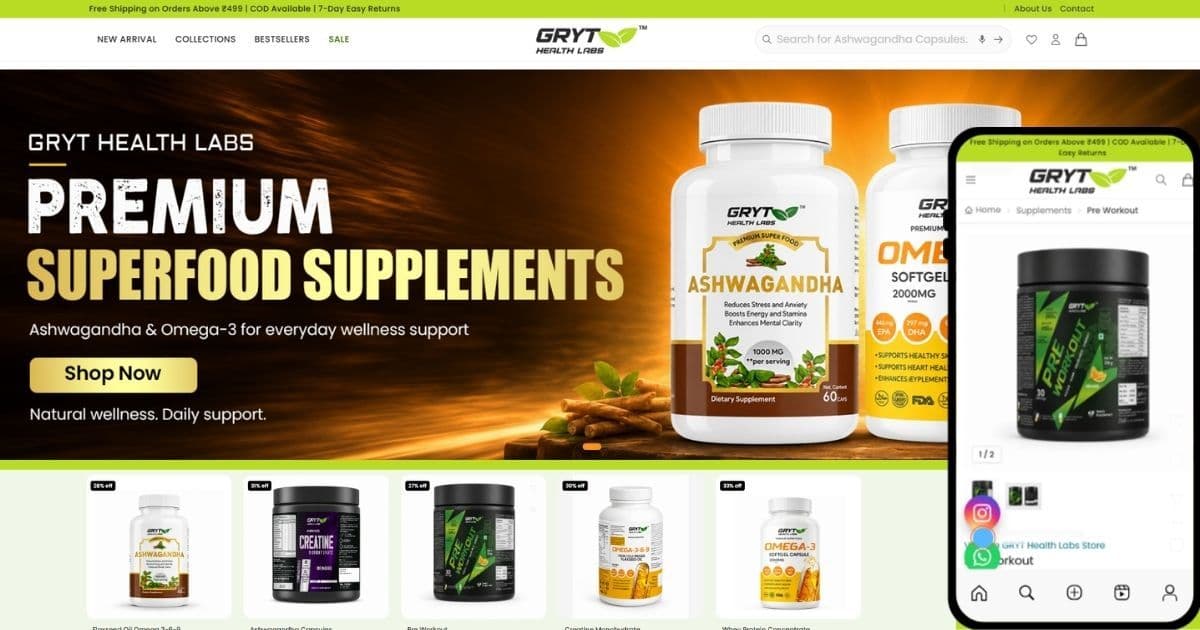
GRYT Health Labs
GRYT Health Labs sells whey protein, creatine, pre-workout, ashwagandha and omega capsules, plus gym shakers, to shoppers across India. Its store at gryt.co.in runs on a custom Laravel build.The range on 13 October 2026 included vanilla whey protein concentrate, unflavoured creatine monohydrate, a pre-workout supplement, ashwagandha capsules, omega 3-6-9 flaxseed oil capsules and plastic and steel shaker bottles, sold singly, in packs of two and in combos such as creatine with pre-workout. The brand is owned and operated by a registered business named on the store. The work covered here is the storefront and the conversion and content brief Dcrayon wrote for it in June 2026.What a supplement store has to show before it sellsSupplement buyers check credentials before they check prices.In India, health supplements fall under the food regulator, and buyers look for proof that a brand is licensed and knows who makes its products. The licence and the owning business need to be easy to find on the store itself, not only on request.Most of the range sells in packs and combos.Creatine, pre-workout and capsules are often bought two at a time or bundled with a shaker. Selling every pack size as an unrelated product makes the saving hard to see and the cart harder to build.The store needed a plan for higher order values.By June 2026 the store was trading, with a cart drawer and cash on delivery in place. The open question was which additions would raise average order value and give product pages richer content, without bending supplement claims beyond what the rules allow.
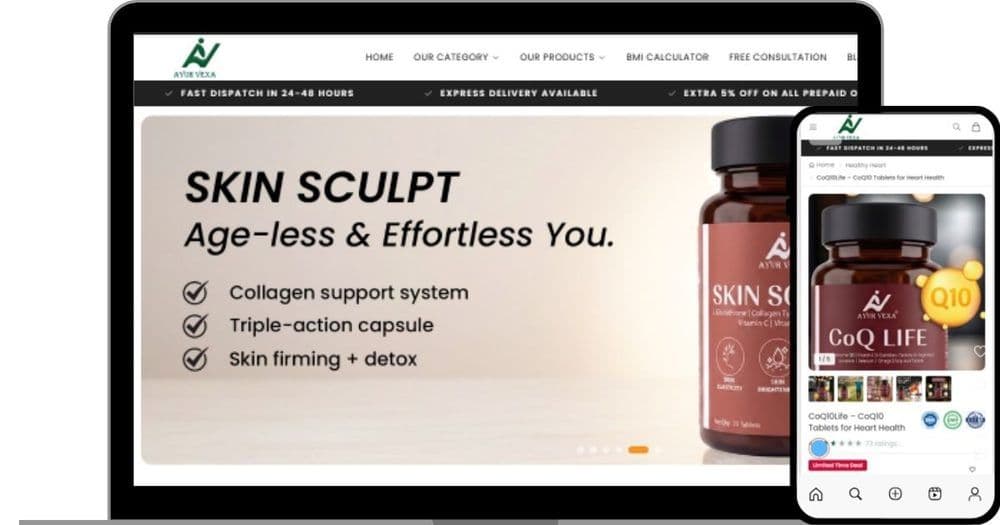
Ayurvexa
Ayurvexa, a Jaipur brand of liver, skin, heart and energy supplements, moved its online store from WordPress onto Dcrayon's multi-brand Laravel commerce platform in April 2026.A five-product supplement brand leaving WordPressAyurvexa sells five nutraceutical products, each aimed at one health concern: Liver Support, Skin Sculpt, Spirulina Bliss, CoQ10Life and Energize Q, plus five combination packs built from them. Its customers buy online across India. Dcrayon's CRM records the brand as a client won in April 2026, with Instagram management and UGC (user-generated content) video on the order and four invoices issued. In the same month, the platform's code history shows the Ayurvexa catalogue being imported onto Dcrayon's Laravel platform, the shared codebase that also ran other Dcrayon-built stores, each brand with its own database. This case study covers the store migration and build.A small catalogue on a platform designed for large onesThe platform's standard homepage assumed categories with many products, shown in a scrolling category carousel above a grid of featured products. Ayurvexa has one product in each of its five health categories. Left as it was, the layout would have shown thin rows and a carousel with almost nothing to scroll.Old WordPress links that were already in useProduct addresses from the WordPress site could still turn up in search results and in links shared earlier. A platform change without redirects would have sent every one of those visitors to an error page, and search engines would have treated the old pages as gone.Supplement buyers who want advice before they paySomeone choosing a liver or heart supplement often has a question first: is this right for me, and which product should I start with? A store that offers only a cart leaves that question unanswered.Shoppers who prefer to pay on deliverySome buyers do not want to pay the full amount before the parcel arrives. The store needed full prepaid payment as well as a middle option, where the buyer pays a small advance online and settles the rest at the door.One brand's data, copy and messages kept apart from the othersOn a shared platform, a cache, an email setting or a banner that is not scoped to one brand can show up on another brand's store. For a health brand, a wrong product photo or another brand's sender address in an order email undermines trust immediately.
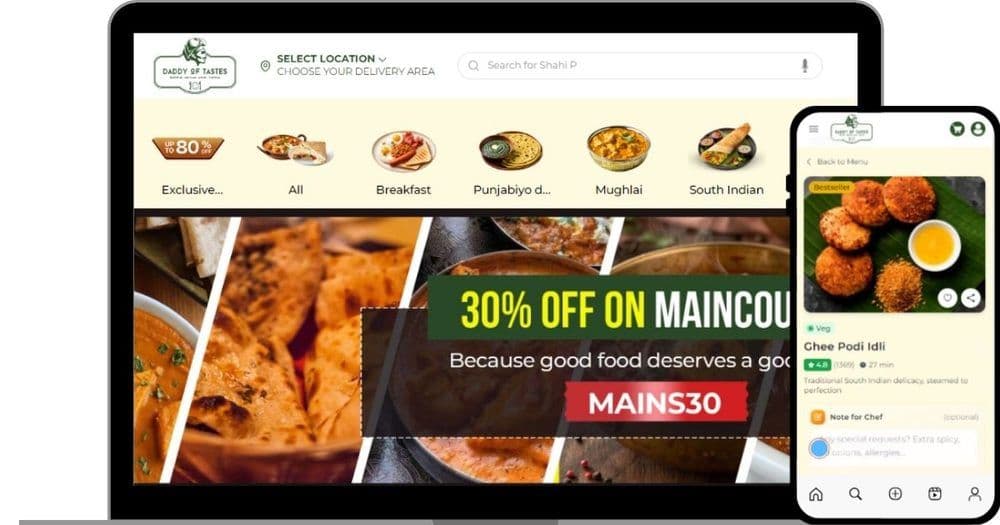
Daddy of Tastes
Daddy of Tastes runs restaurant kitchens across Gurugram. Dcrayon built it a direct online ordering platform: a customer store, a kitchen board and a rider app on one Laravel codebase.Gurugram kitchens that sold mainly through aggregatorsThe group's outlets already sold through food delivery aggregators. Its menu is large and multi-cuisine: momos, rolls, thalis, biryani and rice, Indo-Chinese, pizza, ramen, kulcha and breads, starters, combos, drinks and desserts, cooked at more than one location. A direct channel meant taking on the jobs an aggregator normally does: showing the menu and stock of each kitchen, taking payment, deciding who can be delivered to, finding a rider and proving that the food reached the right person.Four kitchens, one menu, separate stockA dish that has sold out at one kitchen may still be available at another. The menu spreadsheet held 94 items with 376 stock records across four locations, including the Sector 29 and Golf Course Road outlets. Stock therefore had to be tracked per kitchen and reset each day, and the store had to stop a customer paying for a dish that had just run out.Kitchens that need to notice every orderIn a busy kitchen, a new order that nobody notices is a lost customer. Staff needed an alert that could not be missed, that kept ringing until someone took responsibility for the order, and that did not merge several orders into one sound during a rush.Riders who must be found fast and fairlyWithout an aggregator's fleet, every order needs a rider from the group's own pool. An order offered to one rider who ignores it cannot be left waiting, two riders must not both accept the same order, and a rider who is already carrying food should be able to take another order on the same route.Delivery areas that depend on each kitchenEach kitchen can deliver only within a certain distance. Customers needed a reliable way to mark exactly where they are, and the system had to accept addresses near an outlet without wrongly turning them away.Proof that the right person received the foodOn its own channel the restaurant, not an aggregator, has to settle any dispute about a delivery. The handover needed a check the customer takes part in, and a record the restaurant can show later.
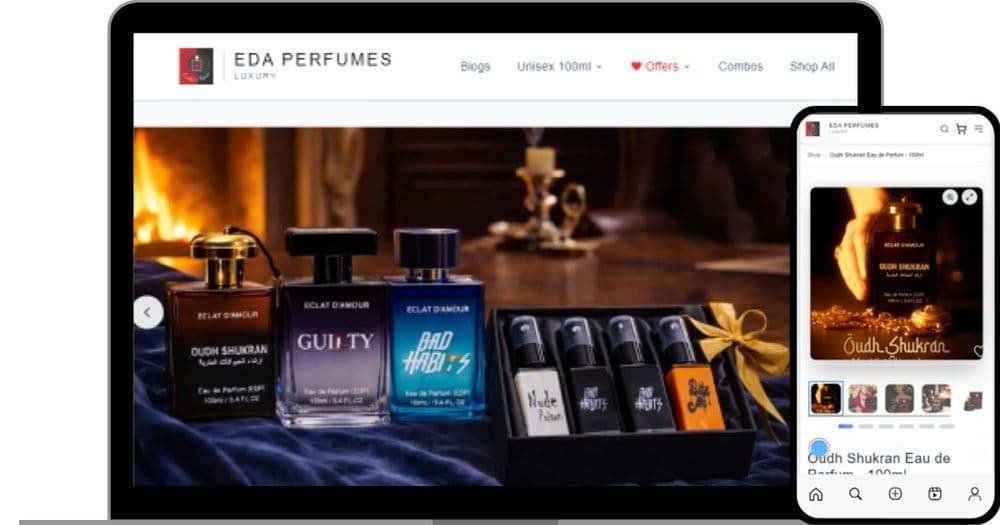
EDA Perfumes
EDA Perfumes, a e-commerce brand, needed an online storefront that made their product range easy to browse and purchase on any device. The brief was a clean, fast catalogue site that highlighted products without feeling cluttered, with emphasis on mobile shopping and easy checkout.
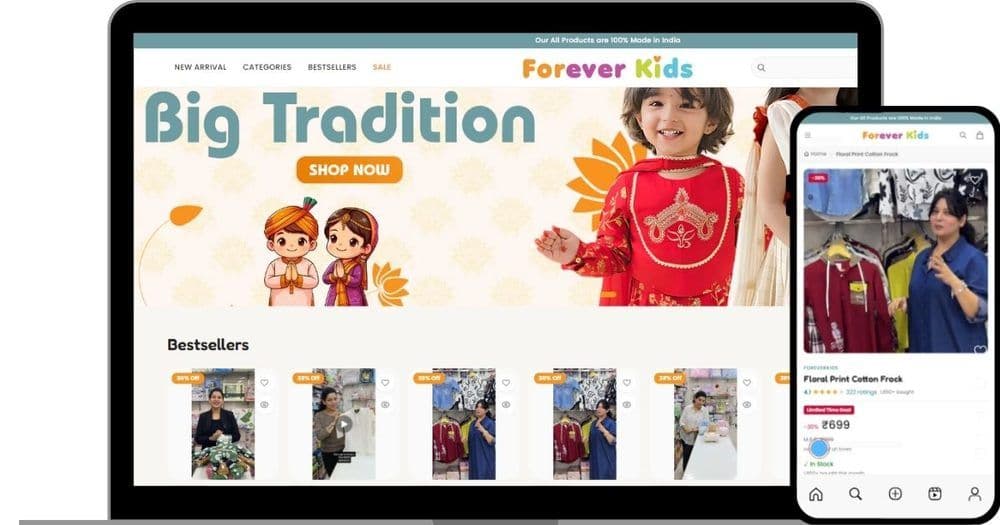
Foreverkids
Foreverkids is a multi-brand kidswear retailer whose shop ran on Marg ERP billing software. Dcrayon built one Laravel system for its online store, shop counter and accounts, and moved the Marg catalogue across.A kidswear shop that billed every sale through MargForeverkids sells children's clothing from hundreds of labels, in sizes from newborn up to 2XL. The shop billed its sales through Marg, a desktop billing and ERP (enterprise resource planning) package, and Marg's stock report listed 10,460 products. Running a website with its own stock count beside Marg would have meant two stock records for the same shelves, so the project built a single system: storefront, point of sale (POS) and accounting on one database, with the Marg history brought across.Ten thousand products locked inside an encrypted billing systemMarg's main data files are encrypted in a proprietary format. Its standard exports gave product names, codes and prices, but not the size and colour detail behind each item, so a straight export would have produced a catalogue without variants.Shelf labels the new till had to readEvery garment in the shop carried a printed Marg label. The barcode field in Marg's product master was empty in every year of data, so nobody knew what number the labels actually encoded. Without that answer, every piece in the shop would have needed relabelling before the new POS could sell it.Size and colour hidden inside a batch fieldMarg stored size and colour together in a single 12-character batch number, such as "9-12M GREY" or "XXL PINK", with colours cut short at seven letters. Those values had to become proper size and colour variants, each with its own stock and price.Money leaving the drawer by the wrong routeA till handles cash, card, UPI, store credit and returns every day. Returns, credit notes and discounts need rules that the cashier cannot bypass by accident: a bill cannot be refunded twice, a refund in cash cannot exceed the cash taken, and a large discount needs a manager.Accounts and GST the owner already relied onThe shop's books, GST returns and supplier ledgers ran through Marg and Tally. A replacement had to keep producing the same outputs, or the owner would end up running two systems side by side.
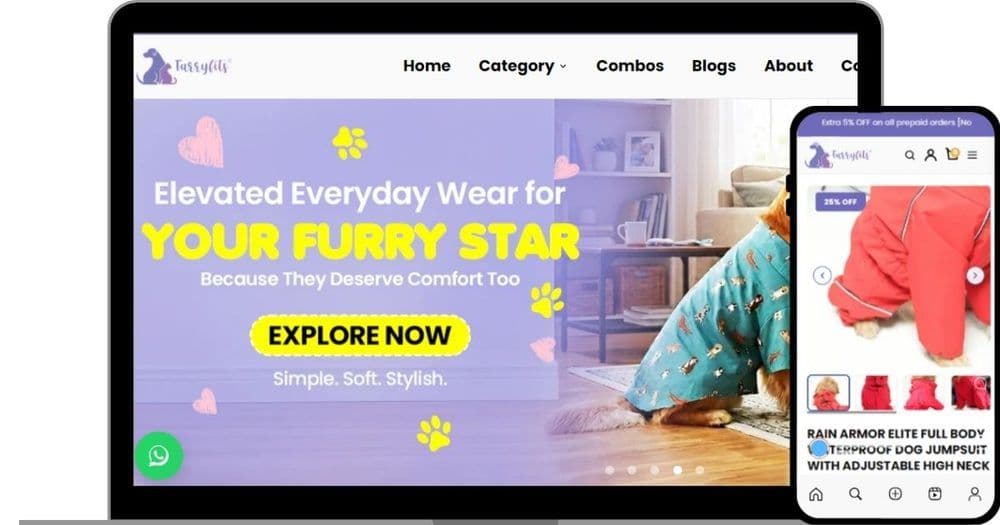
Furry Fits
Furry Fits, a New Delhi brand, sells clothing, grooming products and beds for dogs and cats. Dcrayon replaced its default Shopify set-up with its own theme and maintained the store through 2025 and 2026.Pet clothing is a narrow, seasonal business. Furry Fits sells wedding and festive outfits such as kurtas, sherwanis, tuxedos and lehengas, sweaters, hoodies and puffer jackets for winter, waterproof raincoats for the monsoon, bandanas, casual shirts and polo tees, and alongside them a grooming range of shampoos, a waterless foaming shampoo, paw cream, pet perfumes, massage oil and a tick and flea spray, plus beds and mats. Its customers are pet parents across India who buy for dogs of every size, from small breeds to large ones.Dcrayon's work for the brand has been carried out under a retainer covering theme design and build, website maintenance, product listings and social media marketing. On 13 October 2026 the public catalogue at furryfits.co.in held 113 products in 939 size and style variants, the earliest added in February 2025 and the newest in September 2026. A separate repair made under the same retainer, a fix for the store failing on iPhones and inside Instagram, is covered in the Furry Fits cross-platform fix case study.Where the Furry Fits store stood in February 2025The store was live, but it still showed Shopify's sample content.An archived copy of the home page from 27 February 2025 shows the store on Dawn, Shopify's free starter theme, with most of the starting content untouched. The site title, the line that appears in a browser tab and in search results, read "My Store". A home page block still carried Dawn's instruction to "pair text with an image to focus on your chosen product", a "Book an appointment" block listed grooming, boarding and training, and the menu held placeholder entries such as "Product 2", "Services" and a misspelt "Clothens". Anyone who found the store saw a template, and search engines had almost nothing to say about what it sold.Shoppers buying clothes for a pet cannot try them on.A kurta that is too tight or a raincoat that is too short comes back as a return, and a dog cannot be taken to a changing room. Sizes on Furry Fits clothing run in even numbers, from 8 to 30 on a festive kurta, and the shopper has to pick one of a dozen sizes for an animal that may be fluffy, long-backed or between sizes. The question of which size to choose had to be answered on the product page itself, at the moment of choice.The range changed with every festival and every season.In August 2025 the store led with grooming products and treats. By June 2026 the home page led with festive wear, raincoats and beds. New products arrived in bursts rather than evenly: the public catalogue shows 20 products added in October 2025 and 21 in February 2026, ahead of the wedding season and the monsoon. The store needed a structure that could absorb a new line, such as a lehenga collection or a monsoon range, without a redesign each time.
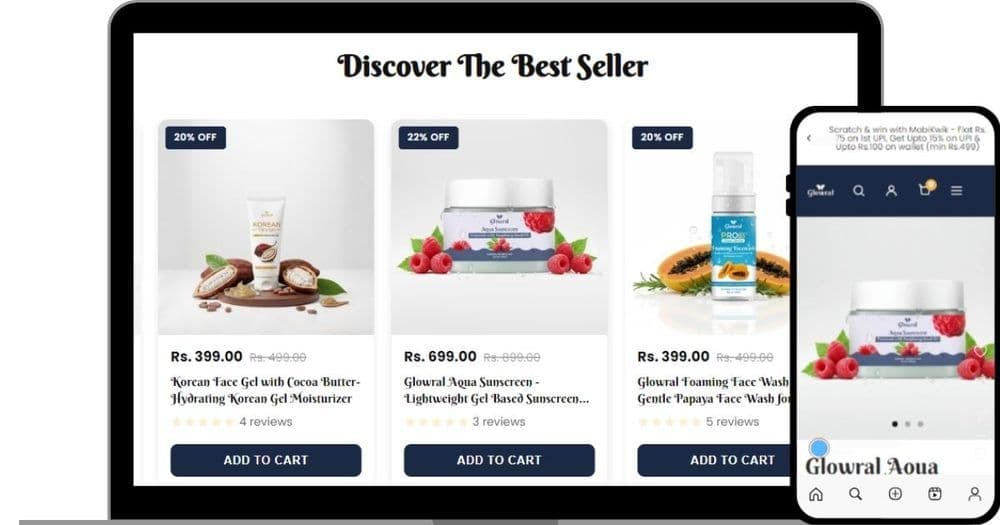
Glowral
Glowral launched with four core skincare products and needed its own online store to sell them. Dcrayon designed and built the Shopify storefront that carried the range.The range covered sun protection, with an SPF 50 body spray and a water-based aqua gel sunscreen, and daily care, with a Korean-style face gel and a salicylic acid face wash. The brief asked for a clean catalogue that showed these products without clutter, was easy to browse and buy from on a phone, and kept checkout short. The theme's files date from early September 2025, and archived copies show the store live with products, prices, a cart and checkout from November 2025. The search and content work that followed the build is covered separately in the Glowral SEO and blog content case study.What Glowral's four-product launch needed from its storeA small range had to look complete without looking padded.Four products can make a store feel empty, and filling the gaps with banners or filler sections makes it feel cluttered instead. The store needed a structure that showed how the products work together, so that a shopper saw a routine rather than four unrelated items, and a way to sell more than one item without inventing new products.The brief expected shoppers to browse and buy on their phones.Mobile shopping came first in the brief. On a small screen every extra step or crowded section costs attention. Navigation, product cards, offers and checkout all had to be designed for a thumb first and a desktop second.A new name had to give shoppers enough information to try it.Glowral was not a brand most shoppers already knew. Before paying, buyers want to see the price and the saving clearly and understand what is in the product and how to use it. The store had to put that information on the product card and the product page, rather than on separate pages a shopper might never open.
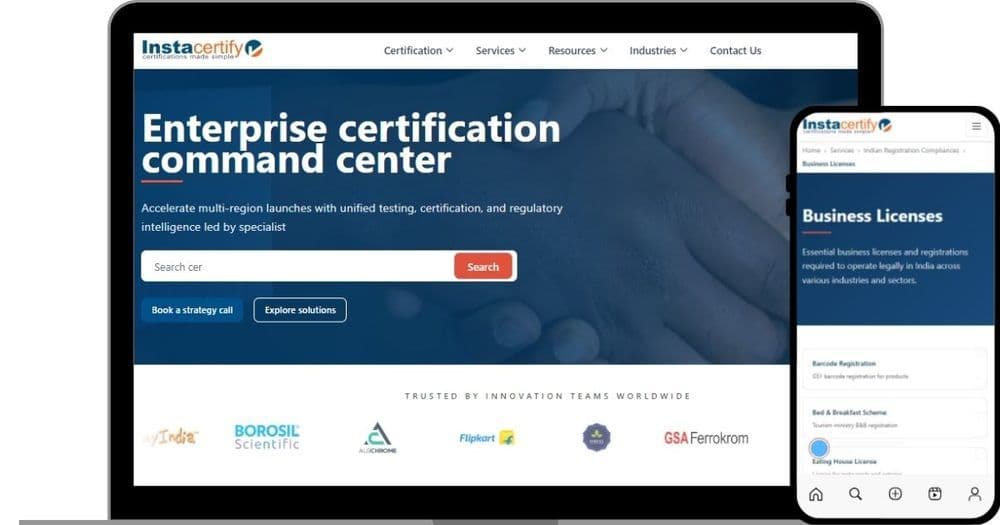
Instacertify
Instacertify helps manufacturers and importers obtain product certifications, registrations and business licences in India and abroad. Dcrayon designed and built its website.A Noida consultancy selling dozens of approvalsInstacertify Labs, based in Noida, works on approvals such as BIS registration and the ISI mark, WPC and TEC approvals for wireless and telecom products, CE marking for Europe and FCC for the United States, along with Indian business licences and registrations such as barcode registration and eating house licences. Its buyers are product companies and their compliance teams, often working across several markets at once and rarely sure at the start which scheme applies to their product.A large compliance catalogue had to be findable by a first-time visitorFew visitors know the full name of the certificate they need. They arrive with a product and a market in mind, and the catalogue runs to dozens of certifications, licences and registrations across India and other regions. A site that expects them to browse menus until they recognise the right scheme loses many of them before they find it.Buyers needed an obvious first stepCompliance is a considered purchase, and a visitor who has found the right certification still needs a clear way to talk to a specialist. The site had to make that next step visible from the first screen without crowding the information buyers came to read.
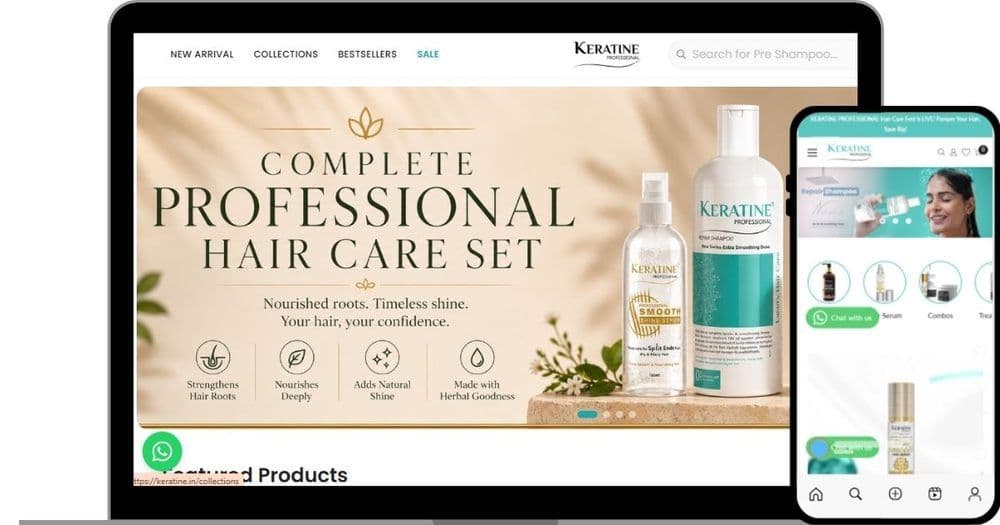
Keratine Professional
Keratine Professional sells keratin shampoos, hair masks, serums and hair spa treatments in India. In April 2026 Dcrayon moved its keratine.in store from Shopify to Dcrayon's multi-tenant Laravel commerce platform.The range on keratine.in is built around smoothing and repair: repair and smoothening shampoos, sulphate-free shampoos with rosemary or Moroccan argan oil, keratin and nano-smoothing hair masks, Brazilian hair spa, a protein repair treatment, shine serums and a long list of shampoo, mask and serum combos. Until April 2026 the store ran on Shopify, with a blog of hair care guides published since at least December 2024. The brand also sells on Amazon, which is covered in the Keratine Professional Amazon case study; the website is the subject here.Dcrayon's scope was the whole move: bringing the catalogue and the articles across, keeping the search titles Google already showed, building a Keratine home page on the shared platform, and getting the domain serving the new store. Laravel is a PHP framework for building web applications. Dcrayon's platform uses it to run several brand stores from one codebase, each brand with its own database. In that setup each brand is a tenant, and Keratine became one.Why keratine.in could not simply be copied acrossShopify's product export does not match the platform's catalogue model.Shopify exports a product as several CSV rows: the first carries the title, description, vendor and price, and the rows below carry extra images and variants. Categories arrive as a single text path, and the vendor is just a name. The Laravel platform stores products, categories, brands and images in separate related tables, and every product belongs to a seller. Pasting the export in by hand would have meant re-keying the range and losing the image order and SEO fields that came with it.The blog and its search titles existed only on Shopify.The guides at keratine.in/blogs/keratine-blogs covered keratin treatments, argan oil hair spa, red onion hair masks and serums for frizz. Each had its own meta title and description that Google was already showing. A platform move that left those behind would have cut the store off from the searches its content already answered.Every section of the first Keratine home page was hard-coded.The first version of the new home page assembled brand-specific blocks straight into the template: a serum feature, a timeless hair care panel, promotional tiles, a botox and keratin block, a hair mask block and a combos banner. Changing an offer, a banner or a product row meant editing code. For a brand that sells mostly through combos and seasonal offers, that tied everyday marketing to developer time.The home page artwork weighed about 19 MB.The section images arrived as PNG files, a format that keeps every pixel and produces large files. The commit that later converted them records their combined weight at about 19 MB. A shopper on mobile data would have downloaded that on a first visit to the home page.
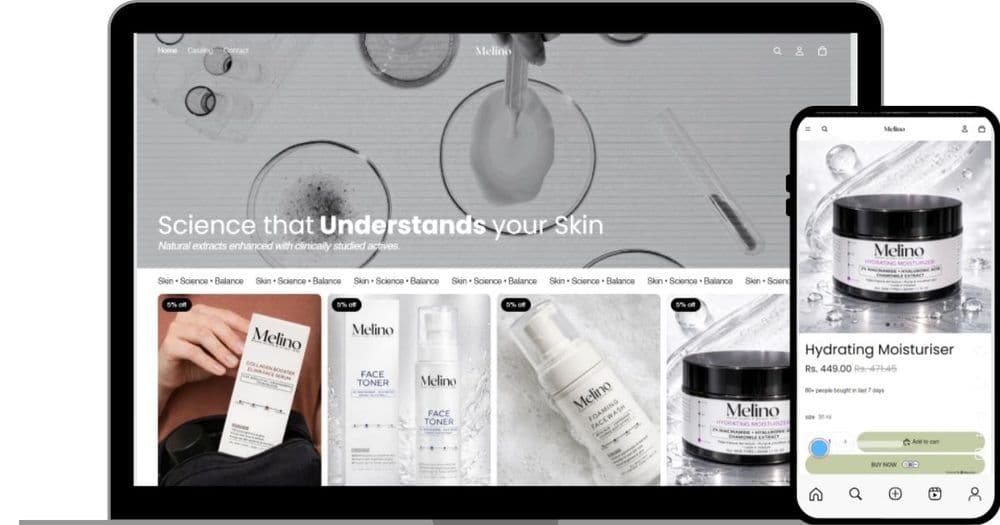
Melino
Melino is an Indian skincare brand whose products combine several actives, from a bakuchiol serum to a niacinamide toner. Dcrayon set up its Shopify store and ran its performance marketing.Dcrayon's performance marketing engagement with Melino began in March 2026. The store itself is small: on 13 October 2026 it listed an elixir face serum with 0.5 percent bakuchiol oil, ashwagandha and frankincense; a face toner with 4 percent niacinamide, rice water and green tea; a foaming face wash with kojic acid, lemongrass and licorice root; a hydrating moisturiser with 2 percent niacinamide, hyaluronic acid and chamomile; and a signature gift box that pairs the toner and serum with bath and gifting extras.Selling a five-product skincare range by ingredientA five-product range has to read as a routine, not a short list.With only four core products, a store can look thin. The range needed to be presented by the skin problems it addresses, with the gift box offering the products together as a set.Skincare shoppers compare by ingredient.Buyers who know their actives search for niacinamide, bakuchiol or kojic acid, often with a percentage in mind. Product names that hide the formula behind a brand name make that comparison harder, both on the store and in search results.
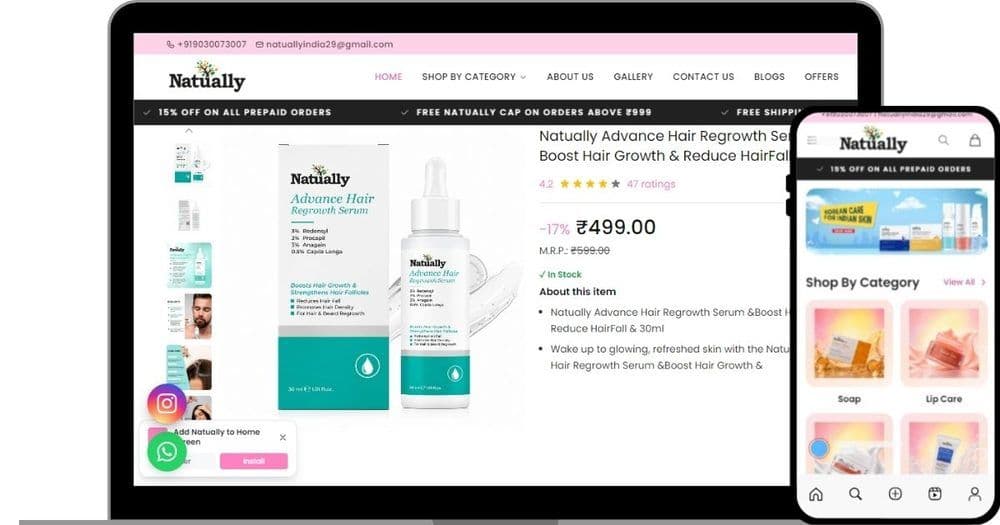
Natually
Natually sells natural skincare and haircare products online in India. From 2025 Dcrayon customised the Shopify theme behind its store, before the brand moved to a Laravel platform in 2026.Natually's store ran on Shopify, selling face serums, creams, cleansers, soaps, lip care, hair care and facial kits, many of them small-ticket products bought together or as combos. Dcrayon's work on the store dates from early 2025, when the published theme was a copy of the Yuva theme set up under Dcrayon's name. The job was customisation, not a new build: shaping the theme around the range and the brand's offers while the store stayed on Shopify. The later move to Dcrayon's own Laravel platform is a separate project, described in Natually's move from Shopify to Laravel.What Natually's Shopify storefront had to handleA wide range had to stay easy to browse.In February 2025 the store already sold across 13 categories, from lip care and face serums to beard growth and soaps. A shopper with one concern, such as dark lips or tanning, needs the right shelf a tap or two from the home page, on a phone as much as a laptop.Offers had to be hard to miss.Natually runs regular offers: a prepaid discount, free gifts above an order value and a buy-one-get-one collection. In February 2025 a scrolling banner promoted a free face wash on orders above Rs 999. Offers like these only work if shoppers see them before the cart.The home page carried a lot on every visit.The February 2025 home page stacked 14 theme sections, including three image sliders, a rotating text bar, a rich text block and an Instagram feed, and loaded scripts for a JavaScript lazy-loading library, the React framework and a spin-the-wheel promotion. Only two of its images used the browser's own lazy loading. Every extra slider and script is more for a phone to download before a shopper sees a product.Theme changes had to sit alongside app features.Several features came from Shopify apps rather than the theme, including a free-gift app, a shoppable-video app and Shiprocket's Fastrr one-page checkout. Theme work had to fit around them without breaking them.
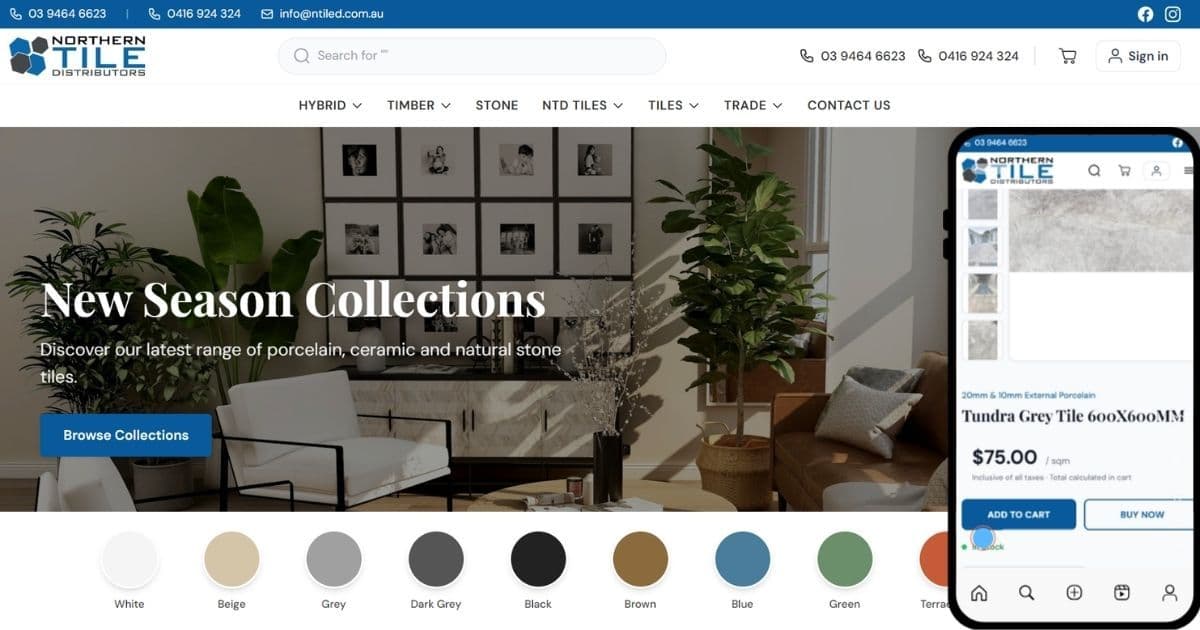
Northern Tile Distributors
Northern Tile Distributors, a home and lifestyle brand, needed an online storefront that made their product range easy to browse and purchase on any device. The brief was a clean, fast catalogue site that highlighted products without feeling cluttered, with emphasis on mobile shopping and easy checkout.
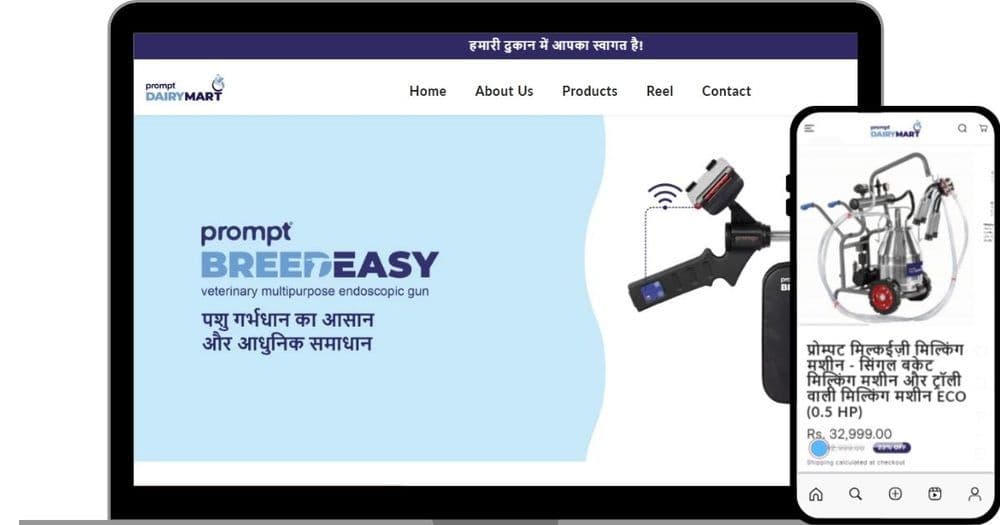
Prompt Dairy Mart
Prompt, a dairy-technology company making equipment for cattle breeding, milk testing and milking, sells direct to farmers through Prompt Dairy Mart. Dcrayon designed and built its Shopify catalogue.The range runs from small consumables to farm machinery. At one end sit BovEasy rapid pregnancy tests for cattle, sold as single kits and in boxes. In the middle are the ThawEasy Lite digital semen thawing machine and the BreedEasy digital insemination gun. At the other end are MilkEasy milking machines in several configurations, priced many times higher than a box of test kits. The buyers are dairy farmers, artificial insemination technicians and vets, and the brief paid particular attention to those ordering online for the first time.Dcrayon was engaged for the website development, and archived copies of promptdairymart.com from April and August 2025 show the store live on Dcrayon's theme. The store was built Hindi-first, and the language and URL decisions behind that are covered in the Prompt Dairy Mart Hindi-first store case study.What Prompt's equipment range asked of an online catalogueOne product came in many pack sizes, and one machine came in many configurations.A farmer checking a few animals needs a single test kit, while a technician working across a village needs a box. Milking machines differ by the number of buckets and clusters (the set of teat cups that attaches to one animal), by motor power, and by whether the unit is fixed in place or mounted on a trolley. If those options sit together under vague names, a buyer can easily order the wrong one, and a wrong milking machine is an expensive return.Buyers of expensive machines needed a way to ask before paying.Building trust with first-time online buyers was a priority in the brief. A buyer weighing a machine that costs many times more than a test kit is likely to have questions that a product page cannot answer on its own, such as which model suits the herd.A new shop had to show the company standing behind it.The shop needed to make clear that it was Prompt's own store, so that buyers knew who they were paying and who stood behind the machine after delivery.

RAA Logistics
RAA Logistics is a freight forwarder in Jebel Ali Free Zone, Dubai, handling sea, air and road freight, customs clearance and warehousing. Dcrayon built its website.A Jebel Ali forwarder with seven services to explainRAA Logistics serves importers, exporters and traders who move goods into, out of and through the UAE. Its head office sits in Jebel Ali Free Zone, next to one of the region's main container ports, and its services run from warehousing and sea, air and road freight to customs clearance, supply chain management and cargo insurance. The company asked Dcrayon for a corporate website that explains those services clearly, works well on a phone, and leads every visitor to one of two actions: request a quote or track a shipment.The earlier web presence did not separate the services or work well on mobileA business looking for a forwarder usually arrives with one need, such as clearing a container through customs or booking air freight for an urgent order. RAA's earlier presence did not separate its services cleanly or hold up well on a phone, so a visitor had to work to find the service they came for and the next step to take.Existing customers needed shipment status without calling the officeShipment status lives in RAA's freight management software, not on a marketing website. Customers who already ship with RAA need a quick way to check where their cargo is, and every status call or email that could have been a self-service check takes time from the operations team.A quote request needs the service before anything elseA freight quote depends on the service, the cargo and the route. An enquiry that says only "please call me" starts a round of questions before anyone can price it, and any public form on a business website also attracts automated spam that someone has to sort through.
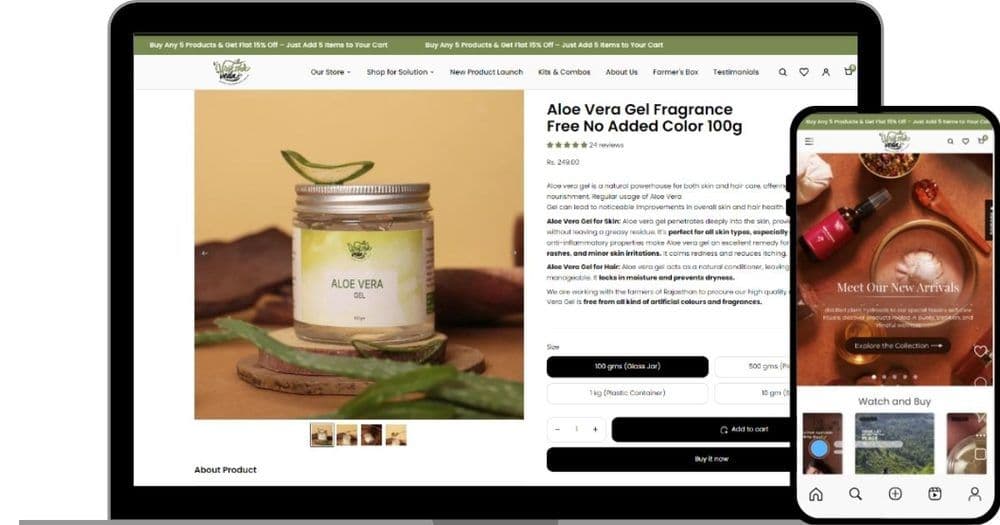
Vriksha Veda
Vriksha Veda sells raw botanical ingredients for home-made skin and hair care, working with Indian farmers since 2020. Dcrayon designed and built its Shopify store at vrikshaveda.com.The engagement began in April 2024, and nine invoices have been raised across it. The store sells ingredients rather than finished products: raw herbs and botanical powders, fruit pulp powders, ubtan bathing powders, cold-pressed and unrefined oils, plant gels, essential oils, steam-distilled hydrosols, clays, shade-dried flowers, Ayurvedic wellness items, gift kits and zero-waste tools. On 13 October 2026 the shop-all collection held 110 products, with a Farmer's Box, a set of courses and a postpartum hair care range alongside them.Selling raw botanicals to makers and newcomersShoppers arrive with a problem, not an ingredient name.Someone dealing with dandruff or post-acne marks may not know that rosemary hydrosol or a particular clay is what they are after. A store organised only by ingredient type serves the experienced DIY maker and loses the newcomer.One ingredient comes in several sizes and containers.Rosemary hydrosol, for example, is sold in 50 ml and 100 ml glass bottles, a 500 ml aluminium bottle and a 1 litre pack. Each size needs its own price and stock without becoming a separate product page.Raw ingredients need handling notes.Unlike a finished cream, a hydrosol or a herb powder comes with questions about shelf life, storage, natural changes in colour and aroma between batches, and patch testing. Buyers need that information on the product page, not in a reply to an email.
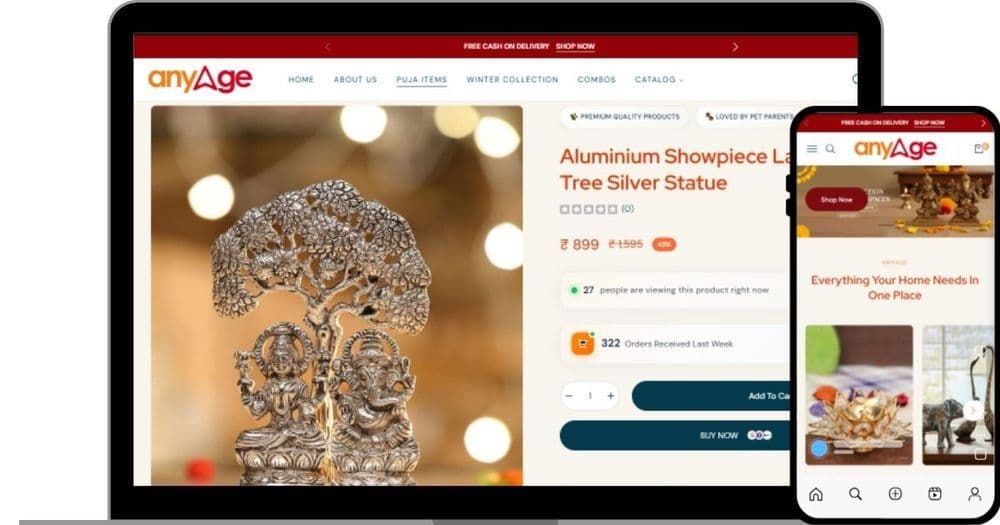
Anyage
Anyage sells puja essentials, brass and aluminium showpieces and everyday home products to shoppers across India. Dcrayon set up its Shopify storefront so that one mixed range reads as a single, easy shop.A range that runs from puja thalis to pet careOn 13 Oct 2026 the Anyage store listed 154 products. Most are brass showpieces, puja items and metal handicrafts, with a short winter range and a small pet-care line alongside them. The storefront had to present that range clearly on a phone, make the saving on each item obvious and take orders from buyers who expect to pay on delivery.Devotional, decorative and utility products in one catalogueA shopper looking for a brass puja thali set should not have to scroll past a pet shampoo to find it. With products as different as a musical Ganesh showpiece, a sindoor dibbi and a home-care combo in the same shop, the range needed separate shelves that each make sense on their own.Decor that buyers judge on finish, size and priceBrass and aluminium pieces sell on how they look and how much space they take. Ten products carry a size option in inches, and buyers want to see the selling price against the MRP before they open a product page.Buyers who expect cash on deliveryThe top banner promises free cash on delivery, so the checkout has to handle cash and prepaid orders equally well on a small screen.
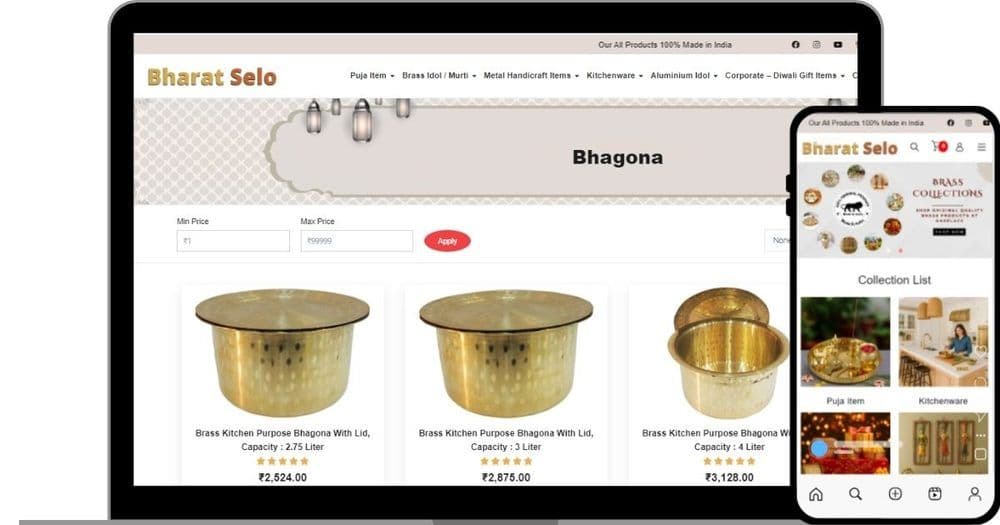
Bharatselo
Bharatselo sells handcrafted brass, copper and aluminium puja items, idols, kitchenware and gifts. Dcrayon built its WooCommerce store to carry a catalogue of nearly 4,000 products.Nearly 4,000 brass and puja products to sortBharatselo's range covers diyas, puja thalis, bells, temples, brass and aluminium idols, brass and steel kitchenware and EPNS (electroplated nickel silver) handicrafts. Its buyers range from families furnishing a home temple to companies ordering Diwali gifts in bulk. On 13 Oct 2026 the store held 3,947 products in 125 categories.More than a hundred categories, several levels deepSomeone looking for a brass Ganga aarti diya needs to reach that shelf from the homepage without scrolling past bowls, ashtrays and chess boards. The category tree runs from Puja Item to Diya Deepak to Hand Aarti Diya, and every level has to stay usable on a phone.Sign-in that works with a phone numberAn email-and-password account adds a step before every repeat order. For a shopper on a phone, a one-time code sent to their number is quicker than recovering a forgotten password.Retail, gifting and wholesale buyers on one siteThe same store serves single-item orders, corporate Diwali gifting, customised gifts such as name plates and clocks, and wholesale enquiries. Each group needs its own route into the site.
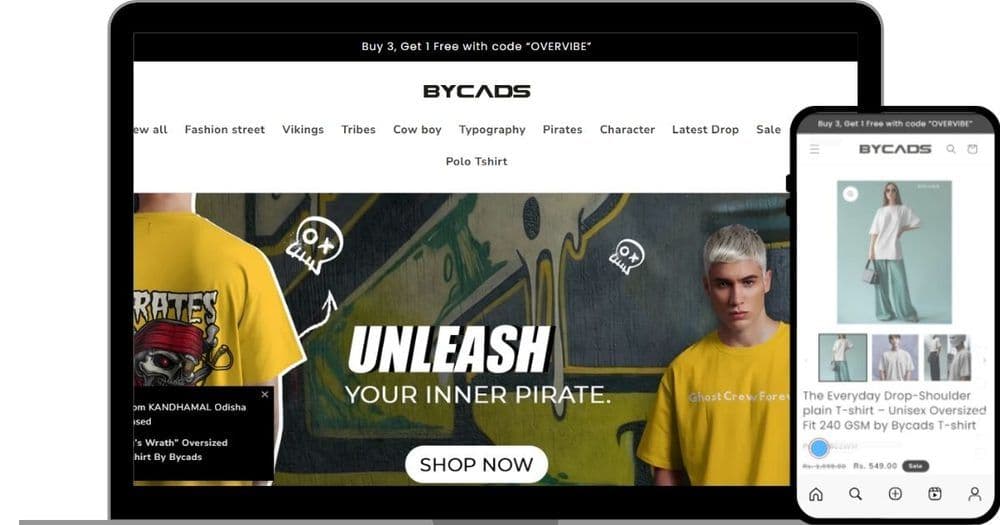
Bycads
Bycads sells oversized graphic T-shirts for men and women, grouped into story-led drops such as Vikings, Pirates and Tribes. Dcrayon built the Shopify store that carries the range.Graphic drops with a story behind every printBycads designs cotton tees with bold prints, plus polos, lowers, co-ord sets and a women's line. On 13 Oct 2026 the store listed 190 products with 2,125 size and colour variants. The brand releases designs in themed drops, and each theme has its own voice: "Vikings didn't ask for permission", or "Pirates didn't follow maps that already existed".More than 2,000 size and colour combinationsEvery product comes in several sizes, and almost every one in more than one colour. On a phone, the buyer has to see quickly which combinations exist and pick one without opening a separate page for each.Designs that sell on story, not on garment typeA shopper drawn to the Viking prints wants every Viking design in one place, whatever the cut. Grouping only by T-shirt, polo or lower would scatter a theme across the site.An oversized fit that buyers need to size correctlyOversized tees are cut larger than a regular fit on purpose. Without a size reference on the product page, buyers guess, and a wrong guess can mean a return.
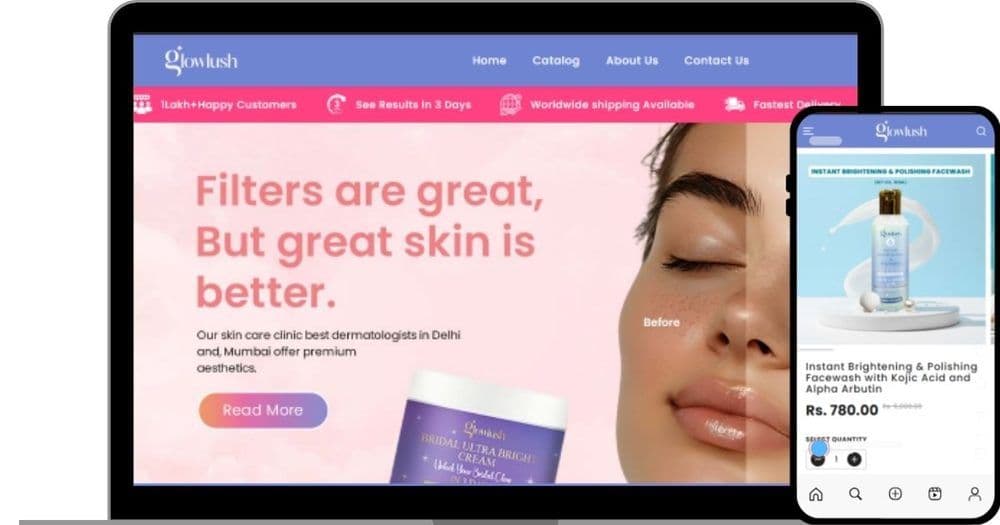
Glowlush
Glowlush is an Indian skincare brand whose range centres on brightening face care. Dcrayon designed its storefront, with the home page and product pages planned for phone screens first.The range includes an instant brightening and polishing face wash made with kojic acid and alpha arbutin, and a bridal brightening cream. Both are products that shoppers tend to research before they buy. Dcrayon's design covered the desktop home page and the mobile product page, the two screens a first-time buyer is most likely to see.Two design problems for a brightening rangeA small range needed one clear message.When a brand sells a handful of related products, a home page that simply lists them reads like a catalogue page. Glowlush needed a single headline idea that tied the range together and gave the shopper a reason to keep scrolling.Product details had to fit on a phone without scrolling.A product title that names two actives, a sale price with the original price beside it and a quantity choice can easily spill below the fold on a small screen. The shopper should see the product, what is in it, what it costs and how many to add, all at once.

Loire
Loire, which trades online as LoireLondon, sells sunscreens, face serums and creams in India. Dcrayon built its Shopify store at loirecosmetics.com and was also engaged for its Amazon account.The engagement with Loire Cosmetics Limited began in January 2026 and covered website development and Amazon account management. The store's range centres on four SPF 50 sunscreens, a run of single-active serums (niacinamide, vitamin C with hyaluronic acid, kojic acid and snail mucin) and three creams: an all-in-one snail repair cream, a glass skin cream and a collagen jelly. Behind the face care sit collections for hair care, shampoos, conditioners, hair serums, intimate care and personal care.Why four SPF 50 sunscreens needed telling apartFour sunscreens with the same rating look alike in a product grid.Loire sells an aqua sunscreen gel, a glow tinted sunscreen, a fluid sunscreen and a hybrid sunscreen, all rated SPF 50 and three of them PA++++. In thumbnails they are four similar tubes at prices between 650 and 999 rupees. A shopper has to be able to tell at a glance which one is the light gel and which one adds tint before they can choose.Skincare buyers compare formulas, not just product names.Many people buying serums and sunscreens want to know what is in them and at what strength. A product page that lists only a name and a price leaves that question to a separate search, possibly on a marketplace where a competing product sits one click away.One catalogue spans face, hair and intimate care.Shoppers rarely arrive with a product name in mind. They arrive with a concern: breakouts, tan, sensitivity, dull skin or hair fall. A store sorted only by product type makes them translate their problem into a category first.Offers change faster than the theme should.The brand runs a storewide discount, free gifts and coupons, and adds a prepaid discount at checkout. These change from week to week, so they had to be managed from apps and settings rather than built into the theme.
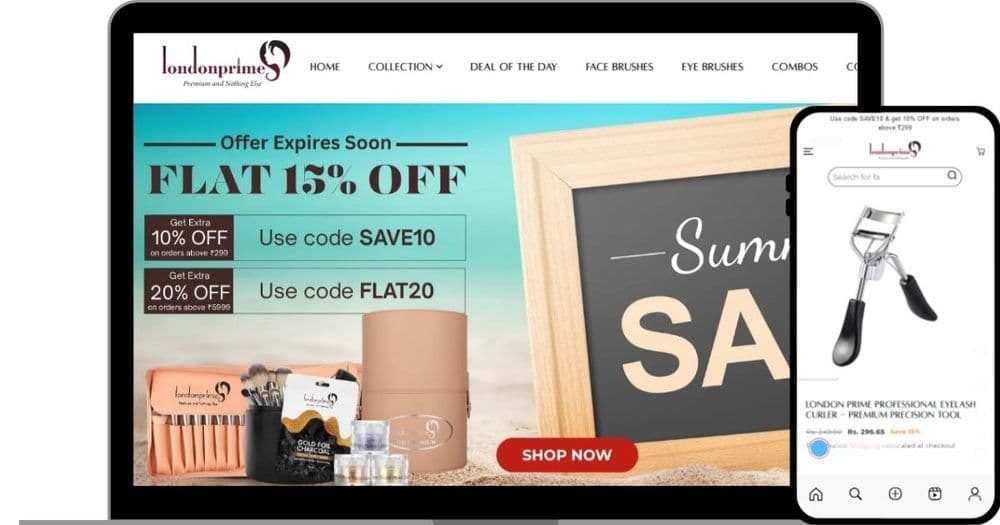
London Prime
London Prime, formerly London Pride Cosmetics, makes makeup brushes, brush sets, holders and sponges in New Delhi. Dcrayon built its Shopify store at londonprimecosmetics.com.The brand sells to makeup students and working artists as well as everyday buyers, and its products also sit on Indian beauty marketplaces, where several listings still carry the line "formerly London Pride Cosmetics". When we checked the store on 13 October 2026 it held 154 products in 53 collections: single face and eye brushes, the Glamstrokes and HD brush sets, signature sets, cylinder brush holders in several sizes and colours, beauty blenders and precision sponges, makeup remover pads, glitters, eyelashes, sheet masks, a brush cleanser and a vanity bag. Dcrayon's scope covered the India store on Shopify and a second Shopify store for the UAE, which is being prepared on a newer version of the same theme.Why a makeup brush range is hard to shop onlineMany products differ only by colour, size or piece count.A cylinder brush holder comes in XL and in a 4.5-inch medium-large size, each in blush pink, pink, maroon, fuchsia or green. Brush sets come in 22, 26 and 32 pieces, with separate face, eye and HD ranges. Shown as one long grid, these near-identical items make it hard for a shopper to find the one brush type they came for, whether that is a flat foundation brush or a full eye set.Brushes are bought on feel, which a photo cannot show.Softness, density and how a brush blends are what buyers care about, and none of that comes across in a still image. A buyer choosing between a kabuki brush and a foundation brush also needs to know which job each one does. The store needed ways to show brushes in use and to explain the differences in plain language.Offers come in several forms at once.The brand runs buy-one-get-one deals, combos, a deal of the day, a complimentary brush cleaner above a spend threshold and a first-order discount for newsletter sign-ups. Each of these needs a place on the store and a way to switch on and off without a developer building it from scratch.A second market needs the same brand without a second build.London Prime's UAE store needed to look and behave like the India store while carrying its own content. Rebuilding the design from nothing for a second country would have doubled the work and let the two stores drift apart.
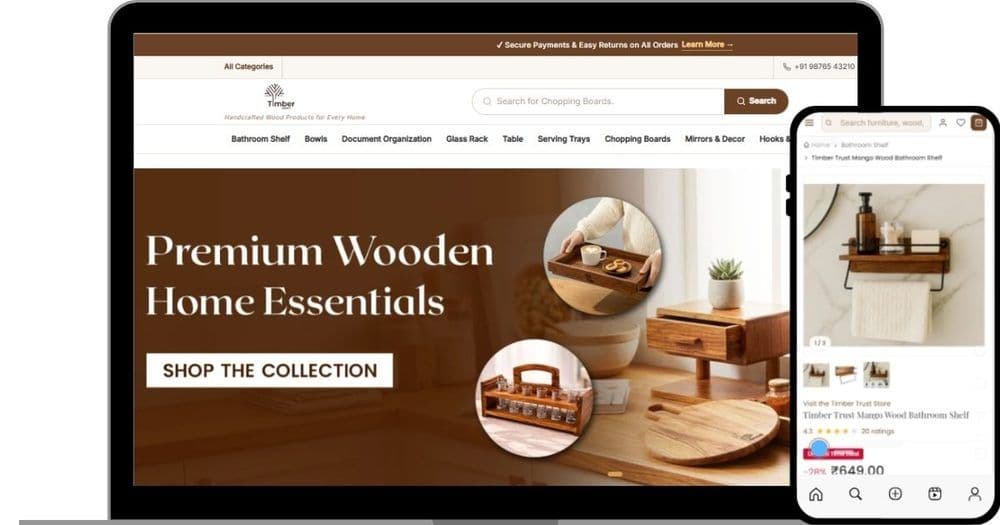
The Timber Trust
The Timber Trust is a Saharanpur woodcraft brand selling chopping boards, serving trays, mirrors, shelves and racks in acacia, mango and neem wood. Dcrayon moved its online store from Shopify to a custom Laravel site.A Saharanpur woodcraft brand renting its storefrontThe Timber Trust describes itself as a woodcraft brand born in Saharanpur, a town long associated with wood carving. Its range covers handmade kitchen and home pieces: round and rectangular chopping boards, serving trays with acacia handles, full-length standing mirrors, bathroom shelves, shot-glass racks, foldable kitchen racks, wall hooks, desk organisers, small tables and dog bowls. On 13 Oct 2026 the store listed 19 products in 10 categories.In April 2026 the store ran on Shopify. Dcrayon's proposal that month set out a move to a custom Laravel e-commerce site, with the brand keeping its thetimbertrust.com domain. The new store is now live on that domain, built on the same storefront code Dcrayon uses for its other Laravel commerce sites.Platform and app fees on every orderOn Shopify the brand paid a monthly plan, a fee on each transaction and separate subscriptions for the apps the store relied on. The plan and app fees repeat every month, and the transaction fee grows with every sale. The proposal noted that raw material and shipping costs already press on the brand's margins, so recurring platform costs mattered.A store the brand did not controlOn a hosted platform the brand rents the software. Customisation stops where the platform's permissions stop, and the code behind the store is not the brand's to keep or move. The proposal named this lack of ownership as a problem alongside the fees.Buyers who choose by timber, room and sizeThe range is defined by its timbers, acacia, mango and neem, and by where a piece goes in the home. A general retail theme groups products by type alone. The brand needed shoppers to be able to narrow the range by wood and by room, and to see dimensions before they buy a mirror or a shelf.Questions that come before a wooden purchasePeople buying wood for the kitchen ask how to oil a board, which wood suits which job, whether a size can be changed and how returns work. Without quick answers on the page, those questions can turn into emails or abandoned visits.Trade and corporate buyers alongside retailBulk and corporate gift orders need a different route from a single-item checkout, with a way to ask for quantities and quotes before an order is placed.
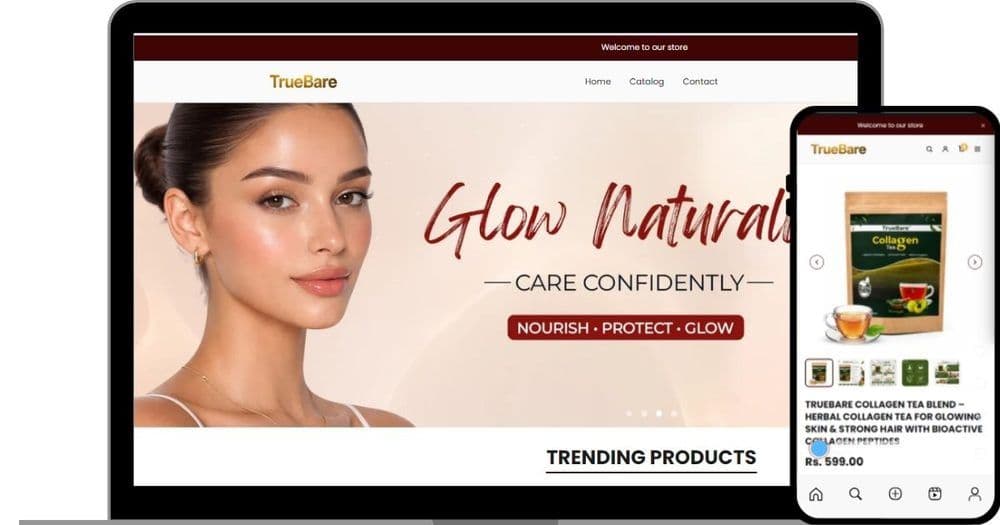
TrueBare
TrueBare sells herbal teas, shilajit, Kashmiri saffron and skincare in India. Dcrayon built its Shopify store at truebare.in and managed its Amazon and Flipkart channels.TrueBare is a brand of CMSOrganix Private Limited. Its 13-product range on 13 October 2026 had three strands. The wellness teas are an anti-ageing blend with ashwagandha, tulsi, turmeric and ginger, a collagen tea, a PCOD support tea and a weight and energy tea. The supplements are apple cider vinegar tablets with B12, shilajit resin, shilajit gold resin, shilajit gummies and Kashmiri mongra saffron. The skincare is a snail mucin serum with niacinamide, a sunscreen with moisturiser, a flaxseed cleanser and a brightening cream. Dcrayon's engagement covered the website alongside Amazon and Flipkart management.What a tea, a shilajit and a serum need from one storeTeas and supplements share a cart with cosmetics, at different tax rates.India's Goods and Services Tax (GST) charges different rates on different goods, and TrueBare's teas and supplements are not taxed like its cosmetics. A store that applies one rate to everything either overcharges on some products or undercharges on others, and the error surfaces later in the accounts.Buyers of things they drink or swallow want proof of what is inside.A shopper looking at a PCOD support tea or a shilajit resin wants to know the ingredients, the form, whether it contains caffeine and whether anyone has tested it. Marketing copy alone does not answer that, and a brand selling on its own site competes with marketplace listings that put specifications in a standard format.Wellness shoppers have the same few questions before they buy.How do I use it, how long until I notice a difference, is it safe every day, and what happens if it arrives damaged? If the store does not answer those, the questions arrive by message instead, or the shopper leaves.The same products also sell on Amazon and Flipkart.A brand on three channels needs its own store to say so clearly, and to give shoppers a reason to buy direct, without competing with its own marketplace listings.
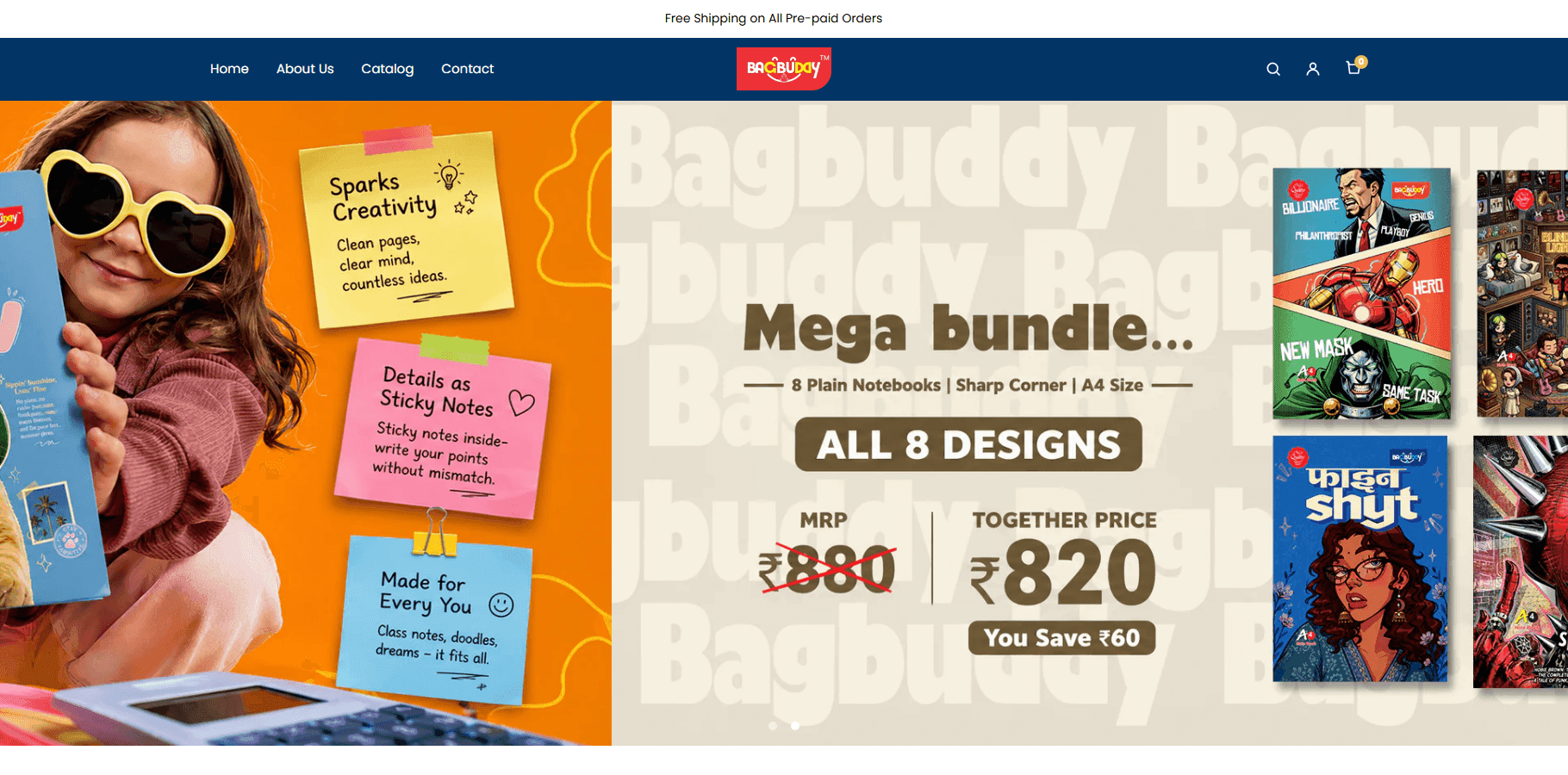
GetBagBuddy
BagBuddy is a paper stationery brand selling themed A4 notebooks and account books for school, work and creative use. Dcrayon built its Shopify store at getbagbuddy.com.A stationery brand with pop-culture coversBagBuddy describes itself as rooted in the legacy of Amit Prakashan, bringing a modern look to traditional stationery. Its notebooks carry pop-culture and character covers, from science heroes to anime and comics, and many come with sticky notes inside. On 13 Oct 2026 the store listed 20 products in two collections: Notebook and Money saver Packs.Many formats of the same productThe range mixes single notebooks of different page counts, packs of four, account books in two colours and bundles of eight notebooks or twelve registers. A buyer has to see page count, paper weight and pack size at a glance to compare value.Offers that reward bigger basketsThe brand runs two spend thresholds with a discount at each, and free shipping on pre-orders. Those offers only work if shoppers see them before they reach the cart.A small catalogue the brand runs itselfWith 20 products, the brand needed a store its own team could update without developer help.
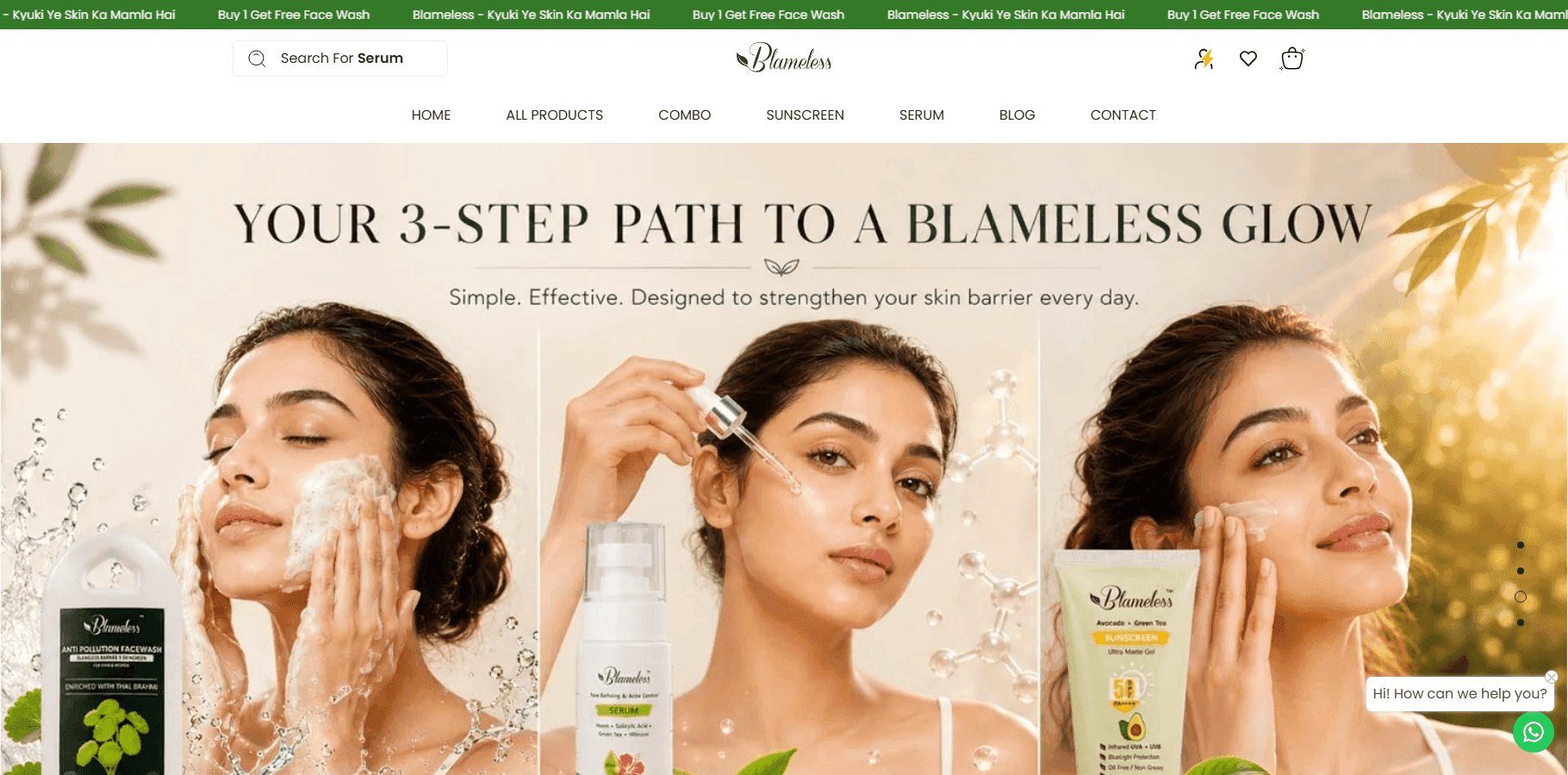
Blameless
Blameless sells serums, sunscreen and face care for oily and acne-prone skin to shoppers in India. Dcrayon worked on its Shopify storefront and was contracted to manage its Instagram account.Ten skincare products that each have to sell themselvesBlameless runs a deliberately short range. On 13 Oct 2026 the store listed ten products: three serums, a matte gel sunscreen, a face wash, a moisturiser spray, a co-branded "Blameless Barrier" range and combination packs. The brand's line, "Kyuki Ye Skin Ka Mamla Hai" (because it is a matter of your skin), sets a plain-spoken tone. In April 2026 the brand also contracted Dcrayon for Instagram account management; this case study focuses on the storefront.Each product explained through its ingredientsWith only ten products, every product page carries a lot of the selling. Shoppers choose by concern, such as oil control, acne or sun protection, and by active ingredient. If a product name does not say what is inside and who it is for, the shopper has to open every page to find out.Shoppers who arrive from short videosBlameless markets itself on Instagram. A shopper who has just watched a reel expects to find the same kind of video on the site and to buy from it, not to start again from a plain grid of product photos.Routines that should be bought togetherThe brand suggests pairing a serum with its matte sunscreen as a day routine. The store needed to sell that pairing as one product with one price.
How We Build Your Website
From first call to launch and beyond
We work in clear stages so you always know what is happening and what comes next. You see the design before we write code, you test the build before it goes live, and you keep everything we make.
- Step 1: Discovery
We start by learning your business, your buyer, and what a good outcome looks like in numbers: more orders, more qualified leads, fewer drop-offs. We map the pages, the user flows, and the tools the site needs to connect to, then agree on scope and a realistic timeline before any design starts.
- Step 2: Design
We design the key screens first, on mobile and desktop, so you can see the real layout, copy structure, and calls to action. You review and we refine. Nothing moves to build until the design answers the question every visitor asks: what is this and what do I do next.
- Step 3: Build
Our engineers turn the approved design into clean, custom code. We build the front end for speed, set up the content structure so your team can edit pages, and wire in the back end: checkout, payments, forms, search, and your CRM or marketing tools. The site is responsive and accessible from the first commit, not patched later.
- Step 4: Test and Launch
We test on real devices and browsers, check page speed and mobile behaviour, and run the full path a buyer takes, from landing to confirmation. We set up analytics, redirects, and basic on-page SEO so search engines and your tracking work on day one. Then we deploy and watch the launch.
- Step 5: Support and Grow
After launch we stay available to fix issues, train your team on the admin, and ship improvements based on what real users do. A website is never finished, so we treat it as something you keep improving, not a one-time delivery.
Technologies we build on
We pick the right platform for your goals instead of forcing one stack on every project. From content sites to custom web apps, here is what we build in.

Shopify
D2C stores, Shopify Plus, and custom theme builds.

WordPress
Content sites, blogs, and landing pages your team can edit.

Wix
Fast-launch sites for SMBs with easy content management.

Squarespace
Design-led sites for portfolios, brands, and service businesses.

Magento
Enterprise e-commerce with complex catalogues and B2B flows.

Laravel
Custom web apps, portals, and APIs built for scale.

Drupal
Structured, multi-section sites with complex content models.

Webflow
No-code CMS with pixel-precise design and clean exports.

WooCommerce
WordPress-native stores for flexible product and pricing setups.

BigCommerce
Scalable SaaS commerce for high-volume and multi-channel retail.

.NET
Enterprise-grade web apps, APIs, and portals on Microsoft stack.

ABP Framework
Rapid modular .NET application platform for complex business apps.

WordPress VIP
Managed enterprise WordPress for high-traffic, compliance-heavy sites.

Sitecore
Enterprise DXP for large content and personalisation teams.

Contentful
Headless CMS feeding fast front-ends across channels.

Custom code
Hand-built front-ends and integrations when off-the-shelf won't fit.
Why Choose Dcrayon for Web Development

Every website type, one team
Custom marketing sites, lead-gen pages, D2C and e-commerce stores, SaaS apps, listing and real-estate portals, booking platforms, B2B sites, web apps, and content and CMS sites all sit under one roof. Designers and developers work together, so a storefront, a portal, or a product app gets the same team and the same standard. You own the code, the design files, and the accounts.

AI-first since 2024
Every web development engagement also ships share-of-answer work across ChatGPT, Gemini, Perplexity, and Google AI Overviews. Your site is built to be found by people and by the AI assistants they now ask first, not only in classic search.

We work from your numbers
We read the search and analytics signals before we build, and we check every build decision against the figures rather than guessing. A five-axis Growth Intelligence sets the baseline before a single page goes live, so design choices answer to measurement.
A 90-day program, not a one-off build
The engagement is tied to one revenue metric you pick, with a weekly working cadence and a monthly summary written so your CFO can read it in one pass. There is a mutual kill-switch at day 90, so both sides stay honest about whether it is working.
We do design and engineering under one roof, so the people drawing the page and the people writing the code are on the same team. That removes the usual gap where a pretty design becomes a slow, broken build, and it keeps the project moving instead of stalling on handovers.
We build for outcomes, not just looks. Every page is made to load fast, work on a phone, and guide the visitor toward a clear action, because that is what drives orders and leads. We connect the site to the tools you already use and set it up so your own team can update content without calling us for every change.
You own everything we deliver: the code, the design files, and the accounts. We write code that other developers can read and extend, document what matters, and explain our decisions in plain language. The goal is a site that keeps working and growing long after launch.

Most questions come down to one thing: will this work for my business?
These are the honest answers we give on the first call. Senior people on the work, weekly reporting, and everything we build is yours to keep.
FAQ
Frequently asked questions
The questions buyers ask us before the first call. If yours is not here, just ask, and we answer straight.
All of them. Custom marketing sites to win attention, lead-generation sites to capture and qualify enquiries, D2C and e-commerce storefronts to sell direct, SaaS product apps for subscription software, listing and real-estate or property portals for inventory at scale, booking platforms for appointments and reservations, B2B sites for longer sales cycles, web apps and customer portals, and content and CMS sites for publishing. Each is staffed by the same design and engineering team and built around a concrete outcome you care about, so the standard holds whether you need a five-page brochure site or a multi-tenant web app.
We have been AI-first since 2024. Alongside the traditional web and e-commerce build, every engagement also ships share-of-answer work across ChatGPT, Gemini, Perplexity, and Google AI Overviews. So when a buyer asks an AI assistant instead of typing a search query, your site and your answers are in the response. We read the search and analytics signals before we build and check every build decision against the numbers, rather than guessing.
We build on WordPress, Laravel, Drupal, Sitecore, Contentful, and custom code. The choice follows the job. WordPress or Drupal for content and CMS sites, Laravel or custom code for SaaS apps, portals, booking platforms, and listing sites, and Contentful or Sitecore where a brand needs a structured content back end. We read your numbers first, then pick the stack that fits the website type and the one revenue metric you chose, not the other way round.
Each engagement runs as a 90-day program tied to one revenue metric you choose. You get a weekly working cadence so you always know where things stand, plus a monthly summary written so your CFO can read it. There is a mutual kill-switch at day 90, so neither side is locked into something that is not working. Build timelines vary by scope, from a few weeks for a marketing site to longer for an e-commerce or SaaS build.
Yes. We build D2C and e-commerce storefronts on platforms like WordPress and custom code, and SaaS product apps on Laravel and custom builds where the app itself is the product. We also build listing and real-estate or property portals, booking platforms, B2B sites, and customer portals, usually on Laravel or custom code. The breadth means one team can take you from a marketing site to a full product without a handoff, with the same five-axis Growth Intelligence baseline and the same measurement against one revenue metric.
You do. You own the code, the design files, and the accounts, with design and engineering both under one roof at Dcrayon. There is no lock-in to a proprietary builder you cannot leave. If the relationship ends, including at the day-90 kill-switch, you keep everything we built and every account stays in your name. Founded in 2016, we work with 485 active clients and have shipped 500-plus campaigns across India, the US, the UK, and the UAE, with offices in Delhi and Wyoming.
Have a project in mind?
Let's discuss how we can help bring your vision to life.
Tell us about your business, the services you are weighing up, and the site you have now. We will point you to the work above that is closest to yours and what a similar scope would involve.
Since 2016 Dcrayon has worked across India, the US, the UK and the UAE, so there is usually a comparable brief behind the work you have just read.