 All Case Studies







The Timber Trust at a glance
The main facts of The Timber Trust store move.
| Item | Detail |
|---|---|
| Client and industry | The Timber Trust, handmade wooden kitchenware and home pieces, Saharanpur |
| Market and audience | India; home buyers, gift buyers and corporate orders |
| Our scope | Move from Shopify to a custom Laravel store, with storefront, checkout and account features |
| Platform and stack | Laravel, PHP 8.3, Blade, Alpine.js, Vite; Razorpay; hosted on Hostinger |
| Catalogue on 13 Oct 2026 | 19 products in 10 categories |
Challenge
The Timber Trust is a Saharanpur woodcraft brand selling chopping boards, serving trays, mirrors, shelves and racks in acacia, mango and neem wood. Dcrayon moved its online store from Shopify to a custom Laravel site.
A Saharanpur woodcraft brand renting its storefront
The Timber Trust describes itself as a woodcraft brand born in Saharanpur, a town long associated with wood carving. Its range covers handmade kitchen and home pieces: round and rectangular chopping boards, serving trays with acacia handles, full-length standing mirrors, bathroom shelves, shot-glass racks, foldable kitchen racks, wall hooks, desk organisers, small tables and dog bowls. On 13 Oct 2026 the store listed 19 products in 10 categories.
In April 2026 the store ran on Shopify. Dcrayon's proposal that month set out a move to a custom Laravel e-commerce site, with the brand keeping its thetimbertrust.com domain. The new store is now live on that domain, built on the same storefront code Dcrayon uses for its other Laravel commerce sites.
Platform and app fees on every order
On Shopify the brand paid a monthly plan, a fee on each transaction and separate subscriptions for the apps the store relied on. The plan and app fees repeat every month, and the transaction fee grows with every sale. The proposal noted that raw material and shipping costs already press on the brand's margins, so recurring platform costs mattered.
A store the brand did not control
On a hosted platform the brand rents the software. Customisation stops where the platform's permissions stop, and the code behind the store is not the brand's to keep or move. The proposal named this lack of ownership as a problem alongside the fees.
Buyers who choose by timber, room and size
The range is defined by its timbers, acacia, mango and neem, and by where a piece goes in the home. A general retail theme groups products by type alone. The brand needed shoppers to be able to narrow the range by wood and by room, and to see dimensions before they buy a mirror or a shelf.
Questions that come before a wooden purchase
People buying wood for the kitchen ask how to oil a board, which wood suits which job, whether a size can be changed and how returns work. Without quick answers on the page, those questions can turn into emails or abandoned visits.
Trade and corporate buyers alongside retail
Bulk and corporate gift orders need a different route from a single-item checkout, with a way to ask for quantities and quotes before an order is placed.
What changed when The Timber Trust left Shopify
The store before and after the move, area by area.
| Area | Before | After | Evidence |
|---|---|---|---|
| Platform cost | Monthly plan, per-order fee and app subscriptions | No per-order platform fee; gateway charge only | Proposal and live store |
| Ownership | Hosted store on rented software | Custom Laravel store the brand owns | Live site |
| Browsing | Product-type collections | Wood-type filter, Browse by Room and a category mega menu | Live listing page and homepage |
| Questions before buying | Email or messages | Chat assistant with wood, care and returns questions, plus WhatsApp | Live chat widget |
| Trade buyers | Same checkout as retail | Bulk and Corporate Orders enquiry page | Live page |
Solution
Why The Timber Trust left Shopify for Laravel
The decision was between staying on Shopify with more apps, or moving to a store the brand owns. The proposal compared the two. Staying meant the monthly plan, the per-order fee and a growing list of app subscriptions, with features limited to what themes and apps allow. A custom Laravel store meant no platform fee on each order, only the payment gateway's charge, and full control of the code, the data and the design. The trade-off is that hosting, updates and backups become the brand's responsibility with its developer, rather than the platform's. The brand chose ownership, and the store was built as a custom web application; the move itself falls under our website redesign work.
A storefront shared with Dcrayon's other Laravel stores
The Timber Trust runs on Laravel with Blade templates on the server and Alpine.js, a small JavaScript library, for the interactive parts of each page. Assets are built with Vite, and the site runs on PHP 8.3. Its front-end bundle has the same structure as Dcrayon's other Laravel stores: four shared Alpine stores hold the state that every page needs (cart for the basket, wishlist for saved items, authModal for the sign-in and registration dialog, and toast for short confirmation and error messages), and a set of reusable Alpine components handles accordions, drop-downs, image galleries, modals, quantity selectors, search and tabs.
Page-level components sit on top of those. A searchBar component runs the header search, quickViewModal opens a product preview from any listing, recentlyViewed keeps a short history of products the visitor has opened, frequentlyBought suggests related pieces on product pages, pwaInstall offers to add the site to a phone's home screen, exitIntent shows the newsletter offer when a visitor is about to leave, and chatbotWidget runs the chat assistant. The Timber Trust therefore started with a cart, search and sign-in that were already in use on other Dcrayon stores, rather than building them from nothing.
Shopping by room, category and wood
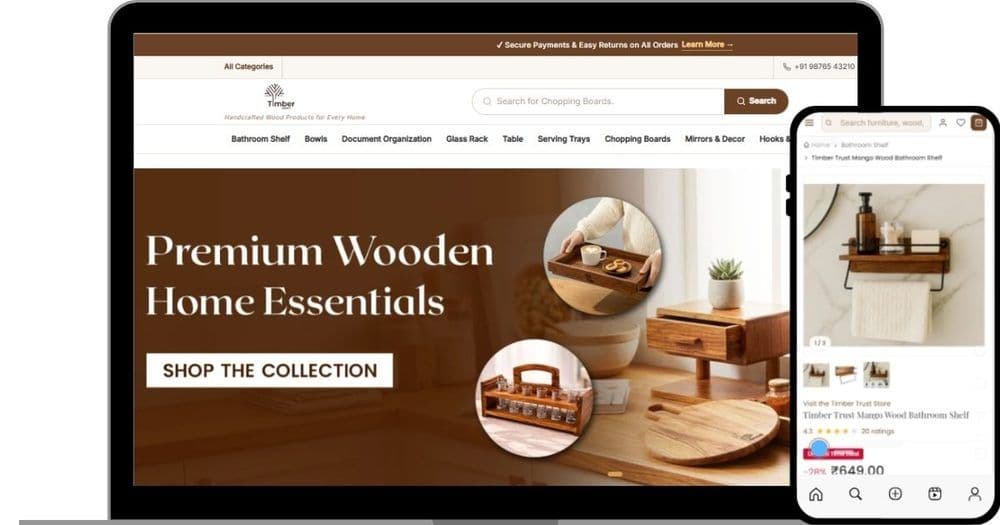
The header carries a mega menu and an All Categories drop-down covering chopping boards, serving trays, bowls, mirrors and decor, bathroom shelves, glass racks, hooks and racks, desk organisers, tables and dog bowls. The homepage adds a Browse by Room section, a Featured Collection, a Trending Now row and a timed offer on wood kitchenware. On the product listing page, a filters sidebar lets shoppers narrow the range by wood type, so someone who wants acacia for a chopping board sees only acacia pieces.
Product names carry the timber and, where it matters, the dimensions, such as an acacia shot-glass rack listed with its size in inches or a round acacia board listed with its diameter. Each product page has an image gallery, a quantity selector, related "frequently bought" pieces and a full details view, and listing cards open the same product in a quick-view window without leaving the page.
Search that answers while the visitor types
Search opens from anywhere on the site with Ctrl+K or Cmd+K, or from the header. As the visitor types, it suggests matching products, keeps the last five searches in the browser for one-tap reuse and offers trending searches such as pet chopping boards and pet bowls. Arrow keys move through the suggestions, Enter opens the selected product, and a full results page is one keystroke away.
Sign-in, checkout and order tracking
The authModal dialog handles sign-in and registration without sending the visitor to a separate page. Customers can sign in with Google or Facebook, or with an email address and password. A forgotten password is reset with a six-digit code sent by email, entered into six boxes that accept a pasted code. Signing in is required before checkout, so every order is tied to an account with its history, addresses and wishlist. Payments run through Razorpay, and customers can follow an order from the Track Order page. Our e-commerce solutions cover this checkout and account set-up.
A chat assistant for wood questions
The chatbotWidget component opens a chat panel with six quick questions: wood types and their differences, delivery timelines and charges, custom orders and sizing, wood care, returns and refunds, and order tracking. A visitor can tap one or type their own question, and the replies appear in the same panel. For anything the assistant cannot settle, a WhatsApp button opens a direct conversation with the brand. The blog carries the longer answers, including a guide to caring for a wooden chopping board.
A separate route for bulk and corporate orders
A Bulk and Corporate Orders page gives trade and gifting buyers their own route, linked from the footer next to the brand's other customer service pages. It is aimed at hotels, offices, builders and interior designers, and its enquiry form collects a name, contact details, a subject and the order details, protected by the same CSRF token as the rest of the site. Large or custom orders arrive as enquiries the team can quote for, while single pieces go through the normal checkout.
Security headers and protected sessions
Every response from the store carries a set of browser security headers, checked with a header request on 13 Oct 2026. HSTS (HTTP Strict Transport Security) tells browsers to use HTTPS only, for a year, across subdomains, and carries the preload directive used by browser preload lists. X-Frame-Options stops other sites from framing the pages, X-Content-Type-Options stops browsers from guessing file types, the referrer policy limits what is shared with other sites, and the permissions policy turns off camera, microphone and location access. A cross-origin opener policy isolates the site's windows, and the content security policy upgrades any insecure request to HTTPS.
Forms are protected by Laravel's CSRF tokens (cross-site request forgery protection, which checks that a form was submitted from the site itself). The session cookie is marked secure, HTTP-only and same-site, so it travels only over HTTPS, cannot be read by page scripts and is not sent with requests started by other sites.
Structured data and a split sitemap
Product pages publish structured data for the product, its offer, its shipping details and delivery time, the regions it ships to, and the return policy, which search engines can use to show price and delivery information. The sitemap is an index of five sitemaps for pages, products, categories, brands and blog posts, so new products and articles are picked up without a manual update. Our technical SEO service covers this layer.
Front-end components on the Timber Trust store
The reusable Alpine.js pieces behind the storefront, from shared state to page-level components.
| Component level | Examples from this build | Used on |
|---|---|---|
| Shared stores | cart, wishlist, authModal, toast | Every page |
| Reusable components | accordion, dropdown, imageGallery, modal, quantitySelector, search, tabs | Product pages, menus and dialogs |
| Page components | searchBar, quickViewModal, recentlyViewed, frequentlyBought | Header, listings and product pages |
| Site-wide widgets | chatbotWidget, pwaInstall, exitIntent | Every page |
Security controls visible on thetimbertrust.com
The browser-facing controls the store sends, and how each was checked.
| Control | Where it applies | How it was checked |
|---|---|---|
| HSTS for one year, with subdomains and preload | Every response | Response headers |
| Frame blocking and content-type protection | Every page | Response headers |
| Camera, microphone and location turned off | Every page | Permissions policy header |
| CSRF tokens on forms and cart requests | Sign-in, registration, cart and bulk enquiry form | Token in page markup and cookie |
| Secure, HTTP-only, same-site session cookie | Every signed-in session | Cookie attributes |
Results
What The Timber Trust runs on today
Shoppers can browse The Timber Trust by room, category or wood type, find a product with instant search, preview pieces without leaving a listing, sign in with Google or Facebook, pay through Razorpay, track an order and get answers about wood, care and returns from the chat assistant or on WhatsApp. Corporate buyers have their own enquiry page.
For the brand, the store is its own. There is no platform fee on each order, the code and data belong to the business, and the features it needs, from wood-type filters to the bulk order route, are part of the site rather than separate app subscriptions. Sales figures for the new store are not published.
Key takeaways
What leaving a hosted platform involves
Moving off a hosted platform is a business decision before it is a technical one. For a homeware brand paying a monthly plan, a fee on every order and several app subscriptions, owning the store removes the per-order fee and the app bills, and lets the store reflect how the brand actually sells: by timber, by room and by trade enquiry. The trade-off is responsibility, because hosting, security updates and backups move to the brand and its developer.
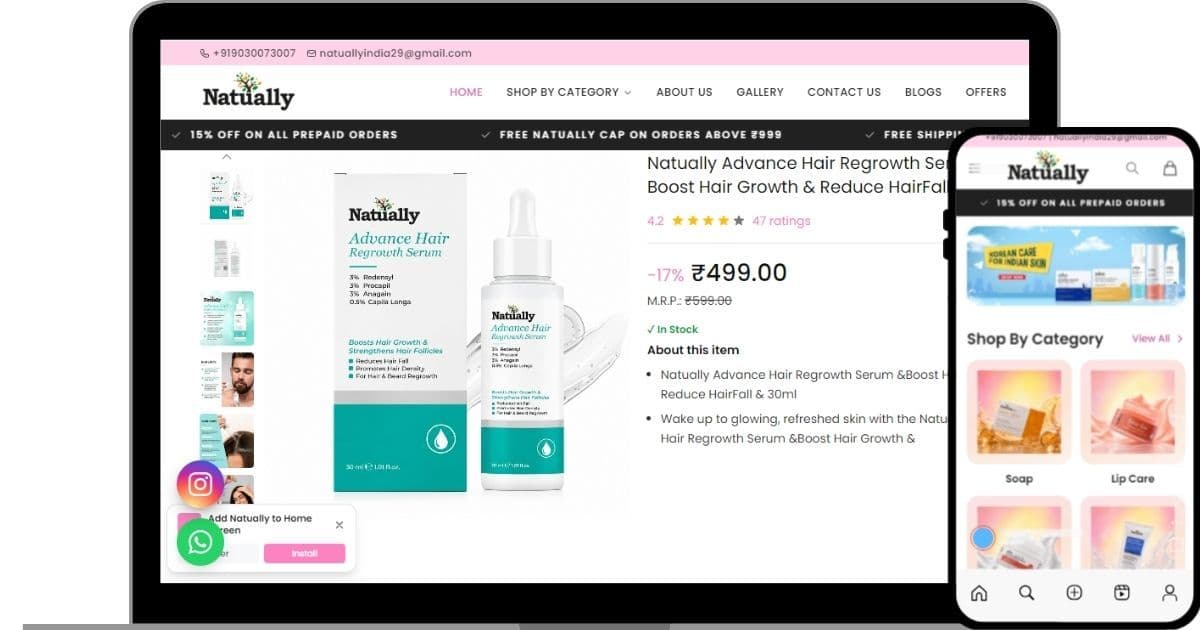
A platform move also changes web addresses. Product pages are only one part: collection and page addresses from the old store need permanent redirects too, so that links shared on social media and indexed by search engines still land somewhere useful. Our comparison of BigCommerce and Shopify covers the hosted options, our article on features a Laravel store needs covers the custom route, and Natually's move from Shopify to Laravel shows how another brand handled its links.
If you are weighing a move off Shopify, talk to our team.
CategoryWeb Development
More work