 All Case Studies










Vriksha Veda at a glance
The main facts of the Vriksha Veda store project.
| Item | Detail |
|---|---|
| Client and industry | Vriksha Veda, raw botanical ingredients for DIY skin and hair care |
| Market and audience | India, DIY beauty makers and natural skincare shoppers |
| Engagement period | From April 2024 |
| Our scope | Shopify store design and build |
| Platform and stack | Shopify, Horizon base with custom sections, Judge.me, live video shopping, WhatsApp chat |
| Live URL | vrikshaveda.com |
Challenge
Vriksha Veda sells raw botanical ingredients for home-made skin and hair care, working with Indian farmers since 2020. Dcrayon designed and built its Shopify store at vrikshaveda.com.
The engagement began in April 2024, and nine invoices have been raised across it. The store sells ingredients rather than finished products: raw herbs and botanical powders, fruit pulp powders, ubtan bathing powders, cold-pressed and unrefined oils, plant gels, essential oils, steam-distilled hydrosols, clays, shade-dried flowers, Ayurvedic wellness items, gift kits and zero-waste tools. On 13 October 2026 the shop-all collection held 110 products, with a Farmer's Box, a set of courses and a postpartum hair care range alongside them.
Selling raw botanicals to makers and newcomers
Shoppers arrive with a problem, not an ingredient name.
Someone dealing with dandruff or post-acne marks may not know that rosemary hydrosol or a particular clay is what they are after. A store organised only by ingredient type serves the experienced DIY maker and loses the newcomer.
One ingredient comes in several sizes and containers.
Rosemary hydrosol, for example, is sold in 50 ml and 100 ml glass bottles, a 500 ml aluminium bottle and a 1 litre pack. Each size needs its own price and stock without becoming a separate product page.
Raw ingredients need handling notes.
Unlike a finished cream, a hydrosol or a herb powder comes with questions about shelf life, storage, natural changes in colour and aroma between batches, and patch testing. Buyers need that information on the product page, not in a reply to an email.
Solution
A two-way menu: by ingredient and by concern
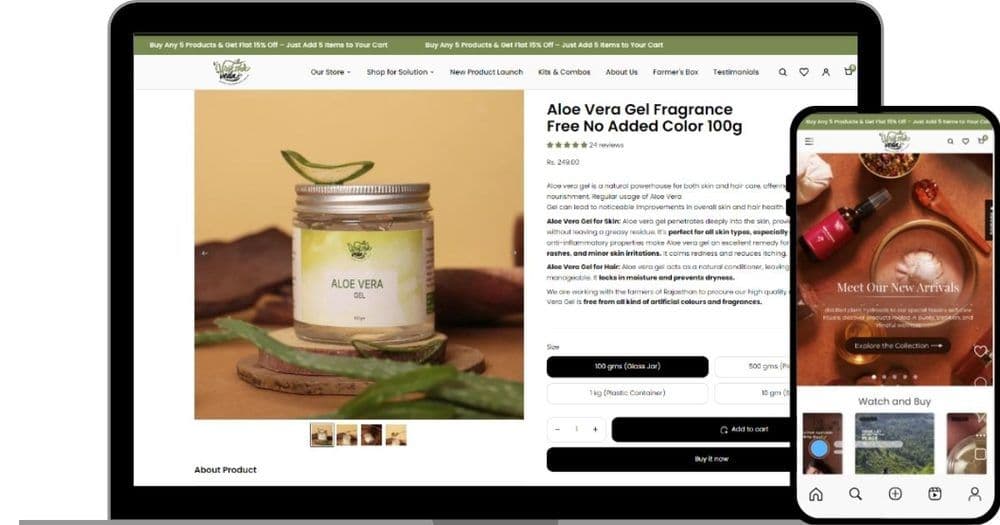
The menu offers two ways in. "Our Store" lists the range by ingredient type, from raw herbs to hydrosols and clays. "Shop for Solution" lists it by concern: hair fall, hair growth and thickness, dandruff, itchy or oily scalp, dry and frizzy hair and premature greying on the hair side; acne, acne marks, pigmentation, sensitive or redness-prone skin, dry, oily, dull and mature skin, everyday skincare and bridal glow on the skin side. Behind the two menus sit 49 collections, so the same product can appear under both and each shopper finds it their way.
Product pages with sizes and handling notes
Product pages carry each size as a variant with its own price, then an "About Product" block with the botanical name, shelf life, quantity, ingredients, packaging, storage, aroma notes and a patch-testing reminder, followed by product FAQs and related products. The rosemary hydrosol page, for instance, states that the water is steam-distilled by farmers in Uttarakhand and that colour and aroma can vary between monthly batches.
Home page sections on a Horizon base
The store runs on a version of Shopify's Horizon theme with custom home page sections: a custom announcement bar for the buy-five offer code, a full-width banner slider, a shop-by-category grid, a "what defines us" values section, a tabbed collections row of best sellers, a dual banner, a gallery carousel, a farm-support section about the farmers behind the ingredients, and a custom footer. The announcement bar, banner slider, tabbed collections and footer sections are the same custom sections used on the TrueBare store. This is the Shopify development and UI/UX design side of Dcrayon's work.
Bulk orders, live video and WhatsApp at Vriksha Veda
A bulk purchase request page gives larger buyers a form instead of a phone call, and a medical disclaimer page sits beside the usual policies. A "Watch and Buy" section runs live video shopping, Judge.me and a Google reviews app show feedback, and shoppers can keep a wishlist or reach the brand on WhatsApp.
Vriksha Veda home page sections and their jobs
The custom sections on the Vriksha Veda home page and what each one does.
| Application part | What it does in this project |
|---|---|
| Custom announcement bar | Carries the buy-five offer code on every page |
| Full-width banner slider and dual banner | Campaign and new-launch banners |
| Shop by category and tabbed collections | Entry points by ingredient type and best sellers |
| What defines us and farm support | Brand values and the farmers behind the ingredients |
| Gallery carousel and custom footer | Visual stories and policy, bulk and support links |
Vriksha Veda search themes by concern
The searches the store's two menus and product pages are organised around.
| Search intent | Keyword themes |
|---|---|
| Ingredient | rosemary hydrosol; unrefined rosehip oil; aloe vera gel; cosmetic clays |
| Hair concern | hair fall control; dandruff; premature greying; postpartum hair care |
| Skin concern | acne marks; pigmentation; bridal glow; sensitive skin |
Results
What Vriksha Veda shoppers can do now
Shoppers can find an ingredient either by name or by the hair or skin problem they want to solve, choose the size that suits them on one page, and read handling and safety notes before buying. Bulk buyers have a request form, and every shopper can watch products in use or message the brand. Vriksha Veda's sales figures are not published.
Vriksha Veda store outcomes
What the store now does for shoppers.
| Outcome | What changed | Status |
|---|---|---|
| Browse by concern | Shop for Solution menu across hair, scalp and skin concerns | Delivered |
| Sizes on one page | Glass, aluminium and bulk sizes as variants of one product | Delivered |
| Handling notes | Botanical name, shelf life, storage, aroma and patch-test notes | Delivered |
| Bulk enquiries | Bulk purchase request page | Delivered |
Key takeaways
What an ingredient store needs from its menu
An ingredient store has two audiences, and the menu should serve both. Pairing an ingredient-type menu with a concern-based one is the simplest way to do that without duplicating products. The handling notes matter just as much: for raw botanicals, shelf life and patch testing are part of the product, not small print.
For more on making a Shopify catalogue findable in search, read our Shopify SEO guide. For another wellness store built on the same custom sections, see the TrueBare case study.
Selling natural ingredients or a large variant catalogue? Talk to Dcrayon.
CategoryWeb Development
More work