 All Case Studies






What's in these case studies
Every study below ships a documented revenue, ROAS or pipeline number we can defend to your CFO. Some are under NDA: ask on the intro call.
Senior on every call
The strategist who scoped the work runs the work. No handoff to an account manager after the kickoff.
Named leads on LinkedIn
Every account has named SEO, paid, social, web, and AI leads. You see who is doing the work before you hire us.
Weekly written report
Under 800 words, in your inbox Friday morning. What shipped, what moved, what didn't, what we are doing next week.
No annual lock-in
Month-to-month retainer. Mutual kill-switch in every SoW after 90 days. If we are not earning the fee, leave.
Filters
7 articles
Proven Water Industries
Ecommerce
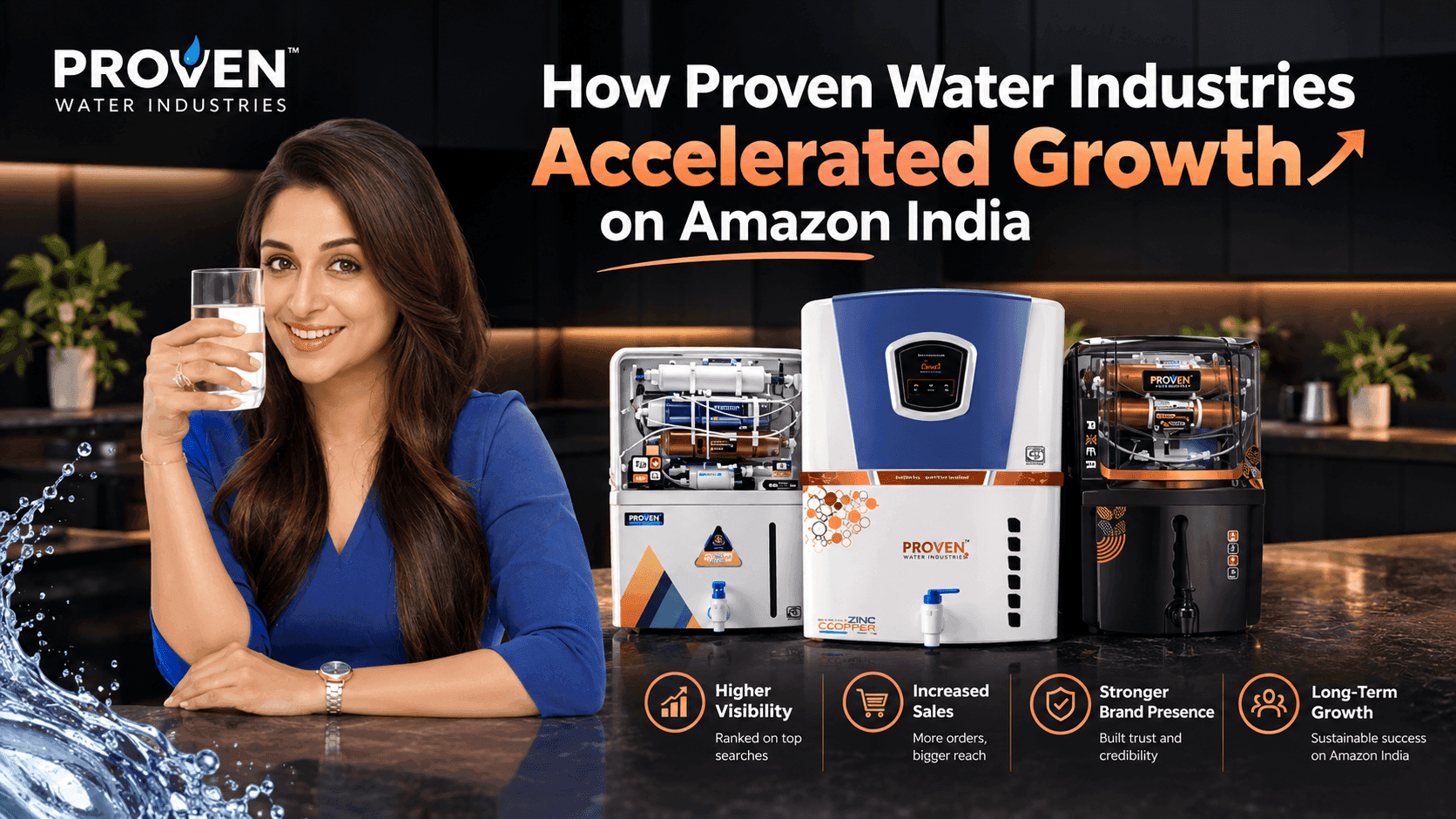
Proven Water Industries makes RO, UV and UF water purifiers for Indian homes and sells them through its PROVEN store on Amazon India. Dcrayon runs the account's advertising and listing work.A purifier brand competing on price in a category that buys on trustProven's range is built around 12-litre purifiers that combine RO (reverse osmosis, a membrane that removes dissolved salts), UV (an ultraviolet lamp that treats microbes) and UF (ultrafiltration, a fine membrane filter), most with copper, zinc or alkaline stages and a TDS adjuster. TDS means total dissolved solids, the measure of salts and minerals in water, and it is the number that tells a household whether it needs RO at all. The models carry names such as Pixer, Swift, Nexon, Jupiter, Magnum and Eleven, and in October 2026 the store held 37 listings on Amazon.in. Proven's advertising account is connected to Dcrayon's in-house Amazon Ads platform, and our scope covers Sponsored Products, listing content and catalogue data.In early October the account's order rate had fallen steeply since August, while account health stayed normal. On 8 October 2026 we ran a full brand audit to find out why, using the account's own order, advertising and FBA (Fulfillment by Amazon) data, Amazon's Business Reports and Search Query Performance report, Amazon's catalogue data, and Jungle Scout keyword and share-of-voice data for Proven against five rival brands. The audit found three causes acting at the same time, plus listing faults that made each of them worse.The best-selling models ran out of FBA stockSix of the models that carried most of the August sales, including Nexon Copper, Jupiter Full Brown, Magnum Black and two Pixer Copper versions, ran out of stock in Amazon's warehouses between mid-August and mid-September. When a listing has no stock its page drops out of search, and it starts lower when stock returns. Most of the fall in orders traced back to these six products, and advertising was still running on some of them while their stock ran down.Clicks became far more expensive without buying more salesSeveral campaigns had been switched to Amazon's "dynamic bids - up and down" strategy, which Amazon describes as raising or lowering a bid based on performance by up to 100 percent. Spend moved into top-of-search placements, and the account's average cost per click more than doubled between late July and September. Budgets were not the limit: only 2 of the account's 215 campaigns reached their daily budget. The bids were. The same weekly spend was buying roughly half the clicks it had bought in July, and searches with no chance of converting, such as "amazon warehouse" and searches for a rival brand's filters, were still being paid for.Shoppers saw PROVEN more often but bought it lessAmazon's Search Query Performance report for Proven's 15 biggest searches showed the brand's share of impressions roughly doubling between August and late September, paid for by advertising, while its share of purchases on the same searches fell by more than half. The wider market had dipped after the monsoon peak, but far less than Proven had. Price was not the cause: at the deal price Proven was the cheapest RO purifier with copper and alkaline stages on page 1. The pages were losing the shopper after the click.The listings contradicted themselves and hid their own highlightsThe best-selling Pixer page said "10-stage" in its first bullet and "12-stage" in its highlight line. Fourteen SKUs had titles past the 75-character limit Amazon introduced on 27 July 2026, so Amazon flagged them and hid their Item Highlights line. Every listing shared one 397-byte backend search string that repeated "water purifier" 16 times and was identical for every model. Fourteen listings described their purification method as "Alkaline" rather than reverse osmosis, duplicate SKUs gave the same product a different capacity and model name, and Amazon was hiding images on 23 listings for breaking its image standards. The second image on the Pixer page announced the installation charge before it showed the product's benefits.
Glowral
Ecommerce
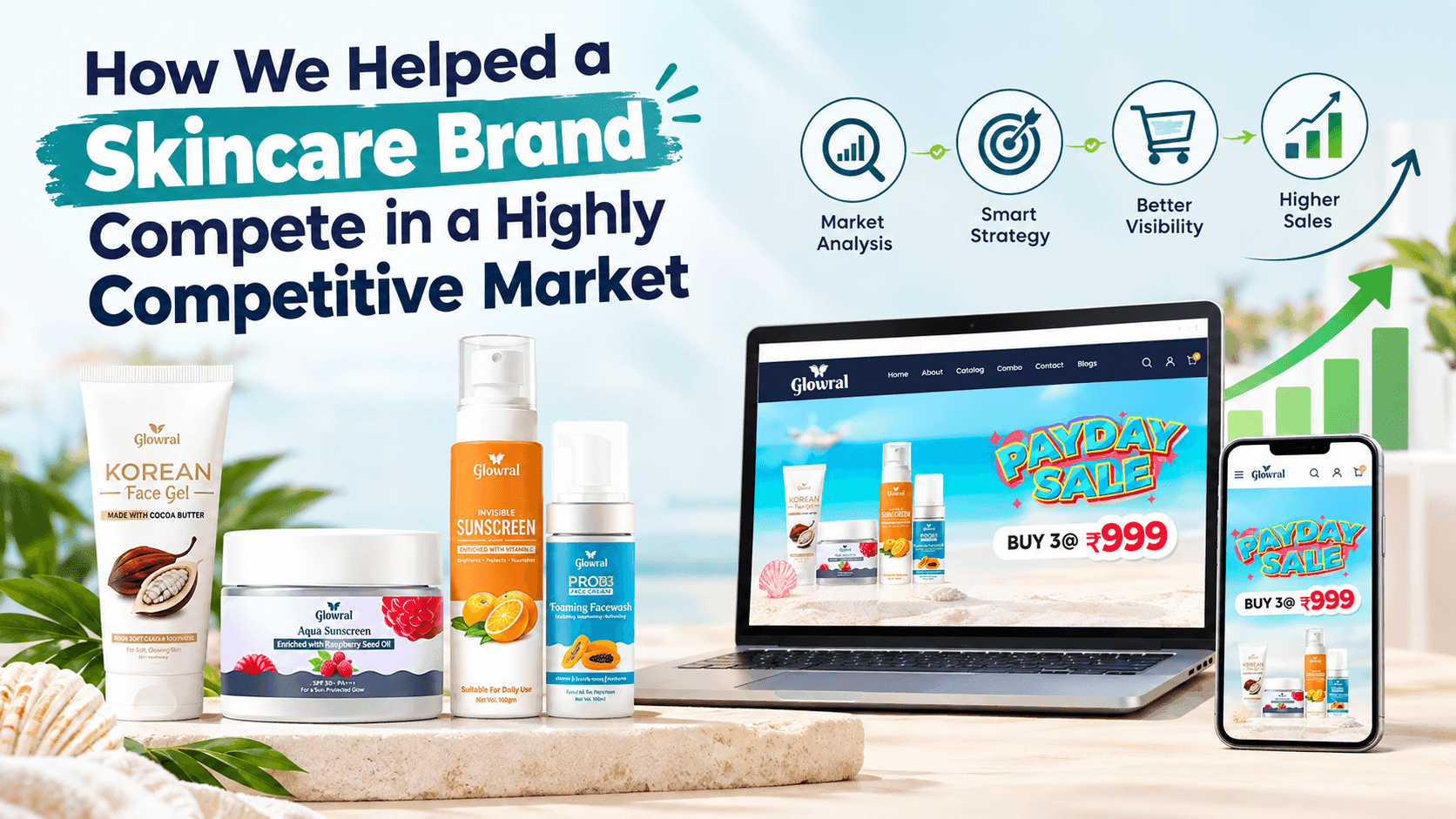
Glowral is an Indian skincare brand selling sunscreens, a Korean-style face gel and a foaming face wash from its Shopify store. Dcrayon was asked to help the store get found in search.The range was small and specific. In December 2025 the store's product sitemap listed seven products: a Sunscreen Body Spray SPF 50 with vitamin C, an Aqua Sunscreen made as a water-based gel, a Korean Face Gel with Cocoa Butter, a Foaming Facewash with salicylic acid, a Daily Glow Combo, a Sun Protection Combo and an All in One Skincare Kit. Its buyers choose skincare by skin type and by concern, such as oily skin, acne, dryness, sun exposure and city pollution.Dcrayon had already built the store's theme, which is covered in the Glowral storefront case study. This project was about search: an SEO audit, keyword research by intent, product page rewrites, a blog built on shopper questions, internal linking and structured data.Why Glowral's products were hard to find in skincare searchBroad skincare searches belonged to large, established brands.Searches such as "sunscreen", "face wash" or "moisturiser" return pages from brands with high domain authority and many backlinks, the links from other websites that search engines read as votes of confidence. A new store with seven product pages could not expect to rank for those terms soon, and a plan built only around them would have left Glowral's pages out of sight.The product pages were not ranking for the terms they were built to sell.The audit found that most product pages did not appear for the commercial keywords that matched them, the phrases people type when they are ready to buy. A shopper looking for a gel sunscreen for oily skin had no route from Google to the product made for exactly that need.Several pages were competing with each other for the same keywords.This is keyword cannibalisation. When two or more pages on one site target the same query, the search engine has to guess which one matters, and it often ranks neither well. On a store this small, every duplicated target wasted one of the few pages Glowral had.Shoppers' questions had nowhere to land.Skincare buyers research routines, ingredient benefits and which product suits their skin type before they buy. The store had little educational content for those searches, and many products could be reached only through the menus, so specific searches had no page to arrive on.A new brand had to earn trust before the first order.People putting a product on their face want clear descriptions, ingredient explanations, usage instructions and answers to common worries before they try an unfamiliar name. Search engines look for the same signals when they judge whether a page is helpful.
Keratine Professional
Ecommerce
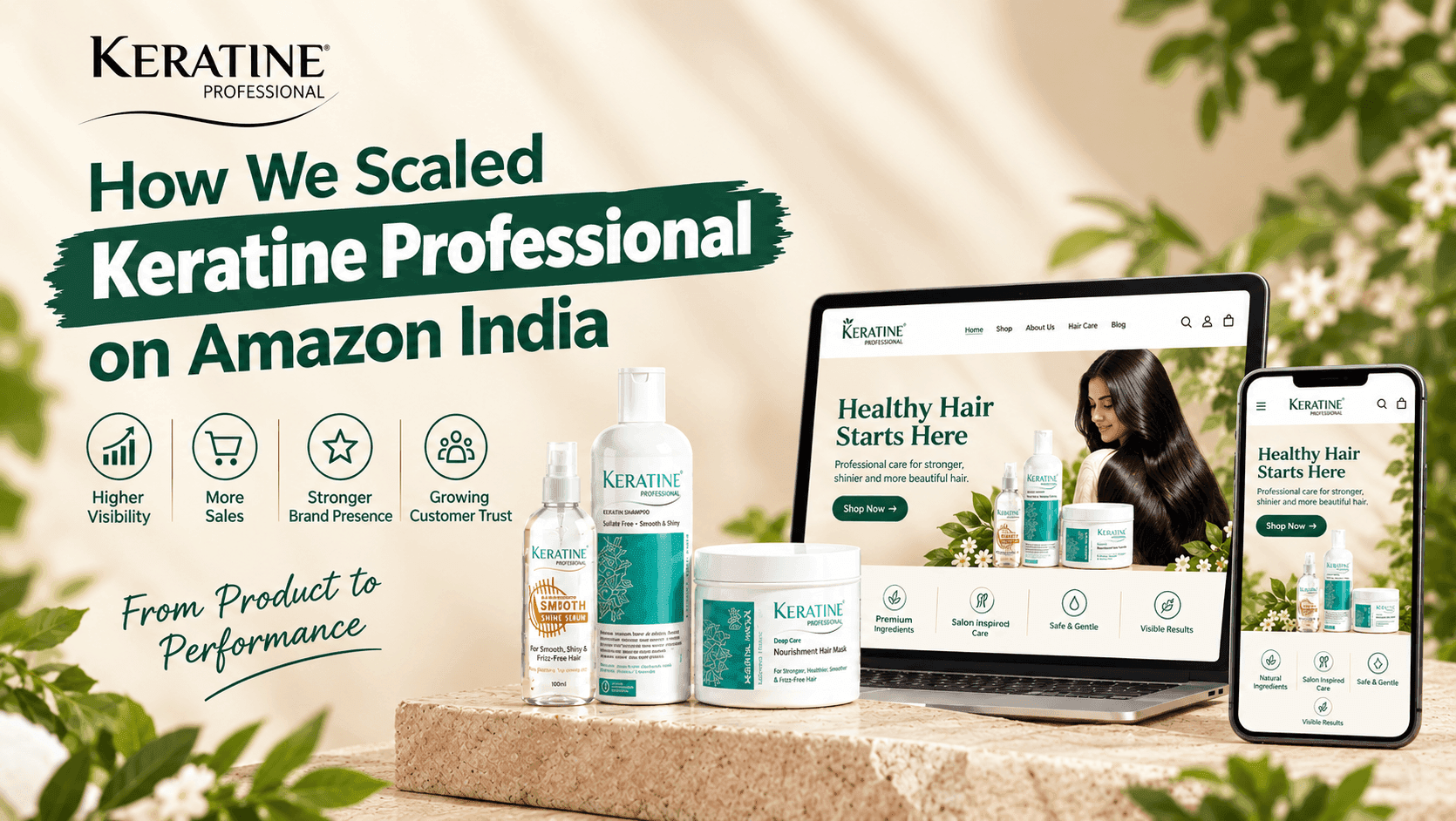
Keratine Professional sells keratin shampoos, hair masks, serums and repair kits through its brand store on Amazon India. Dcrayon manages the account's listings, content and advertising.A keratin hair care range on a crowded Amazon shelfKeratine Professional is a New Delhi hair care brand. Its Amazon range covers sulphate-free smoothening shampoos, repair masks for chemically treated hair, shine serums, Nano Plastia repair sets and post-treatment shampoo and conditioner kits for people who have had a salon keratin treatment. Much of the range is sold as combos of two or three products, so one shopper question, such as what to use after a keratin treatment, can lead to several similar listings from the same brand. The products sit in Amazon's Beauty department, mostly under Shampoos and Hair Masks and Packs. Our scope is Amazon account management: listing copy, A+ Content, keyword research and indexing, Sponsored Products, and deals and promotions.The brand name sits next to a generic ingredient word"Keratin" is an ingredient that dozens of hair care brands put in their titles, and the brand's name is one letter away from it. When we searched Amazon.in for "keratine professional" on 13 October 2026, the results page mixed the brand's own combos with keratin shampoos and masks from other brands, sponsored listings from competitors and a keratin mask from a large national brand. A shopper looking for this brand has to pick it out from products that sound alike, which makes clear product naming and keyword relevance more important here than for a brand with a distinctive name.A combo-heavy catalogue splits spend and attentionWhen three or four combos target the same keratin searches, advertising spend spreads thinly across them and a shopper sees near-duplicates side by side. Without a deliberate structure, the brand ends up bidding against itself for the same search and learning little about which product actually converts.Listings, A+ Content, indexing and advertising were each under-performingDcrayon's starting assessment of the account, set down in our project record, was that the listings, the A+ Content, keyword indexing and the advertising were all short of what the range could support, and that the brand was not reaching the upper ranks of its categories. Each of those has a direct effect on the others: a listing that is not indexed for a term cannot appear for it in organic results, and advertising sends shoppers to pages that then have to do the convincing.

GetSetNova
Ecommerce
GetSetNova sells rechargeable milk frothers and other home and kitchen products on Amazon India and Amazon.com. Dcrayon manages its Amazon accounts and built and runs its website.A Dcrayon-related brand selling across several Amazon categoriesGetSetNova is a brand related to Dcrayon: we host its website and manage its Amazon accounts, so this case study describes our work for a related business rather than an independent client. The brand is based in Samaypur, North West Delhi. Its range covers rechargeable handheld milk frothers, automatic frothers, water dispenser pumps for 20-litre bottles, kitchen and luggage scales, lint shavers, immersion rods, gas lighters, desk lamps and health faucets. On Amazon the products appear under the GetSetNova and Nova names, with brand stores including the Nova Milk Frother Store and the GetSetNova Store. Each product type sits in its own Amazon category, with its own competitors and its own way of being searched. Our scope covers account management on Amazon.in, its extension to Amazon.com, and the brand website.The account's foundations had gaps that capped every categoryAt the start, our review found gaps in listing quality, in brand registry alignment and in the documentation Amazon expects from a seller, including GST and invoicing records. They are unglamorous problems, but they set the ceiling for everything else. Brand Registry is what gives a brand access to A+ Content, Brand Stores and Sponsored Brands ads, and Amazon's own seller guidance names listing quality and account health among the things that affect how products rank in search.One playbook could not fit a frother, a water pump and a lint shaverThese products are bought by different shoppers who search with different words and compare different things: foam and battery life for a frother, bottle fit and flow for a dispenser pump, blade count and speed for a lint shaver. Treating the account as one block, with one keyword list and one advertising structure, would have spread effort evenly across categories that behave very differently and blurred which product was earning its place.An Amazon-first brand still needed a home of its ownA brand that sells mainly through Amazon still needs one place where shoppers can see the whole range, read the warranty terms and then buy from the listing they trust. That site has to support the Amazon listings rather than compete with them, so every product page needs a clear route back to Amazon.
Roundglass
Other
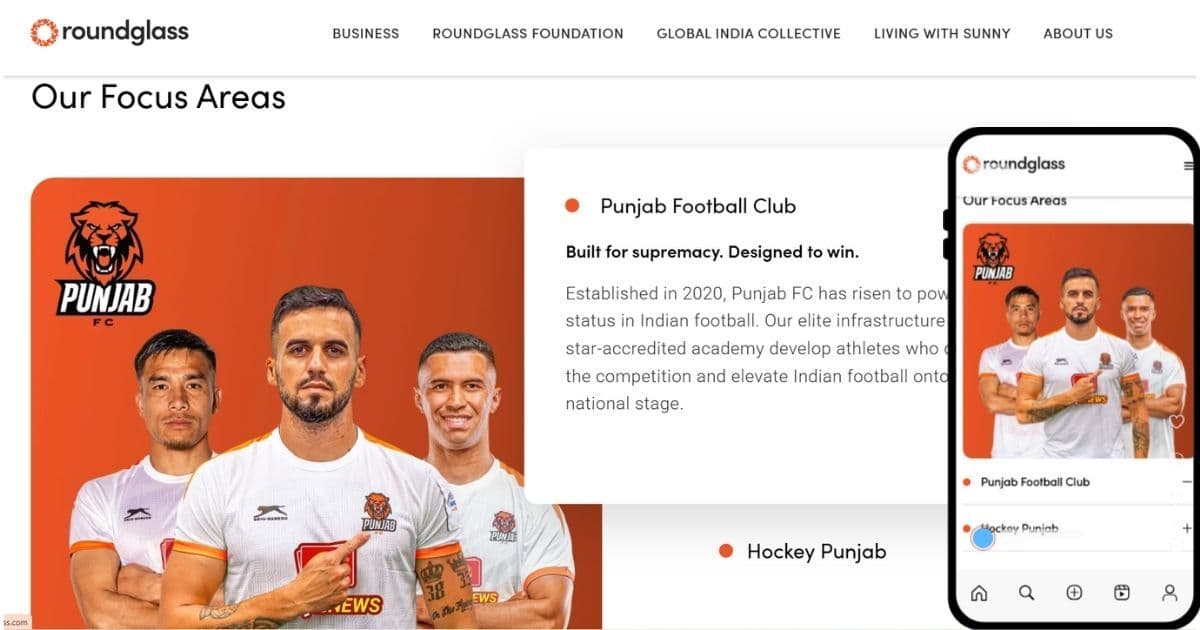
Roundglass kept employee records in Zoho HR and staff identities in Microsoft Azure AD, with people bridging the two by hand. Dcrayon built the service that keeps them in step.Roundglass's two systems for one workforceRoundglass is a wellbeing company with a growing workforce. Its people records, including joining dates, departments, roles, managers and exit dates, lived in Zoho HR. Email, group membership and Microsoft 365 licences were controlled in Azure Active Directory, now renamed Microsoft Entra ID, which is Microsoft's directory of user accounts and the access each account has. Nothing connected the two. Every joiner and every leaver had to be copied from one system to the other by an IT administrator, and the timing of each step depended on someone remembering to do it.New starters could arrive without working email or toolsAccounts were created by hand, often only after the joining date. An administrator had to create the Microsoft account, add the person to the right email and security groups, assign a licence and tell the teams concerned. When any of those steps waited for a ticket or a reminder, the new employee's first day started without the access they needed.Leavers kept access after they had goneThe reverse step was just as manual. Accounts and group memberships of departing staff were not always removed promptly, which left working credentials with people who no longer worked at Roundglass and kept paid Microsoft 365 licences assigned to empty seats. Of the two problems this was the more serious, because an open account belonging to a former employee is a security exposure, not just an inconvenience.Nobody could show who had been given what, and whenWith no automation there was no audit trail. If HR, IT or an auditor asked when an account was created, changed or closed, the answer depended on memory and old tickets.
Mechanic Bazaar
Ecommerce
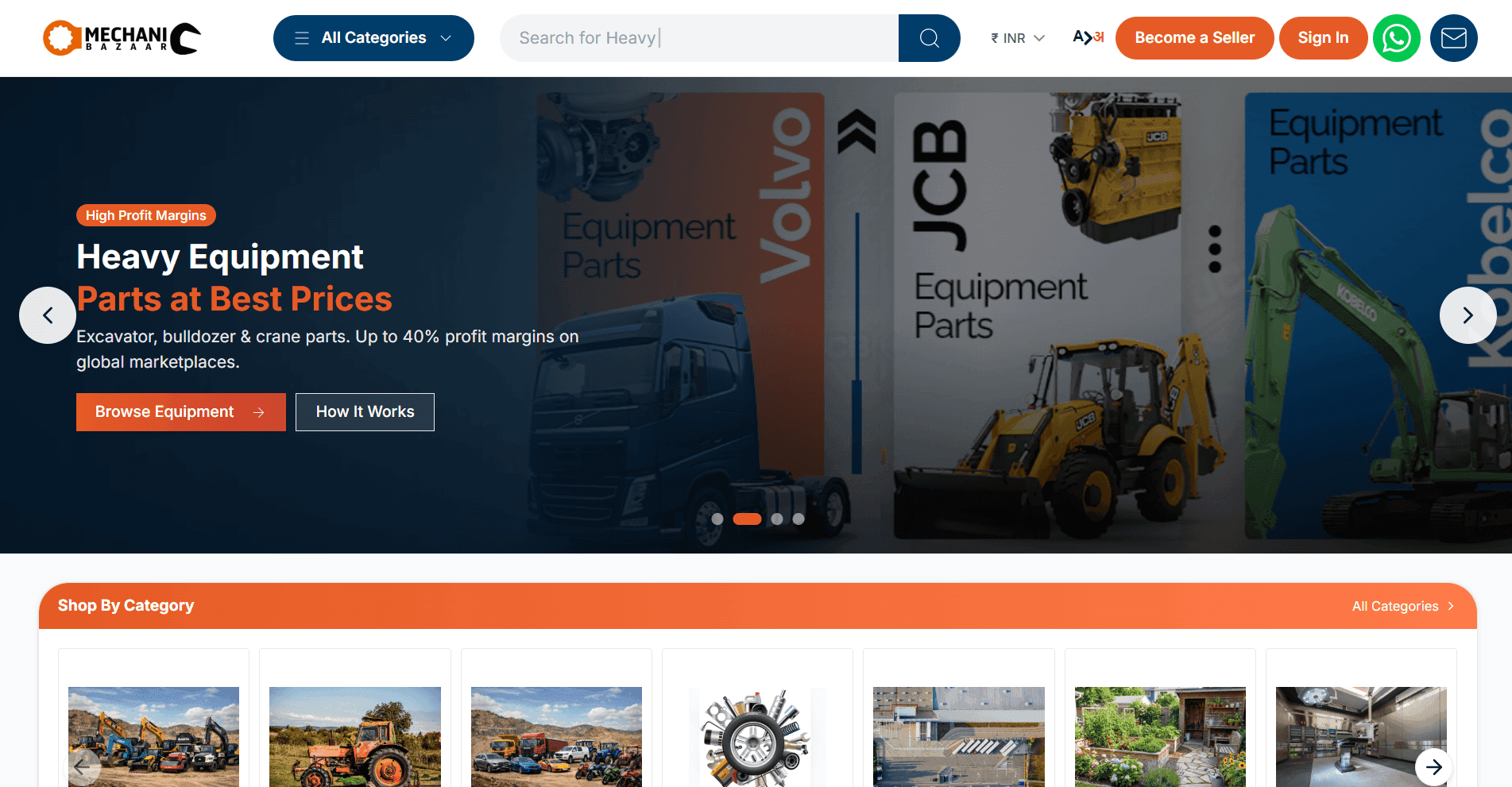
Mechanic Bazaar is a New Delhi B2B marketplace where wholesalers list automotive and heavy equipment parts and resellers buy them to sell on Amazon, eBay and other channels. Dcrayon rebuilt the platform.A parts market with three kinds of userMechanic Bazaar trades from Kashmiri Gate, the old Delhi wholesale district for vehicle parts, and its catalogue runs to thousands of part numbers: bearing kits for Case backhoe loaders, urea filters, fan belts and pulleys, hydraulic seal kits, radiator parts, wiper motors, tractor parts and vehicle filters. The business sits between two groups. Wholesalers and manufacturers hold the stock. Resellers, many of them small online sellers, buy at wholesale prices and sell the same parts on Amazon, Flipkart, eBay and Walmart, where a heavy equipment part can sell for more than its Delhi wholesale price. Mechanic Bazaar's own team approves accounts, keeps the catalogue in order and runs orders between the two. Our brief was to rebuild the platform so that each of these three groups had its own working area, and so that a reseller could see what a part was worth on other marketplaces before buying it.Where the first version of the platform fell shortNew marketplace features were slow to add to the first buildThe earlier version was a Node.js (Express) server with a React front end and a Drizzle database layer. As the business grew, every marketplace feature took longer to add, and there was no clean way to bring third-party resellers onto the catalogue alongside the wholesalers who supply it. For a business whose model depends on resellers buying in volume, that gap limited how far the marketplace could grow on the old code.Wholesalers had to be vetted before they could sellA B2B parts market only works if buyers can trust the sellers. Mechanic Bazaar needed every wholesaler to register a company and pass a document check, with GST certificates, identity proof and business registration reviewed by staff, before their stock appeared to resellers. A check run outside the platform, by email and spreadsheet, leaves no record of who approved whom and when.Resellers needed the wholesale price and the marketplace price side by sideA reseller deciding whether to buy a Case 580 bearing kit needs three numbers together: the wholesale price, a realistic price for listing the same part on eBay or Amazon, and the fee that marketplace takes. If those sit on different websites, every purchase means leaving the platform to do the arithmetic, which slows buying for the users the marketplace is built around.Thousands of part numbers had to be loaded and kept currentHeavy equipment parts are identified by part number, compatible models and condition, and both stock and prices change often. A catalogue of this size cannot stay accurate if every change has to be typed into a web form one product at a time.
Cartense
Ecommerce
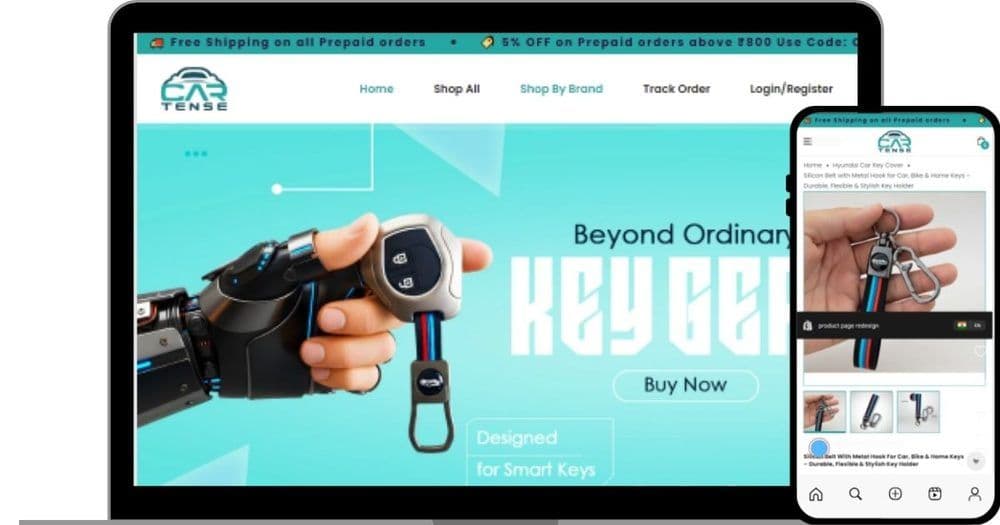
Cartense sells car key covers online in India. In early 2026 Dcrayon ran search engine optimisation, YouTube Shorts and influencer marketing for the brand.Cartense's Shopify store carries 217 products for 18 car brands, organised by brand and key type, in metal-leather, metal-silicone, leather, TPU and zinc alloy. Its homepage and product titles name individual models such as the Swift, Baleno, Fortuner and Innova Crysta, because that is how the product is bought: by car model and key shape, not by the general phrase "key cover".The engagement ran from February to April 2026 and combined three services in each period: search engine optimisation for the store, YouTube Shorts of 45 seconds each, and influencer marketing. In April 2026 Cartense enquired again, this time about SEO and YouTube Shorts specifically.Why selling key covers online is a search and video problemShoppers search by car model, so every model is its own search.Someone with a Hyundai smart key types the model and the key into search, not the name of a cover brand they have never heard of. Each model and key type is a separate query, and a store competes for each one separately. A catalogue of 217 products across 18 brands therefore faces hundreds of small, specific searches rather than a few broad ones.A key cover is hard to judge from a still photo.Buyers want to know whether the cover fits snugly, whether the buttons still press through it and how it looks on a real key in a real hand. A product photo cannot show a cover being fitted; a short vertical video can, in under a minute.A young brand needs voices other than its own.Cartense's current catalogue dates from February 2025. A new brand's own claims carry less weight than a car owner or creator showing the product on their own key, which is the case for influencer content alongside the brand's own videos.



Case study FAQ
We run a free 30-minute discovery call to understand your stage, channel mix, team, and the specific outcome you are trying to move. Based on that we either send a fixed-price proposal (for clearly scoped work like a website migration or a content programme), a retainer proposal (for ongoing growth or platform work), or honestly tell you we are not the right fit and recommend someone who is.
Five practice areas: paid media (Google Ads, Meta Ads, Amazon Ads), ecommerce + marketplace operations (Shopify Plus, Amazon SPN, Flipkart), CMS + headless web development (Next.js, Contentful, Sitecore XM Cloud), AI + automation (Claude on AWS, Vercel AI SDK, custom RAG), and martech operations (HubSpot, CDP integration, lifecycle marketing). Senior strategist on every account, no junior-only delivery.
Early-stage (under Rs 5 crore ARR): focus on a single channel + a single product narrative, pull learnings into a documented playbook before scaling. Mid-market (Rs 5-50 crore ARR): multi-channel orchestration + retention + AOV optimisation + lifecycle marketing rollout. Enterprise (Rs 50 crore+ ARR): multi-region orchestration, governance + audit posture, integration spine across the marketing + commerce + analytics + finance stack.
India Standard Time (IST = UTC+5:30) is our primary working hours. For GCC + UK customers we have overlapping availability windows defined in the engagement contract. US customers get morning IST + late-evening IST coverage; full-overnight coverage is available on enterprise retainers when business-critical.
Day 1-2: discovery + access setup + stakeholder map. Day 3-4: audit kickoff. we read your accounts, your analytics, your customer-service inbox, your past creative. Day 5: working draft of the 90-day plan delivered + reviewed with you. Week 2: signed plan + scope-locked + first execution work begins. By end of week 4 there are visible deliverables in market.
Front-end: Next.js + React, TypeScript, Tailwind. Back-end: .NET 9 + ABP, Node.js (when the stack calls for it), PostgreSQL. AI: Anthropic Claude via AWS Bedrock, Vercel AI SDK, custom RAG on pgvector. Infrastructure: AWS (primary), Azure + GCP (when customer-stack dictates), Vercel for front-end deploys. We bias toward the simplest stack that fits the requirement. not the trendiest.
Standard payment terms are Net-30 from invoice date for retainer engagements and milestone-based for fixed-price projects. We invoice monthly for retainers and on milestone completion for projects. GST invoicing is automated for Indian engagements; we handle PO + GRN for enterprise customers that require it.
D2C brands at Rs 5 crore to Rs 200 crore ARR, SaaS companies past product-market fit, and B2B services firms in mid-market enterprise sales motion. By region: India primary, GCC (UAE + Saudi) growing, UK + US for select engagements. By stage: most of our clients are Series A-C startups or 5-10 year-old profitable businesses scaling regionally.
India: DPDP (Digital Personal Data Protection Act) compliant on customer data we touch. EU / UK: GDPR aware on every engagement that involves EU residents. GCC: regional data-residency on AWS Mumbai or AWS Bahrain as needed. SOC 2 Type II underway for the .NET CRM platform. Access to customer systems is through least-privilege roles + audit logging + quarterly access review.
Honest answer: depends on what we are doing. Paid media: meaningful CPA + ROAS shifts within 30-45 days, once Smart Bidding has enough conversion volume. SEO: 4-6 month lag is normal; we report leading indicators (rankings, click-through, content velocity) inside that window. Website rebuild: 8-14 weeks for a mid-market site, 16-24 weeks for enterprise. Lifecycle marketing: 30 days to first revenue lift, 90-120 days for sustained programme returns.
D2C consumer (beauty, fashion, home, wellness, F&B), SaaS (B2B + product-led-growth), professional services (legal + accounting + consulting), real estate + financial services (consumer-facing), and education (online learning + edtech). We deliberately stay out of industries with adversarial regulatory posture (gambling, adult, crypto, regulated pharma).
Slack-connect channel for daily comms (most customers), weekly written status update via email + dashboard, fortnightly video sync with the strategist + delivery lead, quarterly governance review with the CMO / CTO. The exact cadence is locked at kickoff per the engagement contract. We avoid ad-hoc DMs as the primary channel. written-and-visible-to-everyone-on-the-account scales better.
You own everything we build for you. Code goes into your repo, content goes into your CMS, data goes into your warehouse. We hold a non-exclusive licence to use anonymised insights for case studies (with your written consent), and we retain the right to use generic patterns + frameworks across other engagements. The exact IP terms are in every engagement contract.
Every engagement names a delivery lead + a backup + an account director. P1 escalation (revenue-impacting or trust-eroding issue) gets a same-day response from the account director, a written RCA within 48 hours, and a follow-up review within 7 days. P2/P3 issues route through the regular working cadence. We document the escalation matrix in the engagement contract so there is no ambiguity about who to call.
Project-priced engagements work when the scope is clear and finite (website rebuild, content programme launch, single audit). Retainer engagements work when the outcome is ongoing (growth marketing, platform operations, content-publishing cadence) and predictability matters more than fixed scope. We default to project pricing for first engagements so both sides can size the working relationship before committing to a retainer.
Yes. Most of our work is India-primary but we run engagements across the GCC (UAE + Saudi + Bahrain), the UK, and selectively the US. Multi-region engagements are a significant share of the work. the India + GCC + UK expansion shape is one of the most common reasons customers come to us.
Yes. Once we are at proposal stage we share 2-3 reference contacts in the closest matching vertical + stage as your business. You can speak to them about how we delivered, what they liked, what they did not. We do not curate around your call. the references include both clients who renewed multiple times and at least one engagement that ended on schedule rather than extending.
Yes. Most engagements start small. a single audit, a quarterly retainer to fix one channel, a one-off website + content migration. Half our customers were small teams when they first engaged us; many scaled with us over 2-5 years. The right entry shape depends on what is actually broken vs what is just under-built.
Active partnerships with Google, Meta, Amazon Ads, Amazon SPN, Shopify Plus, Microsoft Advertising, HubSpot, Vercel, Contentful, Sitecore, and AWS. Certifications across the team include Google Ads Specialist, Meta Blueprint, Amazon Ads Verified, Shopify Plus Partner, HubSpot Diamond, AWS Solutions Architect Professional, and Microsoft AI Engineer.
P1 (revenue-impacting): within 2 business hours during IST working hours, within 8 hours otherwise. P2 (operational): within same business day. P3 (planning / question): within 2 business days. Enterprise retainers can negotiate tighter SLAs including 24x7 P1 coverage; this is contracted explicitly when relevant.
Standard NDAs at engagement start. Access to client systems via least-privilege roles + audit logging. Code we write goes into your repos, not ours. Data we touch stays in your warehouse / your cloud account; we do not exfiltrate. Generic architectural patterns + frameworks we use across engagements; specific client data + business logic stays with the client.
For project engagements: documented handover, training of your team on what we built, 30-day post-launch support included in the engagement, optional ongoing retainer if useful. For retainer engagements: notice period per the contract (typically 60-90 days), structured offboarding, documented knowledge transfer. We do not lock customers in; we expect to be retained because the work is useful, not because the exit is painful.
Anything under Rs 50,000 per month total retainer or under Rs 3 lakh for a fixed-price project. Not because we cannot help at smaller scales; because the engagement overhead becomes most of the cost. For founders earlier than this, our blog + glossary + downloadable playbooks are the right starting point; reach out when you are at the next stage.
You can hire them. Our consultants + senior associates are not contractually prevented from joining customer teams. We do require notice + an honest conversation if it's happening, plus an industry-standard placement fee paid to Dcrayon for senior hires. We have placed multiple long-term hires this way; the relationship is more important than the fee.
Depends on the client + the case. We always ask. Some clients prefer named case studies for the marketing value; others prefer anonymised for confidentiality reasons. Both work for showcasing the operational pattern; the value is in the architecture + the result, not the client identity. We never publish without explicit written consent from the client.
Both. We have engagements with Series A-C startups in growth mode + with 5-15 year-old profitable businesses scaling regionally. The criterion is not funding status; it is whether the business has product-market fit + a real growth question we can help answer. We have politely declined engagements with pre-PMF startups where marketing investment would not produce defensible learnings.
We use AI extensively for research, draft generation, code, and operations. but every customer-facing piece passes through a human editor + a senior reviewer before shipping. We do not ship AI-generated content as-is. We are also transparent with customers about where AI is used in our delivery. The position is that AI is a use tool, not a quality substitute.
Both. Common audit shapes: a 10-day Amazon programme audit (Rs 5-8 lakh), a 14-day paid media account audit (Rs 6-10 lakh), a 21-day technical SEO + analytics audit (Rs 8-12 lakh). Each ends with a written report + a 90-minute findings session + a 30-day implementation support window. Many engagements start as an audit and become retainers; many stay as audits.
Fixed fee, almost always. Percent-of-spend creates an incentive to grow spend rather than grow outcomes; we have seen too many agency relationships go wrong over that misalignment. The exception is performance marketing programmes where the customer specifically asks for a small performance kicker on top of a fixed base.
Both within scope of our role. We don't replace your legal team or DPO; we do the technical compliance work (consent capture, data minimisation, retention policy implementation, audit-log architecture, DSAR fulfilment workflows). For full legal + DPO functions, we partner with specialist law firms + recommend specific ones we trust.
We do not take direct competitors in the same category in the same region. Customers in adjacent categories or different regions are fine. The list of categories we currently work in is shared during scoping conversation if relevant. If a competitor signs after you, we honor the original commitment + decline the new engagement.
Both shapes work. Most enterprise engagements are co-delivery: your in-house team owns execution + we own strategy + senior expertise. Smaller engagements may be us doing more of the hands-on work. We are explicit about the shape at engagement scoping. The most common failure mode is the unclear shape. we and your team duplicating work or missing handoffs. so the scoping conversation defines this carefully.
Both. The most common shape: 4-8 week strategy engagement, then transitions into either ongoing retainer or specific implementation projects. We have rarely delivered strategy + walked away; the value is in implementation lessons + iteration. Customers who genuinely want only strategy are welcome too; we make the choice explicit.
Have a project in mind?
Let's discuss how we can help bring your vision to life.
Tell us about your business, the services you are weighing up, and the site you have now. We will point you to the work above that is closest to yours and what a similar scope would involve.
Since 2016 Dcrayon has worked across India, the US, the UK and the UAE, so there is usually a comparable brief behind the work you have just read.