 All Case Studies










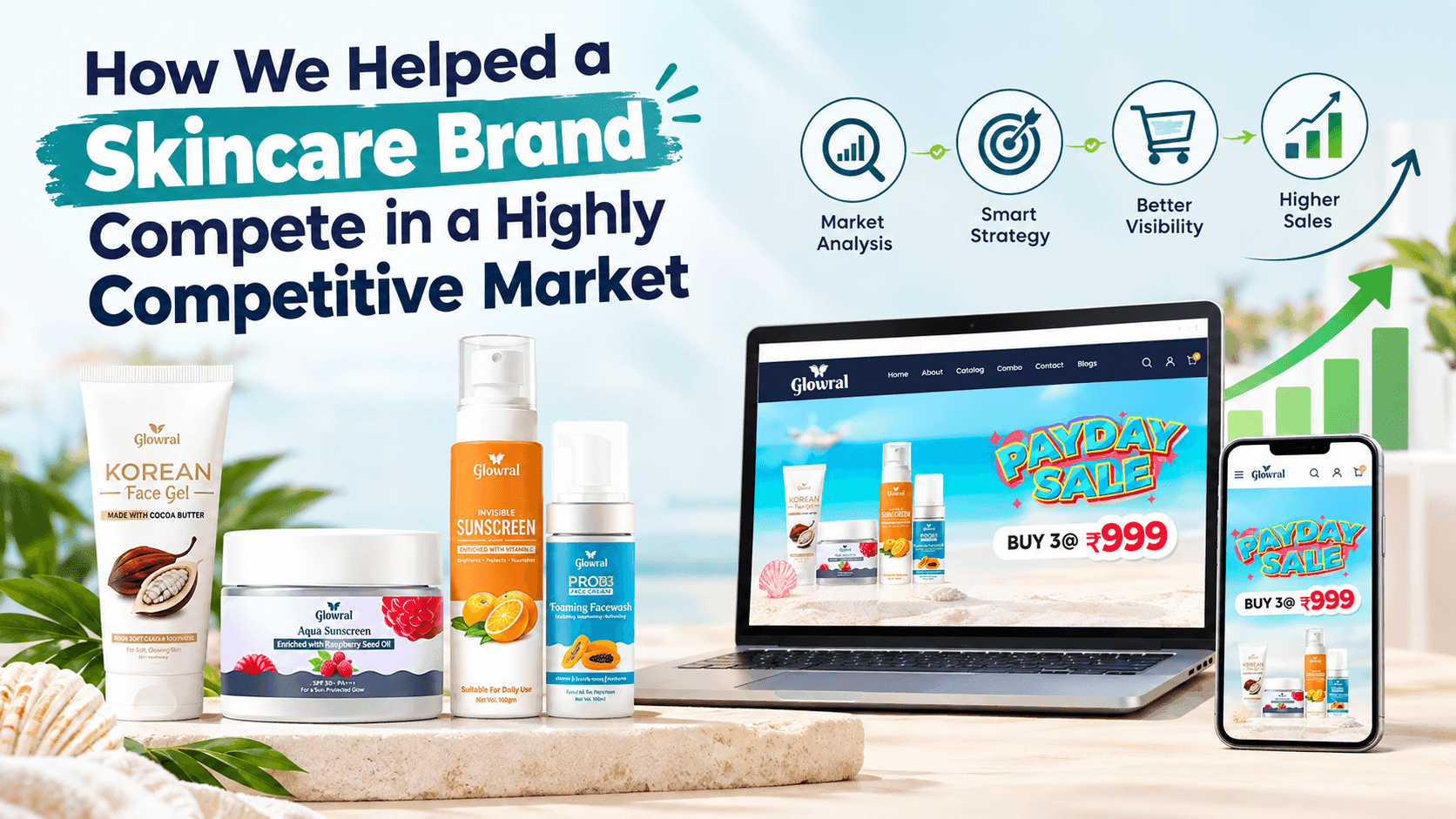
Glowral search project at a glance
The main facts of the Glowral SEO and content project.
| Item | Detail |
|---|---|
| Client and industry | Glowral, D2C skincare (sunscreens, face gel, face wash) |
| Customers | Online shoppers in India choosing skincare by skin type and concern |
| Catalogue | Seven products, including two combos and a kit |
| Our scope | SEO audit, keyword research, product page rewrites, blog content, internal linking, structured data |
| Platform | Shopify, on a theme built by Dcrayon |
| Blog by 27 Dec 2025 | 54 posts |
Challenge
Glowral is an Indian skincare brand selling sunscreens, a Korean-style face gel and a foaming face wash from its Shopify store. Dcrayon was asked to help the store get found in search.
The range was small and specific. In December 2025 the store's product sitemap listed seven products: a Sunscreen Body Spray SPF 50 with vitamin C, an Aqua Sunscreen made as a water-based gel, a Korean Face Gel with Cocoa Butter, a Foaming Facewash with salicylic acid, a Daily Glow Combo, a Sun Protection Combo and an All in One Skincare Kit. Its buyers choose skincare by skin type and by concern, such as oily skin, acne, dryness, sun exposure and city pollution.
Dcrayon had already built the store's theme, which is covered in the Glowral storefront case study. This project was about search: an SEO audit, keyword research by intent, product page rewrites, a blog built on shopper questions, internal linking and structured data.
Why Glowral's products were hard to find in skincare search
Broad skincare searches belonged to large, established brands.
Searches such as "sunscreen", "face wash" or "moisturiser" return pages from brands with high domain authority and many backlinks, the links from other websites that search engines read as votes of confidence. A new store with seven product pages could not expect to rank for those terms soon, and a plan built only around them would have left Glowral's pages out of sight.
The product pages were not ranking for the terms they were built to sell.
The audit found that most product pages did not appear for the commercial keywords that matched them, the phrases people type when they are ready to buy. A shopper looking for a gel sunscreen for oily skin had no route from Google to the product made for exactly that need.
Several pages were competing with each other for the same keywords.
This is keyword cannibalisation. When two or more pages on one site target the same query, the search engine has to guess which one matters, and it often ranks neither well. On a store this small, every duplicated target wasted one of the few pages Glowral had.
Shoppers' questions had nowhere to land.
Skincare buyers research routines, ingredient benefits and which product suits their skin type before they buy. The store had little educational content for those searches, and many products could be reached only through the menus, so specific searches had no page to arrive on.
A new brand had to earn trust before the first order.
People putting a product on their face want clear descriptions, ingredient explanations, usage instructions and answers to common worries before they try an unfamiliar name. Search engines look for the same signals when they judge whether a page is helpful.
Solution
What the SEO audit checked across the store
The work started with an SEO audit of the whole store. The team checked indexing (which pages Google had stored and could show), metadata, duplicate content, gaps in internal linking and crawlability, meaning whether search engine bots could reach and read every page. The problems above came out of this audit.
Two decisions followed from it. The first was to build the plan on long-tail phrases, longer and more specific searches made less often but by people much closer to a decision, rather than on the broad terms that large brands already held. The second was a single rule for the whole site: each product page owns its own group of terms, and question-style searches go to blog posts that link back to the product. That rule dealt with the cannibalisation and the missing content at the same time.
Keyword themes sorted by what the shopper wants
Keyword research was organised by intent rather than by volume. The target list included "Korean face gel", "aqua sunscreen SPF 50", "face wash for combination skin", "body sunscreen spray", "gel sunscreen for oily skin", "hydrating face gel" and "daily skincare routine". Each of these maps to a product Glowral actually sells, so a page that ranks for one is also the right page for the person searching.
The themes split into four kinds of search. Some shoppers already know the product type and want to buy one. Some are choosing by skin type or concern, such as oily or acne-prone skin. Some are comparing two kinds of product, such as an aqua gel sunscreen and a regular cream. And some are asking how to use a product or build a routine. Each kind was given a home: product pages for the first, product FAQs and blog guides for the second and third, and blog posts for the fourth. The table below sets out the map.
Rewriting seven product pages around their search terms
Each product page was reworked as a single answer to one group of searches, which is the core of our ecommerce SEO work. The rewrite covered the page title, the meta description (the short summary shown under the title in search results), the heading structure, the product description, image alt text (the written description of an image that screen readers and search engines read), internal links and an FAQ section.
Archived copies from November 2025 and January 2026 show the result. Product names carried the product type and its use, for example "Aqua Sunscreen - Hydrating UV Protection - Water Based Gel Sunscreen for Men & Women". The face gel page's meta description spoke directly to glass skin, glowing skin and oily skin types. Image alt text named each product, such as "Glowral gentle foaming facewash" and "Glowral Korean Face Gel with cocoa butter". The January 2026 face wash page had one H1 heading, the product name, with the description broken into H3 sections for why shoppers choose it, product specifications, how to use it, caution notes and the manufacturer and marketer details.
The product FAQs were written as the questions people type into Google. The face gel page answered "Which is the best Korean face gel for oily skin in India?", "How to choose the right Korean face gel for sensitive skin?", "Can Korean face gel moisturizers help with acne-prone skin?" and "How often should I use a Korean face gel moisturizer?". The face wash page answered questions such as "How to choose the right facewash for acne prone skin?" and "Top-rated foaming facewash for oily skin in India?". Each answer named the relevant ingredients, such as cocoa butter, centella and ceramides in the gel. In the theme, these questions and answers are stored as product metafields (extra text fields attached to each product), so every product carries its own FAQ through one shared FAQ section rather than a separate page template.
A skincare blog grown around shopper questions
The content plan turned the questions shoppers ask before they buy into educational posts, and the blog grew around them. By 27 December 2025 the store's blog sitemap listed 54 posts, most of them about sunscreen, the Korean face gel and the foaming face wash. Some answer a skin-type question directly, with posts on choosing the best facial sunscreen for oily skin and on water-based sunscreen for oily skin. Some explain the difference between two kinds of product, such as aqua sunscreen against regular sunscreen, or where a face gel fits between hydration and moisturisation. Others meet a practical or local worry, from common sunscreen mistakes and pregnancy-safe sunscreen to the best sunscreen for Delhi's pollution. Writing that serves a search engine and a reader at the same time is what our SEO content writing service covers.
The blog also had a route onto the home page. A featured articles section showed three posts, so a visitor arriving for a product could see the guides without opening the blog.
Home page copy that routes visitors to each product line
The home page carried a long-form section written for both readers and search engines. In the December 2025 version it was a 673-word block with an H2 heading and four H3 sub-headings, each about one product line and each linking to that product. In January 2026 it was rebuilt as an expandable "read more" section of 815 words with six H2 headings, one for the brand and one for each of the vitamin C sunscreen, the Korean face gel, the aqua sunscreen and the foaming face wash, plus a closing section on why shoppers trust the brand. It linked to all four product pages, the sun protection collection and the all-products collection.
Folding the copy behind "read more" kept the home page short for shoppers on phones while leaving the full text in the page for search engines. Internal links of this kind help search engines work out which page is the main one for a topic and help bots find every product page, which mattered because several products had been reachable only through the menus.
Structured data and measurement on glowral.com
Structured data is code in a page that tells search engines what the page contains. The product pages carried FAQPage data with the same five questions as the visible FAQ. The face wash page also carried Product data with the brand, a SKU, the price and availability, and its pack size of 100 ml as a product property. Pages carried Organization data linking the brand's Instagram profile, and the home page carried WebSite data with a site search action. Pages also set a canonical tag pointing at its own address, so duplicate versions created by filters or tracking links would not split the page's signals. This is part of our technical SEO work.
For measurement, the store carried a verification tag for Google Search Console, the service that reports how Google sees a site and which searches bring visitors, and it loaded Google Tag Manager with a Google Analytics 4 tag, Microsoft Clarity for session recordings and heatmaps, and the Meta pixel for social advertising. That set-up gave Glowral the means to see search queries and on-site behaviour side by side as the content grew.
Glowral keyword themes by shopper intent
The kinds of search the plan covered, the themes in each and where each was answered.
| Search intent | Keyword themes | Where it was answered |
|---|---|---|
| Ready to buy a product type | Korean face gel, aqua sunscreen SPF 50, body sunscreen spray | Product pages |
| Choosing by skin type or concern | Gel sunscreen for oily skin, face wash for combination skin, face gel for acne-prone skin | Product FAQs and blog guides |
| Comparing two kinds of product | Aqua sunscreen versus regular sunscreen, hydration versus moisturisation | Blog guides |
| Learning how to use or build a routine | Daily skincare routine, double cleansing, sunscreen mistakes | Blog posts and product how-to sections |
What each part of a Glowral product page did for search
The parts of a rewritten product page and the job each one did.
| Page part | What it does in this project |
|---|---|
| Product name and title tag | Names the product type and its use, matching the target terms |
| Meta description | Speaks to the skin type and result the shopper is searching for |
| H1 and H3 headings | One H1 for the product; H3 sections for benefits, specifications, use, caution and label details |
| Image alt text | Names the product in each image for screen readers and image search |
| FAQ from product metafields | Five search-style questions per product, shown on the page and marked up as FAQPage data |
| Links to guides and products | Connects the product page to the blog and the home page copy |
Results
What Glowral gained from the search work
A shopper searching for something specific, such as a sunscreen for oily skin or the difference between aqua and regular sunscreen, had a page on Glowral's site written to answer that exact question. On the product pages, the common questions were answered in place, the ingredients were explained and the label details were visible, so a first-time buyer did not need to leave the store to check them.
For the Glowral team, the work left a keyword map that gives each product its own group of terms, 54 published posts to build on, an FAQ pattern stored in product metafields that new products can follow, and a home page section that links every product line. With Search Console and analytics tags in place, the team could see which questions brought visitors in.
Glowral search work, delivered and next
What was delivered and the next step recommended.
| Outcome | What changed | Status |
|---|---|---|
| Product pages matched to search terms | Titles, meta descriptions, headings, alt text and FAQs rewritten per product | Delivered |
| Question-led blog | Blog of 54 posts on sunscreen, face gel and face wash questions, including the content plan's topics | Delivered |
| Home page routing to products | 815-word expandable section linking every product line | Delivered |
| Structured data and measurement | FAQPage, Product and Organization data; Search Console and analytics tags in place | Delivered |
| Fewer overlapping blog posts | Merge posts that target the same face gel searches | Recommended |
Key takeaways
What the search work teaches small skincare brands
On a small store, specific searches are the realistic place to start. Seven product pages cannot win broad terms against brands with years of authority, but each one can be the best answer to a narrow group of searches that match what the product does. Giving every page its own terms also stops pages from competing with each other.
Content earns its place when it answers a buying question and points to a product. Volume brings its own risk, though. Around fifteen of Glowral's 54 posts centre on the Korean face gel, so several of them now chase the same searches. Merging overlapping posts into one stronger guide per question is the step we would take next on a blog of this size.
If you are planning a similar programme, our guide to Shopify SEO covers the store-side basics, and our piece on how beauty brands use digital marketing to increase sales looks at the wider channel mix. The storefront this work was built on is described in the Glowral Shopify build case study.
If your store has good products that search engines are not showing, tell us about it and we will start with an audit of what is already there.
CategoryEcommerce