 All Case Studies








Prompt Dairy Mart language project at a glance
The main facts of the Prompt Dairy Mart language and URL project.
| Item | Detail |
|---|---|
| Client and industry | Prompt Dairy Mart, online store of Prompt, an Ahmedabad dairy-technology company |
| Customers | Dairy farmers, AI technicians and vets across India, many in rural areas |
| Our scope | Multilingual website development, SEO strategy, Hindi content, URL planning |
| Platform | Shopify; Dcrayon theme based on Yuva 5.0 |
| Default language | Hindi at the main address |
| Languages by Aug 2025 | Hindi, English, Gujarati, Marathi, Punjabi |
Challenge
Prompt Dairy Mart sells breeding, testing and milking equipment to dairy farmers across India. Dcrayon set up its online store so that farmers could browse and buy in Hindi.
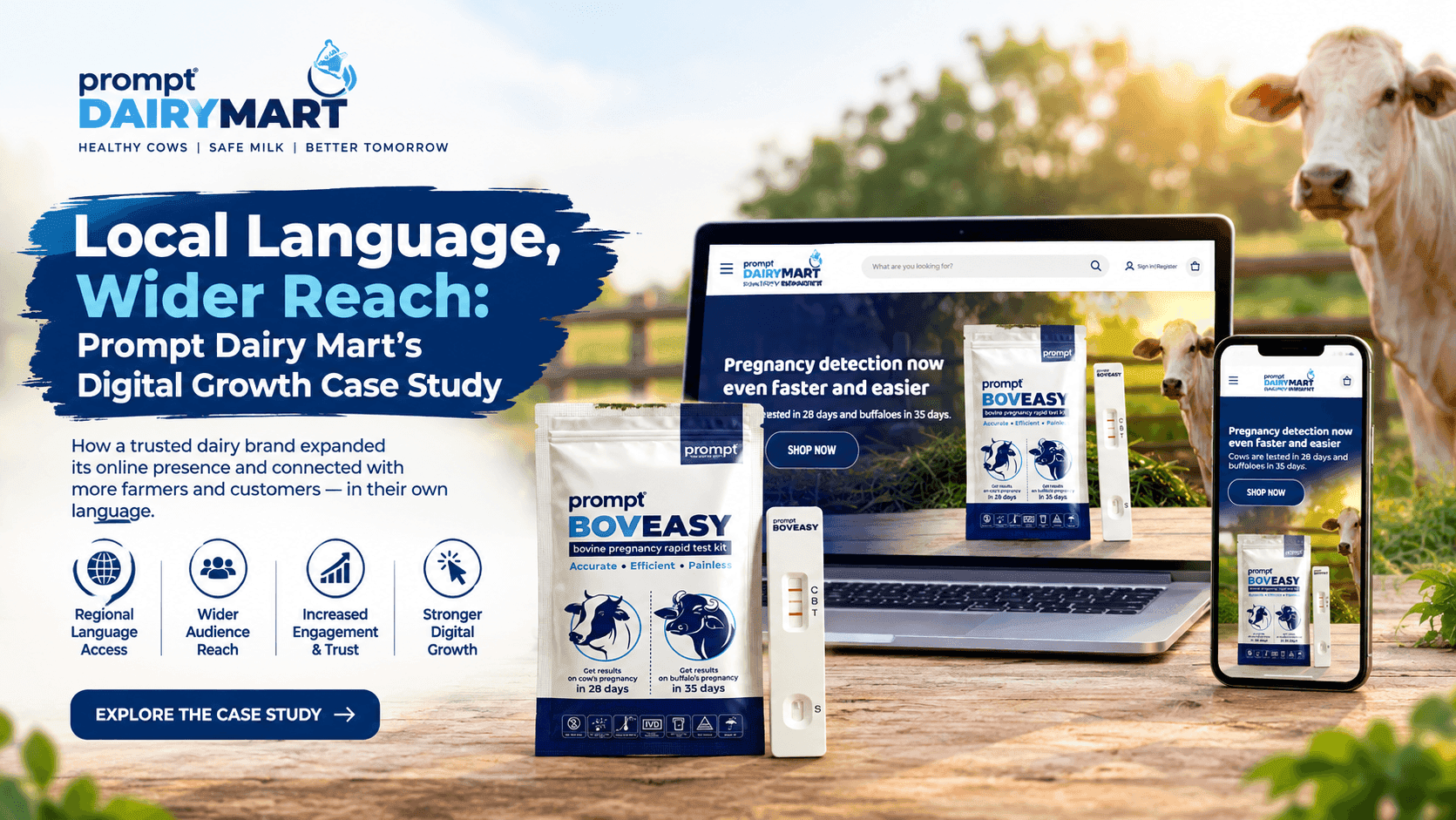
Prompt Dairy Mart is the online store of Prompt, an Ahmedabad dairy-technology company. Its range includes BovEasy rapid pregnancy test kits for cows and buffaloes, the ThawEasy digital semen thawing machine, the BreedEasy digital AI gun used in artificial insemination, and MilkEasy milking machines in trolley and fixed versions. The store's own copy describes its buyers as dairy farmers, artificial insemination technicians and veterinarians, many of them in rural areas, and the project team found that a large share of them prefer to browse in Hindi.
Dcrayon's scope covered multilingual website development, the SEO strategy, Hindi content and URL structure planning. The catalogue structure itself, from pack sizes to machine configurations, is described in the companion Prompt Dairy Mart storefront case study.
Why an English-only dairy store did not work for Prompt's buyers
Farmers were being asked to read about technical equipment in English.
The starting point was an English-only website. A milking machine or a pregnancy test kit is a considered purchase, and the buyer needs to understand configurations, usage and care before paying. When that explanation is in a language the buyer does not read easily, the product page does not do its job, and for a first-time online buyer it may be the only explanation they get.
Translating the URLs into Hindi would have created a new problem.
The obvious way to localise a site is to translate everything, including the URL slug, the part of the address after the domain. A Hindi slug written in Devanagari for "milking machine" looks short on screen, but when it is copied into WhatsApp, an email or an analytics report it often appears in percent-encoded form, a 101-character string that begins %E0%A4%A6%E0%A5%82. Links like that are hard to read, can break when shared, are hard to scan in reports, and are easy to get wrong when the team builds internal links by hand.
Hindi search behaviour had to be researched, not assumed.
The team could not assume that a Hindi-speaking farmer searches in Hindi script. The words buyers use for each product type had to be checked before the pages were written, or the Hindi content would be readable but hard to find.
Solution
What we checked before choosing the language set-up
The team reviewed the existing site architecture and URL structure, how search engines were indexing the pages, regional keyword opportunities, how users searched, the intent behind Hindi searches, and how competitors handled regional languages.
The strategy that came out of it was a hybrid. Everything the shopper reads would be in Hindi, from the store's interface and product names to the brand story and the calls to action. The URL slugs would stay in English, so that an address such as /milk-machine stays short and readable wherever it is pasted. It is worth being precise about why. Google's own URL guidance allows words in the audience's language in a URL, and transliterated words too, so English slugs are not a search engine requirement. They were a practical choice that keeps links shareable and reports readable, while the Hindi on the page does the work for the reader and for search. Separating what search engines need from what people need, and designing for both, is the core of our technical SEO work.
Dairy buyer intents and the Hindi pages that serve them
The store's pages were organised around the jobs a dairy buyer is trying to do. A farmer checking whether a cow or buffalo is pregnant looks for a test kit and needs to choose a pack size. A technician improving insemination results looks for an AI gun and a semen thawing machine. A farm moving to machine milking looks for a milking machine and needs to choose a configuration. And a buyer who has never ordered farm equipment online wants to know who is behind the shop. Each of those intents has a page type in the store: pack-size product pages for the test kits, model pages for the breeding equipment, configuration pages for the milking machines and a Hindi home page that tells the company's story. The table below maps them.
Hindi at the main address, English one folder away
The store was built on a Dcrayon theme adapted from the Yuva 5.0 Shopify theme, with Hindi set as the default language and served at the main address. The page code declared the language as Hindi, which tells browsers and screen readers to treat the main address as a Hindi page. English sat beside it in its own folder, /en. The default matters because it is the version a first-time visitor from a search result or a shared link sees before touching the language menu. Our Shopify development team configured the store's languages alongside the theme, so the language set-up was part of the build rather than an add-on.
Writing the store interface and product names in Hindi
The store was Hindi from the first line. The skip link for keyboard users, the welcome message at the top ("Welcome to our shop!"), the sign-in link, the "Our products" heading, the sale label on discounted products and the footer headings for useful links, contact and social media were all in Hindi, as were Shopify's own system messages, such as the note that choosing an option refreshes the page. The product names were written in Hindi with the model, configuration and pack size, for example the BovEasy rapid pregnancy test kit sold as a single kit and in boxes of 3, 10 and 30 tests.
The home page carried three Hindi sections written for this audience. "What is Prompt?" explained the company's three decades in the dairy industry and its work across farm management, milk collection, quality testing and preservation. A second section described the breeding products and who they are for, naming dairy farmers, artificial insemination workers and veterinarians. A banner invited farmers to modernise their dairy farm and to get in touch for more information. The aim was to explain machinery in plain Hindi rather than translate English sales copy word for word, which is the part of the job our SEO content writing service handles.
Five language versions from one catalogue
The store published hreflang tags, short lines of code in each page's head that tell search engines which language a page is in and where its other language versions are. In April 2025 the tags marked the Hindi version at the main address and the English version, both with an India region code, plus a default for everyone else. Without them, a search engine can show the English page to a Hindi searcher or treat the two versions as duplicates of each other. The home page also carried a canonical tag naming its own address.
By August 2025 the language menu offered Hindi, English, Gujarati, Marathi and Punjabi, each version in its own short folder such as /gu or /mr, and the hreflang tags listed the English, Gujarati, Marathi and Punjabi versions alongside the default Hindi address. Because Shopify keeps one catalogue with translations attached, adding a language did not mean building and stocking a second store: a price change applies to every language at once, and a new product appears in each version. By then the theme also carried a Search Console verification tag, a tag manager container with Google Analytics 4, and the Meta pixel, so traffic to each language version could be measured.
How Prompt Dairy Mart's URLs handled Hindi
Copies archived in April and August 2025 show the English slug rule in place for the store's pages, such as /pages/about-us and /pages/contact, for the main all-products collection and for products such as /products/prompt-boveasy and /products/boveasy-pack-of-10. Products that were first entered with Hindi titles kept handles in Devanagari, because Shopify creates a product's handle from its title at the moment the product is first saved, and changing the title later does not change the handle.
Prompt Dairy Mart buyer intents and the pages that serve them
The jobs a dairy buyer comes to the store to do, the themes they search for, and the page type that answers each.
| Search intent | Keyword themes | Page that serves it |
|---|---|---|
| Check whether a cow or buffalo is pregnant | Pregnancy test kit for cows and buffaloes, rapid bovine pregnancy test | BovEasy pages, one per pack size |
| Improve artificial insemination | AI gun, digital semen thawing machine | BreedEasy and ThawEasy model pages |
| Move to machine milking | Milking machine, single and double bucket, trolley milking machine | MilkEasy pages, one per configuration |
| Find a supplier to trust | Prompt dairy equipment, Prompt Dairy Mart | Hindi home page with the company story |
Prompt Dairy Mart language and URL set-up, before and after
How the store's language and URL set-up changed, with the record for each state.
| Area | Before | After | Evidence |
|---|---|---|---|
| Default language | English | Hindi at the main address, English in its own folder | Archive, 24 Apr 2025 |
| Interface text | English | Hindi welcome line, sign-in link, headings, sale label and footer headings | Archive, 24 Apr 2025 |
| Product names | English | Hindi names that carry the model, configuration and pack size | Archive, 24 Apr 2025 |
| Language signals | Not documented | hreflang tags for the language versions, plus a default | Archive, 24 Apr and 8 Aug 2025 |
| Other languages | Not documented | Gujarati, Marathi and Punjabi in their own folders | Archive, 8 Aug 2025 |
| URL slugs | Not documented | English for pages, the main collection and some products; Devanagari for products first entered with Hindi titles | Archive, 24 Apr and 8 Aug 2025 |
Results
What the Hindi-first store gave Prompt's farmers and team
A farmer who opened the store from a search result or a link shared on WhatsApp landed on a Hindi page by default. The interface, product names, company story and calls to action were in Hindi, and the language menu let the same buyer switch to English, Gujarati, Marathi or Punjabi without leaving the page they were on.
Prompt ran one catalogue in five languages instead of separate sites, with each language at a predictable address and hreflang tags telling search engines how the versions relate. By August 2025 analytics and Search Console tags were in place, so the team could see which language versions buyers used.
What Prompt's Hindi-first store delivered
The delivered capabilities and the next step recommended.
| Outcome | What changed | Status |
|---|---|---|
| Hindi first for every visitor | Hindi served at the main address by default | Delivered |
| Five languages from one catalogue | Hindi, English, Gujarati, Marathi and Punjabi in one store | Delivered |
| Search engines told which version is which | hreflang tags on the language versions; canonical tag on the home page | Delivered |
| Measurement in place | Analytics, tag manager and Search Console verification tags by Aug 2025 | Delivered |
| English slugs on every new product | Check each handle before a product is first saved | Recommended |
Key takeaways
Lessons from building a dairy store in Hindi first
A multilingual store is an architecture decision before it is a translation job. Which language sits at the main address, how the versions are signalled to search engines and what the URLs look like all have to be settled before the first product goes in, because each is hard to change once products and links exist.
A URL rule has to be enforced where products are created. Because Shopify fixes a product's handle when the product is first saved, a Hindi-first store needs either an English working title at creation, with the Hindi title added as the store's own copy, or a check of the handle before the first save. That check belongs in the handover notes of any multilingual store.
The reasoning matters as much as the rule. Google allows URLs in the audience's language, so a team that keeps English slugs should do it for shareability and reporting, and should still put the effort into the Hindi on the page. For the wider picture, our article on technical SEO architecture for D2C brands covers URL and indexing decisions, and our multi-locale reference architecture shows how larger sites manage many languages. The catalogue side of this store is in the Prompt Dairy Mart storefront case study.
If you sell to customers who read Hindi or another regional language first, talk to us about a multilingual store.
CategoryWeb Development
More work