 All Case Studies










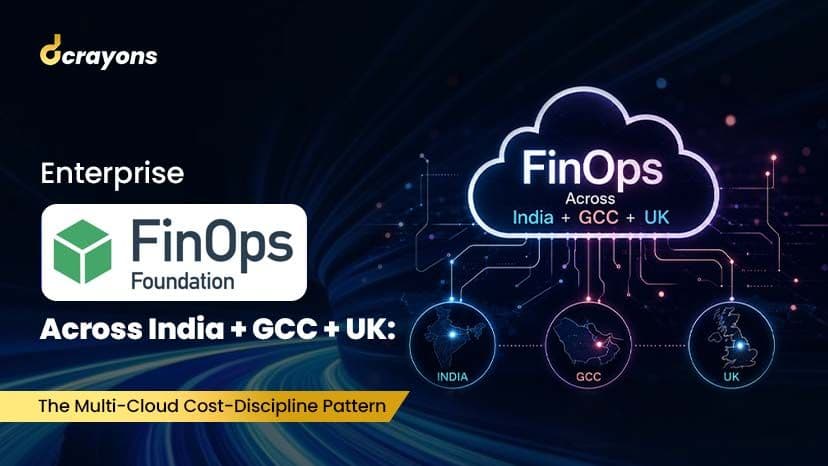
Enterprise FinOps Across India + GCC + UK: The Multi-Cloud Cost-Discipline Pattern
May 12, 2026 | 7 min read

Rahul Yadav
Founder and CEO at Dcrayon
Context: why FinOps stopped being optional
Five years ago, cloud spend was a line item the CFO glanced at quarterly. In 2026, for any digital-first business at Rs 25+ crore ARR, cloud is the second or third largest infrastructure cost line. behind only payroll and (sometimes) office. For enterprises operating multi-region across India + GCC + UK, the spend complexity multiplies: per-region pricing, per-region currency, per-region tax, per-region regulatory data-residency, per-region team accountability.
The right operational posture is FinOps. the practice of treating cloud spend as a continuously-managed variable, not a fixed budget line. The wrong posture is the "we'll look at it next quarter" approach that compounds 15-30 percent of unnecessary cost annually.
This piece is the reference architecture Dcrayon applies on enterprise FinOps engagements in 2026. It covers four areas: the tagging + attribution discipline that makes cost meaningful, the unit-economics model the CFO reviews monthly, the Reserved Instance + Savings Plan portfolio strategy, and the quarterly governance cadence that turns FinOps into a sustained programme.
Tagging + attribution discipline
The first FinOps law: you cannot optimise what you cannot attribute. Tagging is the foundation.
The Dcrayon tag taxonomy (minimum):
Environment: prod / staging / dev / sandboxProduct: which product or business lineTeam: which engineering team owns the resourceCostCenter: which finance cost center charges thisRegion: AWS region (or GCP / Azure equivalent)DataClassification: public / internal / confidential / restricted
Every resource carries every tag. Untagged resources are blocked from creation via Service Control Policies (SCPs on AWS), policy-as-code (OPA / Sentinel), or post-creation alerts.
Auto-tagging vs manual tagging. Most tags should auto-populate from infrastructure-as-code (Terraform, Pulumi, CDK). Manual tagging is error-prone + drifts. Where auto-tagging isn't possible (shared resources, legacy systems), a tagging compliance dashboard tracks compliance percentage; below 95 percent triggers remediation.
Multi-account topology. AWS Organizations + Identity Center, or Azure subscriptions, or GCP folders + projects. the multi-account topology mirrors the org chart + product portfolio. A typical Indian enterprise expanding to GCC + UK runs: prod-IN / staging-IN / dev-IN, prod-AE / staging-AE / dev-AE, prod-UK / staging-UK / dev-UK, plus shared services (logging, security, audit). Each account has consolidated billing under the management account; tags flow through Cost Explorer + CUR (Cost and Usage Report) for attribution.
CUR + warehouse pipeline. AWS CUR data lands in S3 daily, gets loaded into Snowflake or BigQuery, joined with the warehouse's revenue + usage data. The output: cost-per-active-user, cost-per-order, cost-per-API-call, cost-per-region per product. This is the unit-economics model.
Unit economics: the model the CFO reviews monthly
Aggregate cloud spend is meaningless without business context. Unit economics is the model that makes it meaningful.
Cost per active user. Total cloud cost / monthly active users. Trended monthly. A growing business should see this DECREASE as scale absorbs fixed costs; an increase warrants investigation.
Cost per order (for D2C / commerce). Total cloud cost / orders shipped. Indian D2C benchmark: Rs 4-12 per order at Rs 50+ crore ARR, depending on architecture. Inflated cost per order usually means over-provisioned compute or inefficient data pipeline.
Cost per inference (for AI-powered features). AI inference cost / inference calls. Inflated cost per inference often means missing caching, missing batching, missing model-tier routing.
Cost per region. Per-region total / per-region revenue or active user. GCC + UK regions are often 1.3-1.8x the India region cost per user, partly due to per-region pricing differences + partly due to lower utilisation. Visibility on this is the prerequisite for region-by-region optimisation.
Cost per data classification. Confidential / restricted data costs more (KMS-encrypted, audit-logged, replicated). Knowing the breakdown lets the security + finance teams negotiate where the cost is justified vs over-engineered.
Monthly review. The CFO + CTO + Head of Engineering review the unit-economics dashboard monthly. Drift triggers action: which product line is consuming more cost per user, why, what's the remediation plan.
RI + Savings Plan portfolio strategy
Reserved Instances (RIs), Savings Plans, and equivalent commitments (Azure Reserved Instances, GCP Committed Use Discounts) offer 30-72 percent discounts on compute + database in exchange for 1-3 year commitments. Managing the portfolio is its own discipline.
The Dcrayon RI/Savings Plan rules:
Coverage target. 70-80 percent of stable production compute covered by commitments. Leave 20-30 percent on-demand for elasticity + experimentation. Below 70 percent coverage means leaving discount money on the table; above 90 percent means rigid + commitment-trapped.
Commitment term mix. 60-70 percent of commitments at 1-year (more flexibility), 30-40 percent at 3-year (higher discount, accept lock-in for known-stable workloads). 100 percent at 3-year is too rigid; 100 percent at 1-year leaves discount unrealised.
Convertible vs Standard RIs. Standard RIs cheaper but locked to a specific instance family. Convertible RIs slightly more expensive but exchangeable. For mid-term portfolios (1-year on a growing platform), Convertible reduces the risk of stranded commitments.
Compute Savings Plans + Instance Savings Plans + EC2 Savings Plans. Compute Savings Plans are the most flexible (any region, any family); Instance Savings Plans give deeper discounts for a fixed family/region; EC2 Savings Plans give the deepest discount for the narrowest commitment. Most enterprises run a mix.
Quarterly purchase + review cadence. Forecast next-quarter compute usage based on growth + planned deploys; size the commitment to 70-80 percent of forecast. Review past-quarter commitment-utilisation; unused commitments are direct waste.
Multi-account vs single-account commitments. AWS Organizations allows commitments to apply across linked accounts (consolidated billing). For multi-region enterprises, the central management account owns the commitments; usage flows through any linked account. Saves the complexity of per-account commitment management.
Quarterly governance cadence
FinOps as a one-off audit doesn't stick. The governance cadence is what makes it sustainable.
Weekly. Anomaly detection alerts (cost spike > 30 percent week-over-week per service / per account triggers investigation). Tagging compliance dashboard (below 95 percent triggers remediation). Recent commit + review of in-flight optimisations.
Monthly. Unit-economics dashboard review (CFO + CTO + Head of Engineering). Spend by product / region / environment. RI + Savings Plan utilisation report.
Quarterly. Strategic review: total cloud spend trend, unit economics trend, top 5 optimisation opportunities + assigned owners, RI/Savings Plan repurchase + adjustment, multi-region cost analysis, multi-cloud vendor comparison.
Annually. Cloud-vendor renewal negotiation (for enterprise-tier customers). Multi-year forecast vs business plan. Architecture-level optimisation review (which workloads are over-provisioned by design, what infrastructure modernisation could shift cost, what services + tiers are worth re-evaluating).
Common optimisation patterns
The Dcrayon high-ROI optimisation playbook:
- Right-sizing compute. 30-50 percent of EC2 / RDS / containerised workloads are over-provisioned. CloudWatch + Trusted Advisor + third-party tools (CloudHealth, Cloudability, Spot) identify candidates.
- Schedule-stopping non-prod. Dev + staging environments stopped outside business hours saves 50-70 percent on those environments.
- Graviton (AWS ARM-based). 20-40 percent cost reduction vs equivalent x86 for many workloads. Migration is straightforward for most modern stacks.
- S3 lifecycle policies. Tier old objects to Glacier + Glacier Deep Archive. Easy 60-80 percent storage cost reduction on older data.
- RDS to Aurora Serverless v2. For variable-load databases, Aurora Serverless v2 + scale-to-zero (where supported) materially cheaper than provisioned RDS.
- CloudFront price-class. If your audience is concentrated in specific regions, use price-class-100 (US + EU) or price-class-200 (US + EU + Asia) instead of all-edge-locations. 10-30 percent CloudFront cost reduction.
- Reserved Instance + Savings Plan portfolio. Per the rules above.
- Spot instances for batch + non-critical workloads. 60-90 percent cost reduction; complexity is in handling spot-interruption.
Production checklist: the rollout sequence
For an enterprise FinOps programme at Rs 1+ crore monthly cloud spend:
- Tag taxonomy locked + enforced via IaC + SCPs / policy-as-code
- Multi-account topology mapped to org + product + environment
- CUR + warehouse pipeline: cost data joined with business data
- Unit-economics dashboard built: cost per user / order / inference / region
- RI + Savings Plan portfolio sized to 70-80 percent coverage + quarterly review
- Anomaly detection alerts active + escalation path documented
- Optimisation playbook prioritised by ROI; top 5 in-flight quarterly
- Multi-region cost breakdown + per-region optimisation owners
- Weekly / monthly / quarterly / annual cadence + named owners
- Cloud-vendor relationship + enterprise discount negotiation managed at the CFO level
- Multi-cloud arbitrage assessed annually (where workload portability supports it)
References + linked context
- Dcrayon glossary: finops, vpc, iam-role, kubernetes, gitops
- Dcrayon AWS reference architecture: see /learn?tag=cloud-infra for the multi-region + KMS + Organizations pattern FinOps pairs with
If your enterprise cloud programme is hitting a cost-creep wall, a multi-region attribution gap, or an RI/Savings-Plan portfolio question, this is the FinOps architecture we deploy. Reach out via the contact form for a 30-minute review against your current setup.
Related Articles
More insights from the Dcrayon desk.

Tesla’s Flying Roadster Stunt How Bold Brand Stunts and Marketing Capture Attention in the Age of Social Media
Meta description: Explore how Tesla’s Flying Roadster stunt highlights viral marketing, bold brand positioning, creative campaigns, and social media engagement.

High-Converting Business Websites: What Service Firms Need
What makes a service or B2B website produce enquiries: one page per service, proof beside the form, short forms that ask the right question, and fast pages.

Luxury Brand Website Redesign Without Losing Traffic
How to redesign a premium or luxury brand website and keep search traffic and sales: URL inventory, redirects, photography, type, speed and checkout trust.
Want to grow your digital presence?
Let's discuss how we can help your business.