 All Case Studies








Why Your Website Isn't Showing in AI Search Results and Proven Ways to Fix It
July 16, 2026 | 7 min read

Yash
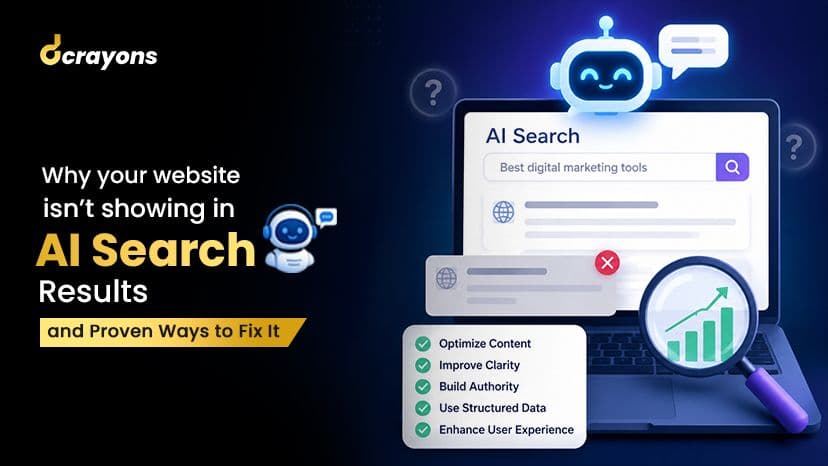
The Internet search experience is evolving with the help of artificial intelligence (AI). Search engines such as Google provide AI-generated answers in lieu of a list of websites through Google AI Overviews. ChatGPT, Gemini, and Perplexity, among other platforms, also suggest trusted websites as they respond to the questions of users.
This shift has left many businesses asking, "Why isn't my website showing in AI search results?" If your website isn't appearing in AI-generated answers, it doesn't always mean your SEO is poor. In most cases, it means your content isn't fully optimized for how AI search engines understand, evaluate, and select information.
The positive is the fact that there are a few strategies that you can use to improve your website. Here are the reasons why the AI search might not be picking up your website and strategies that have been shown to boost your ranking.
Why Is My Website Not Showing in AI Search Results?
AI search engines don't rely solely on keywords. They work to provide the content that is the most reliable, accurate, and helpful to users.
Your site may not be showing up due to the following reasons:
- Your content is no longer current.
- Your website is not well established on the internet.
- You don't answer users' questions clearly in your articles.
- Your web pages take too long to load.
- You have limited, good-quality backlinks.
- You're having technical issues with your website.
- Your content has a lack of authority.
AI systems look at several trusted sources and choose information for the answers, unlike traditional ranking, which looks at just one.
How AI Search Works
Google AI Overviews, ChatGPT, Gemini, and Perplexity use information from numerous trusted websites to create answers.
Typically, they like websites that:
- Publish original content
- Demonstrate expertise
- Keep information updated
- Have strong authority
- Provide a terrific user experience.
AI search engine optimization is essential to boost your website's visibility in AI-generated answers in addition to traditional SEO.
1. Create Helpful Content That Solves Real Problems
The first step towards enhancing AI search visibility is to produce content that truly addresses user needs.
Don't create articles for keywords; answer the questions your audience is asking.
Good content should:
- Using a real-life problem to solve.
- Describe concepts in straightforward terms.
- Include practical examples.
- Use an example of actual experience, if possible.
- Be updated regularly.
If they type in "How to rank in AI search," they want to know what to do, not some general information.
When your content is helpful, AI systems will place greater trust in and make more recommendations for it.
2. Follow AI SEO Best Practices
There are still a lot of sites that are still promoting traditional SEO. This is not enough anymore today.
By adhering to AI SEO best practices, you can make it easier for AI systems to comprehend your content.
Some of the key practices are
- Create original work; avoid plagiarism.
- Use descriptive headings.
- Keep paragraphs short.
- Answer questions directly.
- Include links to other relevant articles on the site.
- Improve page speed.
- Optimize the website for mobile.
Such enhancements benefit both your users and AI search engines in comprehending your website.
3. Build Topical Authority
If you only publish one article on AI SEO, your site won't be an authority.
Instead, make several articles on the same subject.
If you have a website dealing with digital marketing, your content can be on the following:
- AI SEO
- Technical SEO
- Content marketing
- Schema markup
- Google algorithm updates
- Local SEO
- AI tools
Link these articles together using internal links.
It is telling the AI search engines that your website has a lot to offer on a particular subject, and therefore it's more likely to be chosen as a reliable resource.
4. Improve Technical SEO
If your website is facing technical issues, even if the content is good and perfect, it would not do well.
Some of the most notable technological advancements are the following:
- Fast loading speed
- Mobile-friendly design
- Secure HTTPS website
- Clean URL structure
- XML sitemap
- No broken links
- Easy website navigation
These are also factors to consider when it comes to AI search ranking factors since AI systems have to be effective at crawling and understanding your pages.
Use tools like Google Search Console and PageSpeed Insights to identify and fix technical issues.
5. Optimize for AI Overviews by Google
Google AI Overviews and SEO are two of the largest opportunities in today's time.
When creating a content strategy, Google will choose content that offers clear, direct, and reliable answers.
To have the best chance:
- Immediately under the heading, answer the main question.
- Write short paragraphs.
- Consider using bullet points if they aid in understanding.
- Include definitions and step-by-step explanations.
- Maintain accurate and up-to-date information.
These practices also help with AI overview optimization, as they ensure that your content is easily understood by AI systems and can be summarized.
6. Build Trust With EEAT
Google and AI search engines are looking to suggest content that can be trusted by people. That's where EEAT (experience, expertise, authority, and trust) comes into play.
Show Your Experience
Include examples, results, or case studies, where feasible. If you have experience with AI SEO, share your insights and the strategies that led you to success.
Demonstrate Expertise
Talk about a subject that you are familiar with. Write at a "college" level in a manner accessible to readers.
Build Authority
Power is gained through repetition. It can be enhanced by:
- Regularly publishing valuable content.
- Earning backlinks from trusted websites
- Getting brand mentions online
- Keeping the old content up to date with new data
Increase Trust
The trust factor is among the most significant factors that impact the decision of which website to index when using an AI search engine.
To build trust:
Add an author bio.
- Include contact information.
- Make sure your website is secured using HTTPS.
- Draw facts and statistics from reliable sources.
- Avoid misleading headlines.
The more your website fulfills the EEAT criteria, the more likely you are to show up in AI-generated search results.
7. Use Structured Data to Help AI Understand Your Content
Schema markup, also known as structured data, can help search engines interpret your content.
While schema doesn't ensure rankings, it does offer extra context for AI systems to consider as they scan your website.
Some schema types that are useful may be the following:
- Article Schema
- FAQ Schema
- Organization Schema
- Breadcrumb Schema
- Author Schema
Incorporating structured data can lead to better indexing and enhance your site's visibility in AI-driven search results.
8. Use Generative Engine Optimization (GEO)
This is no longer the time for traditional SEO methods. However, Generative Engine Optimization (GEO) should be the next area of interest for businesses.
The aim of GEO is to develop content that can be easily understood, summarized, and referred to by AI platforms.
In order to become a better player at the GEO strategy:
- Share new research and observations.
- Delve into the subjects.
- Be clear in answering common questions.
- Use descriptive headings.
- Keep articles updated.
- Develop solid topical authority.
- Use internal links that are relevant.
Your content is more helpful for AI tools such as ChatGPT, Gemini, Perplexity, and Google AI Overviews.
9. How to Rank in AI Search
How to rank in AI search is a common query among many website owners who can't seem to get their sites to feature in search results without relying on conventional SEO methods.
There is no ranking factor, but these best practices will help you increase visibility:
Write for People First
Always develop content that is problem-solving. AI systems are incentivized to create content that provides value and information.
Keep Content Fresh
Add new information, examples, and statistics frequently to articles.
Answer Questions Clearly
The majority of the answers that are returned by AI are taken from web pages that directly address the users' inquiries.
Improve Website Speed
Fast websites will offer a better user experience and make it easier for the search engines to crawl your pages.
Build Quality Backlinks
Backlinks from reputable sites help boost your website's credibility and enhance your ranking potential with AI-powered search engines.
10. Monitor Your Website Performance
Making your website even better is a continuous process.
Track your progress with these free tools:
- Google Search Console
- Google Analytics
- Bing Webmaster Tools
- Google PageSpeed Insights
Monitor important metrics such as:
- Organic traffic
- Indexed pages
- Click-through rate (CTR)
- Core Web Vitals
- User engagement
You can detect any issues early on and make content improvements over the years with regular monitoring.
Overall Summary
To ensure that your website does not show up in AI search results, try to produce content that is useful, correct, and readable. Websites that showcase their expertise, offer a seamless user experience, and have a good technical performance are favored by AI search engines. Rather than focusing on keywords, create your own content, maintain it periodically, and develop your website's value over time. To stay competitive in the evolving landscape of online search, where AI plays a pivotal role, it is crucial to adopt modern AI SEO strategies and produce content that bears relevance to the users' questions.
Related Articles
More insights from the Dcrayon desk.

Tesla’s Flying Roadster Stunt How Bold Brand Stunts and Marketing Capture Attention in the Age of Social Media
Meta description: Explore how Tesla’s Flying Roadster stunt highlights viral marketing, bold brand positioning, creative campaigns, and social media engagement.

High-Converting Business Websites: What Service Firms Need
What makes a service or B2B website produce enquiries: one page per service, proof beside the form, short forms that ask the right question, and fast pages.

Luxury Brand Website Redesign Without Losing Traffic
How to redesign a premium or luxury brand website and keep search traffic and sales: URL inventory, redirects, photography, type, speed and checkout trust.
Want to grow your digital presence?
Let's discuss how we can help your business.