 All Case Studies









Tesla’s Flying Roadster Stunt: How Bold Brand Stunts and Marketing Capture Attention in the Age of Social Media
In today's competitive digital landscape, capturing audience attention has become one of the biggest challenges for brands. Consumers scroll through hundreds of posts, videos, and advertisements every day, making it increasingly difficult for businesses to stand out. This is where bold creative campaigns, memorable product demonstrations, and strategic social media marketing can make a difference.
The idea of a flying Tesla Roadster captures the imagination because it combines futuristic technology, visual spectacle, and the curiosity that drives online conversations. However, before treating the Tesla’s Flying Roadster stunt as a confirmed real-world event, its details should be verified. Regardless, the concept offers a useful starting point for understanding how brands can turn an attention-grabbing moment into a broader marketing opportunity.
For businesses, the lesson goes beyond automotive innovation. It is about creating experiences and content that people want to watch, discuss, and share.
1. What Makes Tesla’s Flying Roadster Stunt a Marketing Talking Point?
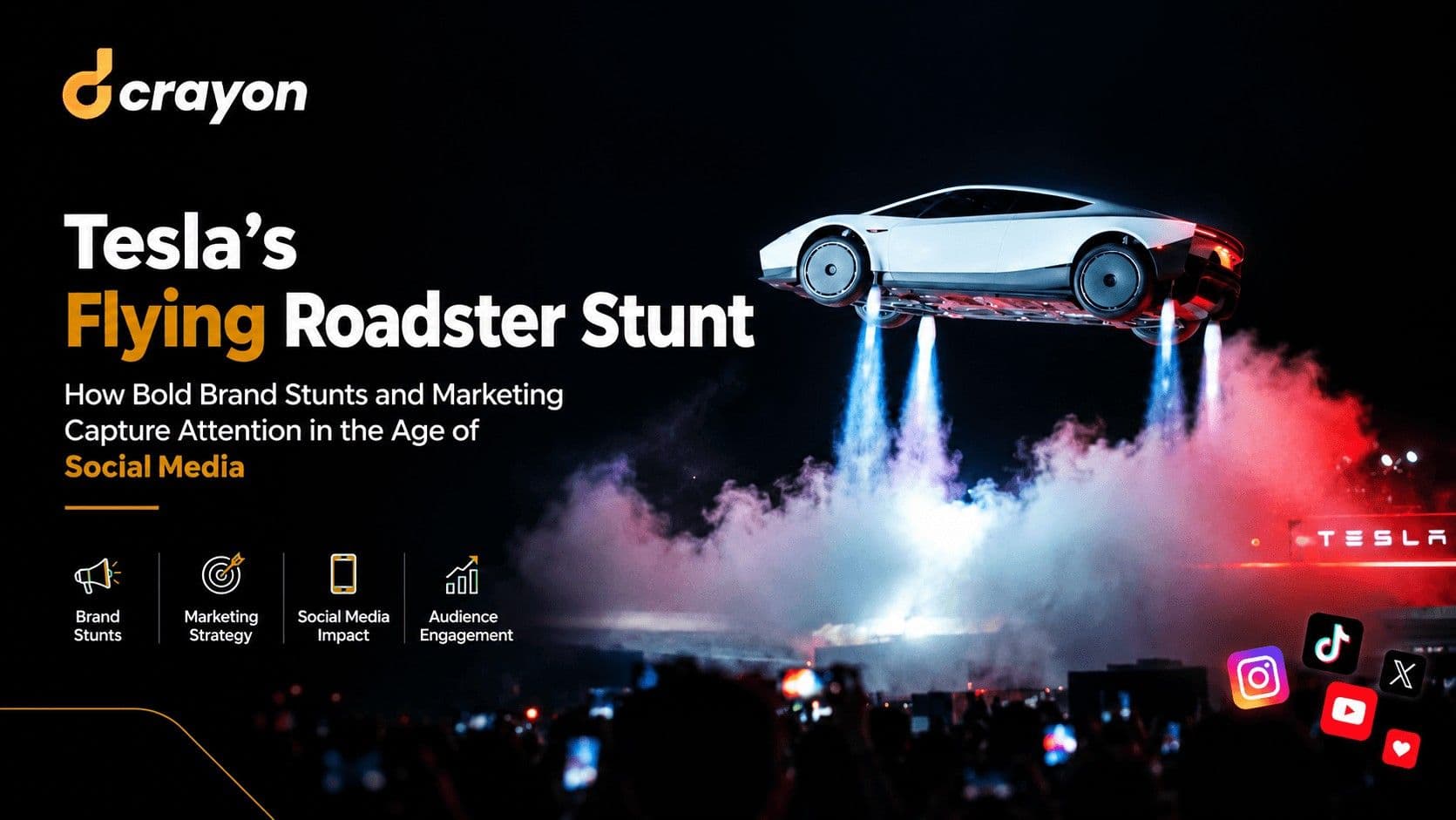
Tesla unveiled its next-generation Roadster on October 15, 2026, with a demonstration featuring rocket-style thrusters, an upside-down driving sequence, and a mid-air flip. The vehicle's production is planned for 2028, so the demonstration should be understood as a showcase of a prototype rather than a fully available consumer product.
From a marketing perspective, what makes this demonstration interesting is its ability to transform a product presentation into a memorable visual experience.
Traditional product launches often rely on specifications, presentations, and feature comparisons. These elements are important, but they do not always create an emotional response. A visually dramatic demonstration, on the other hand, can make people stop scrolling and pay attention.
The Tesla’s Flying Roadster stunt illustrates how an unexpected product demonstration can create opportunities for news coverage, social sharing, online discussions, and brand awareness.
For businesses, the lesson is simple: instead of only explaining what a product does, find creative ways to demonstrate why it matters.
2. Why Bold Brand Stunts Capture Attention on Social Media
Social media platforms are crowded with promotional content. From product advertisements to influencer collaborations, brands compete every day to earn a few seconds of audience attention.
A bold brand stunt can help break through this competition because it introduces something unexpected into the audience's regular content experience.
Tesla's Roadster demonstration offers an example of this principle. The unusual visual of a sports car performing a mid-air manoeuvre is inherently more attention-grabbing than a conventional product photograph. Coverage of the demonstration and reactions from other brands helped extend the conversation beyond the original reveal.However, attention alone is not enough. A successful marketing campaign should connect the initial excitement with the brand's identity, product value, and business objectives.
Businesses can apply this approach by creating:
Product demonstrations that highlight a unique feature.
Short-form videos that reveal something unexpected.
Creative campaigns that encourage audience participation.
Shareable content that makes a product easier to remember.
Interactive experiences that invite customers to engage with the brand.
The goal is not to create controversy or spectacle for its own sake. It is to develop an idea that makes the brand more interesting and relevant to its intended audience.
3. The Role of Social Media Marketing in Amplifying a Product Launch
A product launch no longer needs to remain limited to a physical event or a single advertisement. With an effective social media marketing strategy, one launch can become a series of content opportunities across different platforms.
For example, a brand can begin with a teaser campaign, publish the main product demonstration, share behind-the-scenes footage, and then create shorter videos highlighting individual features. Each piece of content can serve a different purpose while reinforcing the same campaign message.
Tesla's Roadster reveal demonstrates how a visually distinctive event can provide material for multiple conversations and creative interpretations. The demonstration attracted attention from media outlets and social teams at other brands, which used the moment to publish their own reactions and related content.
Businesses can use a similar approach without having a large advertising budget.
For instance, a skincare brand launching a new sunscreen could create a short video demonstrating its texture, explain its ingredients in a follow-up post, and invite customers to share their everyday skincare routines. A fashion brand could reveal a collection through styling videos, creator collaborations, and audience polls.
The principle is to make each piece of content contribute to a larger campaign rather than publishing disconnected posts.
4. What the Tesla Flying Car Concept Teaches Us About Brand Positioning
The phrase Tesla flying car immediately creates curiosity because it combines two familiar ideas in an unexpected way: an electric sports car and flight-like capabilities.
This illustrates the importance of brand positioning. A product becomes easier to discuss when its defining feature can be communicated through a clear, distinctive idea.
In Tesla's case, the Roadster demonstration connects automotive performance with aerospace-inspired technology. This supports an image of innovation and engineering ambition, although the demonstration itself does not establish that the vehicle is a practical, fully operational flying car.
Other businesses can apply the same principle by identifying what makes their products meaningfully different.
Ask these questions before developing a campaign:
What is the most distinctive benefit of our product?
Can we demonstrate that benefit visually?
What would make the target audience curious?
How can we communicate the idea in a few seconds?
Does the campaign reinforce the brand's desired image?
Strong positioning helps customers understand not only what a business sells, but also why its offering deserves attention.
5. Turning Attention Into Engagement and Conversions
A viral video can generate millions of views, but views alone do not guarantee sales. Marketing campaigns need a clear path from initial attention to meaningful customer action.
This is where content strategy becomes essential.
After an attention-grabbing campaign, businesses should provide content that answers customer questions, explains product benefits, addresses objections, and makes the next step clear.
A practical campaign funnel could look like this:
Stage 1: Capture attention
Publish a striking creative, teaser, or short-form video that introduces the product or campaign.
Stage 2: Build engagement
Share additional content, answer questions, encourage comments, and give people reasons to explore the brand.
Stage 3: Encourage action
Direct interested audiences to a product page, enquiry form, booking page, or purchase opportunity.
Businesses should measure results at every stage. Reach and video views help evaluate awareness, engagement rates indicate audience interaction, and website visits, leads, and conversions help assess business outcomes.
For an agency, this approach also demonstrates that creative work is not just about producing attractive visuals. It is about connecting creative execution with measurable marketing objectives.
6. How Small Businesses Can Apply These Marketing Lessons
Not every business can produce a spectacular product demonstration, and not every business needs to. The underlying principles of curiosity, storytelling, and differentiation can work on a much smaller scale.
A local business, emerging D2C brand, or service provider can create an engaging campaign by focusing on one compelling idea.
Consider these examples:
Business type
Creative campaign idea
Skincare brand
A visually engaging product-texture demonstration
Fashion brand
A transformation video showing different ways to style one product
Restaurant
A behind-the-scenes video revealing how a signature dish is prepared
Fitness brand
A short demonstration of a product's practical use
Marketing agency
A before-and-after creative showing how stronger design changes brand perception
The objective is to make the content relevant to the audience and distinctive enough to be remembered.
With the right social media marketing strategy, even a modest campaign can generate useful engagement when it addresses a real audience interest and communicates a clear message.
7. Why Creative Strategy Matters More Than Chasing Virality
One of the biggest mistakes brands make is treating virality as the primary objective of every campaign. They may imitate trending formats or create attention-grabbing content without considering whether it supports their positioning or appeals to potential customers.
A better approach starts with the brand's business goals, target audience, and unique value proposition.
The creative idea should then be developed around those foundations. A strong campaign connects an interesting visual or story with a relevant product benefit, a recognisable brand identity, and a meaningful next step.
The Tesla Roadster demonstration is a useful case study because it shows how an unusual product showcase can create a wider conversation. But businesses should distinguish between the attention generated by an event and the commercial outcomes that follow.
For marketing agencies, this distinction is particularly important. Clients need more than impressions and likes; they need creative campaigns that contribute to brand recognition, qualified leads, customer relationships, and sustainable growth.
conclusion
The conversation around Tesla's Roadster demonstrates why distinctive ideas remain valuable in a crowded digital environment. A bold product demonstration can capture attention, encourage sharing, and give audiences a reason to discuss a brand.
However, the real marketing opportunity lies in what happens next. Brands must connect attention with consistent storytelling, useful content, strong positioning, and measurable business outcomes.
Whether a company is promoting a futuristic vehicle or launching an everyday consumer product, the principles remain similar: understand the audience, communicate a compelling idea, and give people a reason to remember the brand.
For businesses looking to stand out, effective social media marketing is not simply about posting more often. It is about creating the right message, presenting it in an engaging way, and turning audience attention into lasting brand value.
Related Articles
More insights from the Dcrayon desk.

From Scrolling to Shopping How Meta Muse Is Changing E-Commerce
What if your next shopping assistant wasn’t a person, but an AI agent? Meta is exploring exactly that possibility with Muse, its AI-powered assistant designed to help users discover products, compare deals, and make purchasing decisions.
Read More about From Scrolling to Shopping How Meta Muse Is Changing E-Commerce

What Is Crawl Budget and Why Is It Important for SEO?
When reviewing your website for technical SEO in tandem with professional web development, you can detect unnecessary redirects, broken links, duplicate URL patterns, and other problems that hinder website crawling.
Read More about What Is Crawl Budget and Why Is It Important for SEO?

How to Increase Conversion Rate on Landing Pages
As a trusted digital marketing agency in NSP, we assist businesses to develop their landing pages and transform their website visitors into profitable leads using effective conversion optimization techniques.
Read More about How to Increase Conversion Rate on Landing Pages
Want to grow your digital presence?
Let's discuss how we can help your business.