Myntra is one of India's leading fashion and lifestyle marketplaces, making it an attractive platform for brands looking to reach a larger online audience. For fashion businesses, getting listed on Myntra can create new sales opportunities, improve brand visibility, and provide access to customers actively looking for apparel, footwear, accessories, beauty, and lifestyle products.
However, understanding how to sell on Myntra requires more than simply uploading products. Brands need to choose the right selling model, prepare their catalog, meet marketplace requirements, and manage their operations efficiently.
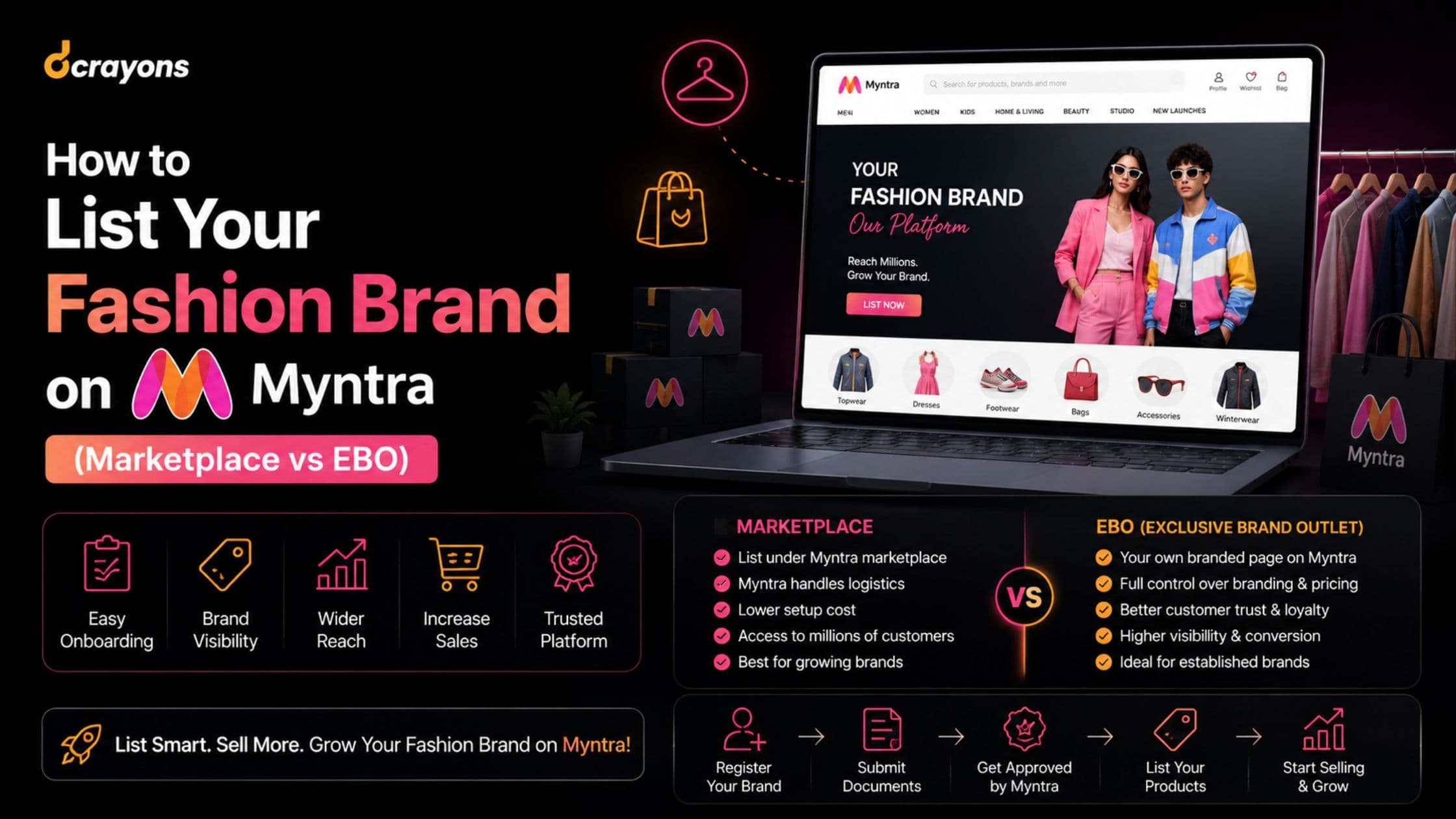
Two important routes for fashion brands are the Myntra Marketplace model and the EBO (Exclusive Brand Outlet) model.
What Is the Myntra Marketplace Model?
Under the marketplace model, a brand or seller lists its products on Myntra's online platform and sells directly to customers through the marketplace ecosystem.
The brand typically remains responsible for providing accurate product information, maintaining inventory, pricing products, and meeting applicable operational requirements.
The marketplace model can be suitable for brands that want to:
Reach a large online fashion audience
Test products before expanding
Increase online sales
Build digital visibility
Expand their distribution
Introduce new collections
Scale without immediately opening physical stores
For many growing fashion brands, this can be a practical starting point.
What Is an EBO?
EBO stands for Exclusive Brand Outlet.
An EBO is a physical retail outlet dedicated to a particular brand. Instead of selling products through multiple brands in one marketplace or store, an EBO provides customers with a dedicated brand environment.
For fashion businesses with strong brand recognition and an offline expansion strategy, an EBO can provide:
Physical brand visibility
Direct customer interaction
A controlled brand experience
Opportunities for offline sales
Better presentation of complete collections
A stronger connection between online and offline retail
However, an EBO generally requires significantly greater investment and operational planning than simply establishing an online marketplace presence.
Myntra Marketplace vs EBO
The right model depends on your brand's stage, budget, goals, and retail strategy.
Factor
Myntra Marketplace
EBO
Primary channel
Online
Physical retail
Investment
Comparatively lower
Higher
Customer reach
Digital audience
Local/physical audience
Store setup
Not required
Required
Brand experience
Digital
Physical + visual
Inventory planning
Marketplace-focused
Store-focused
Best suited for
Online growth
Offline brand expansion
Scalability
Easier to expand online
Depends on store expansion
For a new or growing fashion brand, the marketplace route can be a more accessible way to establish online demand before investing heavily in physical retail.
How to Sell on Myntra: Step-by-Step
1. Evaluate Your Brand
Before applying or preparing your catalog, evaluate whether your brand and products are ready for a fashion marketplace.
Consider:
Product quality
Brand positioning
Target audience
Product range
Pricing
Packaging
Inventory availability
Product photography
Existing sales performance
A clear understanding of your brand will help you build a stronger marketplace strategy.
2. Prepare Your Brand Information
Fashion marketplaces require accurate business and brand information.
Prepare the relevant documentation and information required for onboarding, including applicable business details, tax information, brand documents, product information, and other marketplace requirements.
Requirements can vary, so brands should verify the latest requirements directly with Myntra before applying.
3. Prepare Your Product Catalog
Your product catalog should be complete and accurate before products go live.
Important information can include:
Product name
Category
Brand
Size
Color
Material
Fit
Product description
Product specifications
Price
Inventory
Images
For fashion products, size and fit information is particularly important because customers cannot physically try the product before purchasing.
4. Invest in Professional Product Photography
Fashion is a highly visual category.
Product images should clearly communicate the product's appearance, fit, details, and styling.
Depending on the product, useful visuals can include:
Front view
Back view
Side view
Close-up details
Fabric texture
Model images
Lifestyle photography
Size and fit information
Strong visuals can improve product presentation and help customers make more confident buying decisions.
5. Optimize Product Content
Product titles and descriptions should be informative rather than overloaded with unnecessary keywords.
Your content should clearly communicate:
What the product is
Who it is designed for
Key features
Material
Fit
Style
Usage or occasion
Care instructions
Accurate product information can also help reduce customer confusion and avoidable returns.
6. Maintain Inventory
Fashion brands often have multiple combinations of sizes, colors, styles, and designs.
Inventory management is therefore critical.
A brand should monitor:
Best-selling sizes
Popular colors
Fast-moving SKUs
Seasonal demand
Low-stock products
Slow-moving products
Keeping high-demand products available can help prevent missed sales opportunities.
7. Plan Pricing Strategically
Fashion customers frequently compare products across brands.
Pricing should take into account:
Product cost
Marketplace expenses
Discounts
Competitor pricing
Product positioning
Profit margins
Seasonal promotions
A premium brand does not necessarily need to compete by being the cheapest. Instead, the product's quality, design, positioning, and overall value should support its price.
8. Manage Orders, Returns, and Customer Experience
Fashion has unique operational challenges, particularly around sizing, fit, color expectations, and product preferences.
Brands should closely monitor:
Orders
Dispatch
Returns
Exchanges
Cancellation trends
Customer feedback
Product-level return rates
If one particular size or product repeatedly receives returns, the brand should investigate whether the issue is related to sizing, product quality, description accuracy, or customer expectations.
How to Decide Between Marketplace and EBO
Choose Marketplace When:
A marketplace model may be appropriate if your primary objective is:
Online customer acquisition
Testing market demand
Expanding digital sales
Reaching customers across India
Building marketplace visibility
Scaling an existing product range
Consider EBO When:
An EBO may make more sense when your brand has:
Strong offline demand
Established brand recognition
Sufficient product depth
Resources for physical retail
A clear store expansion strategy
A need for direct customer interaction
For some brands, the two approaches can eventually work together, creating an omnichannel strategy.
Common Mistakes Fashion Brands Should Avoid
When learning how to sell on Myntra, brands should avoid treating marketplace onboarding as the final goal.
Common mistakes include:
Uploading poor-quality images
Incomplete product information
Incorrect size charts
Weak product descriptions
Poor inventory planning
Pricing without competitor research
Ignoring product-level return patterns
Launching too many products without analyzing demand
Failing to maintain catalog accuracy
The marketplace should be treated as an ongoing sales channel that requires continuous optimization.
How Ecommerce Services Can Help
Managing a fashion marketplace account can become challenging as the product catalog grows.
Businesses looking for ecommerce services in Delhi can work with an experienced e-commerce agency to support their Myntra operations.
Services may include:
Marketplace onboarding support
Catalog management
Product listing optimization
Product content writing
Product image coordination
Inventory management
Competitor research
Pricing analysis
Marketplace reporting
Sales strategy
Multi-marketplace management
Professional support can help fashion brands maintain consistency across their marketplace operations while allowing internal teams to focus on product development and brand building.
Final Thoughts
Understanding how to sell on Myntra starts with choosing the right business model.
The Myntra Marketplace model can provide fashion brands with an opportunity to expand their online reach, test demand, and grow digital sales. An EBO, on the other hand, is a physical retail approach designed for brands ready to invest in a dedicated offline experience.
Neither model is universally better. The right choice depends on your brand's current stage, investment capacity, product range, customer base, and long-term growth strategy.
For brands seeking ecommerce services in Delhi, professional marketplace support can simplify catalog management, product optimization, inventory coordination, and ongoing performance analysishelping create a stronger foundation for Myntra growth.