 All Case Studies








Amazon PPC and TACoS Management Services (Cost + Method)
August 29, 2026 | 6 min read

Rahul Yadav
Founder and CEO at Dcrayon
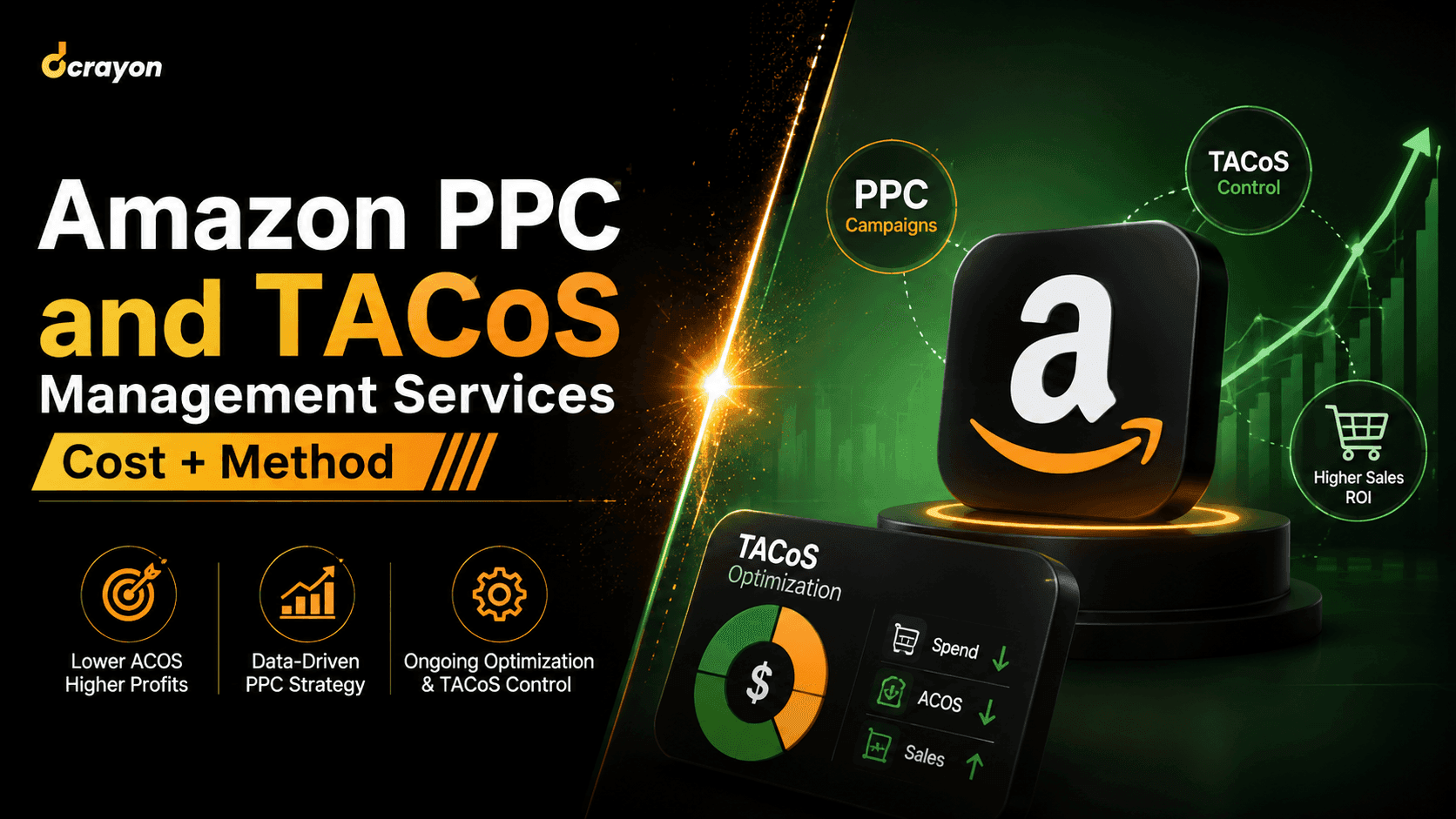
Amazon advertising can help brands increase product visibility, attract high-intent shoppers, and generate sales. But simply spending more on ads does not guarantee better results. Successful Amazon advertising requires the right campaign structure, keyword targeting, bidding strategy, budget allocation, and continuous performance analysis.
This is where amazon ppc management services can help brands build a more systematic and profitable advertising strategy.
What Is Amazon PPC?
Amazon PPC, or Pay-Per-Click advertising, allows sellers and brands to promote their products across Amazon. Advertisers generally pay when a shopper clicks on their advertisement.
Amazon PPC can help businesses:
- Increase product visibility
- Reach shoppers with purchase intent
- Promote new products
- Generate additional sales
- Defend important keywords
- Support organic ranking
- Improve product discovery
- Scale successful products
However, the goal should not be to generate clicks alone. The focus should be on generating profitable and relevant sales.
What Is TACoS?
TACoS stands for Total Advertising Cost of Sales.
Unlike ACOS, which measures advertising spend against advertising-attributed sales, TACoS looks at advertising spend in relation to the total sales generated by the product or business.
A simple formula is:
TACoS = Total Advertising Spend ÷ Total Sales × 100
For example, if a brand spends ₹20,000 on Amazon advertising and generates ₹2,00,000 in total sales:
TACoS = ₹20,000 ÷ ₹2,00,000 × 100 = 10%
TACoS helps sellers understand how advertising expenditure relates to their overall business revenue.
ACOS vs TACoS
Both metrics are useful, but they answer different questions.
Metric
What It Measures
Main Purpose
ACOS
Ad spend compared with ad-attributed sales
Measures advertising efficiency
TACoS
Ad spend compared with total sales
Measures advertising impact on overall sales
A campaign may have a higher ACOS but still contribute to business growth if advertising is helping generate organic sales and improve overall product performance.
That is why TACoS can be useful when evaluating the bigger picture.
How Amazon PPC Management Works
A professional PPC management process usually starts with research and continues through regular optimization.
1. Product and Competitor Research
Before launching campaigns, the product, category, competitors, pricing, reviews, listing quality, and customer search behavior should be evaluated.
This helps determine which products are ready for advertising and where advertising opportunities exist.
2. Keyword Research
Keyword research is one of the foundations of Amazon PPC.
Relevant keywords can be identified using:
- Amazon search behavior
- Competitor listings
- Search-term reports
- Existing campaign data
- Product relevance
- Customer intent
- Category-specific search patterns
Keywords can then be organized according to their relevance and expected commercial value.
3. Campaign Structure
A structured campaign setup makes performance easier to monitor and optimize.
Campaigns can be separated based on:
- Product
- Match type
- Keyword
- Search intent
- Brand terms
- Competitor targeting
- Product targeting
- Campaign objective
A well-organized structure also makes it easier to control budgets and bids.
4. Automatic and Manual Campaigns
Automatic campaigns can help discover relevant search terms and product targets, while manual campaigns provide greater control over specific keywords and targeting.
A combination of both can be useful. Dcrayon used this split when it rebuilt Keratine Professional's Sponsored Products into automatic, broad and exact campaigns.
Automatic campaigns can support keyword discovery, while manual campaigns can be used to scale valuable targets.
5. Bid Management
Bids should not remain unchanged forever.
Performance can vary depending on:
- Keyword relevance
- Conversion rate
- Competition
- Product price
- Profit margin
- Search volume
- Placement
- Seasonality
Bids can be increased for strong-performing targets and reduced or paused when the cost is not justified by performance.
Amazon PPC Optimization Method
A practical PPC optimization process can follow a continuous cycle:
Research → Launch → Monitor → Analyze → Optimize → Scale
Step 1: Launch
Create campaigns based on the product's goals, keyword strategy, budget, and targeting requirements.
Step 2: Collect Data
Allow campaigns to gather enough performance data before making unnecessary changes.
Step 3: Analyze Search Terms
Review which search terms are generating clicks, conversions, and sales.
Step 4: Identify Winners
High-performing keywords and targets can receive greater attention and budget.
Step 5: Control Wasted Spend
Irrelevant or consistently poor-performing targets can be adjusted, reduced, or excluded when appropriate.
Step 6: Optimize Bids
Adjust bids according to performance, competition, profitability, and campaign objectives.
Step 7: Monitor TACoS
Look beyond individual campaigns and evaluate how advertising affects overall sales.
How Much Do Amazon PPC Management Services Cost?
The cost of Amazon PPC management varies depending on the size and complexity of the account.
Common pricing models include:
Monthly Management Fee
An agency charges a fixed monthly fee for managing campaigns, reporting, optimization, and strategy.
Percentage of Ad Spend
Some agencies charge a percentage of the monthly advertising budget.
Performance-Based Pricing
Certain arrangements may include fees linked to specific performance objectives.
Customized Packages
Larger brands may require customized solutions covering multiple products, marketplaces, campaigns, and advertising formats.
The final cost can depend on:
- Number of products
- Monthly advertising budget
- Number of campaigns
- Product category
- Competition
- Marketplace
- Advertising objectives
- Reporting requirements
- Level of strategic support
Instead of choosing a PPC service only on the basis of price, brands should evaluate the quality of strategy, reporting, optimization, and business understanding provided by the agency.
What Is a Good TACoS?
There is no universal TACoS percentage that works for every Amazon business.
A suitable TACoS depends on factors such as:
- Product margins
- Product category
- Brand maturity
- Product lifecycle
- Growth objectives
- Organic sales
- Competition
- Launch strategy
A new product may intentionally have a higher TACoS during its launch phase because the brand is investing in visibility and customer acquisition.
An established product with strong organic rankings may aim for greater advertising efficiency.
Therefore, TACoS should be evaluated in relation to profitability and growth, rather than treated as a standalone target.
Common Amazon PPC Mistakes
Many sellers make the mistake of treating PPC as a set-and-forget activity.
Common problems include:
- Targeting irrelevant keywords
- Using the same bids for every keyword
- Ignoring search-term data
- Spending heavily on low-converting targets
- Failing to optimize product listings
- Focusing only on ACOS
- Ignoring TACoS
- Not separating campaign objectives
- Scaling campaigns without checking profitability
- Making frequent changes without sufficient data
Effective PPC management requires regular analysis and controlled optimization.
How Ecommerce Services Can Support Amazon PPC
Businesses looking for ecommerce services in delhi can work with an experienced e-commerce agency to manage their Amazon advertising and broader marketplace operations.
Depending on the service package, support may include:
- Amazon PPC campaign setup
- Keyword research
- Campaign restructuring
- Bid optimization
- Search-term analysis
- Budget management
- ACOS and TACoS monitoring
- Competitor research
- Product listing optimization
- Performance reporting
- Advertising strategy
An integrated approach can be particularly useful because advertising performance is closely connected with listing quality, pricing, reviews, product images, and conversion rate.
Endnote
Amazon PPC is not simply about increasing advertising spend. It is about putting the right products in front of the right shoppers while maintaining control over costs and profitability.
With structured amazon ppc management services, brands can continuously research keywords, optimize campaigns, control wasted spend, adjust bids, and identify opportunities for growth.
At the same time, TACoS provides a broader view of how advertising contributes to total business sales. By monitoring both advertising efficiency and overall revenue, sellers can make more informed decisions about when to optimize, when to reduce spending, and when to scale.
For brands seeking ecommerce services in Delhi, professional Amazon PPC management can provide the strategy, monitoring, and ongoing optimization required to build a more efficient marketplace advertising system.
Related Articles
More insights from the Dcrayon desk.

Tesla’s Flying Roadster Stunt How Bold Brand Stunts and Marketing Capture Attention in the Age of Social Media
Meta description: Explore how Tesla’s Flying Roadster stunt highlights viral marketing, bold brand positioning, creative campaigns, and social media engagement.

High-Converting Business Websites: What Service Firms Need
What makes a service or B2B website produce enquiries: one page per service, proof beside the form, short forms that ask the right question, and fast pages.

Luxury Brand Website Redesign Without Losing Traffic
How to redesign a premium or luxury brand website and keep search traffic and sales: URL inventory, redirects, photography, type, speed and checkout trust.
Want to grow your digital presence?
Let's discuss how we can help your business.